. 2013;8(3):e58934.
doi: 10.1371/journal.pone.0058934. Epub 2013 Mar 11.

Cellular catabolism of the iron-regulatory peptide hormone hepcidin

Affiliations

Cellular catabolism of the iron-regulatory peptide hormone hepcidin

Gloria Cuevas Preza et al. PLoS One. 2013.

Abstract

Hepcidin, a 25-amino acid peptide hormone, is the principal regulator of plasma iron concentrations. Hepcidin binding to its receptor, the iron exporter ferroportin, induces ferroportin internalization and degradation, thus blocking iron efflux from cells into plasma. The aim of this study was to characterize the fate of hepcidin after binding to ferroportin. We show that hepcidin is taken up by ferroportin-expressing cells in a temperature- and pH-dependent manner, and degraded together with its receptor. When Texas red-labeled hepcidin (TR-Hep) was added to ferroportin-GFP (Fpn-GFP) expressing cells, confocal microscopy showed co-localization of TR-Hep with Fpn-GFP. Using flow cytometry, we showed that the peptide was almost completely degraded by 24 h after its addition, but that lysosomal inhibitors completely prevented degradation of both ferroportin and hepcidin. In addition, using radio-labeled hepcidin and HPLC analysis we show that hepcidin is not recycled, and that only degradation products are released from the cells. Together these results show that the hormone hepcidin and its receptor ferroportin are internalized together and trafficked to lysosomes where both are degraded.


Conflict of interest statement

Competing Interests: The authors have declared that no competing interests exist.

Figures

Figure 1
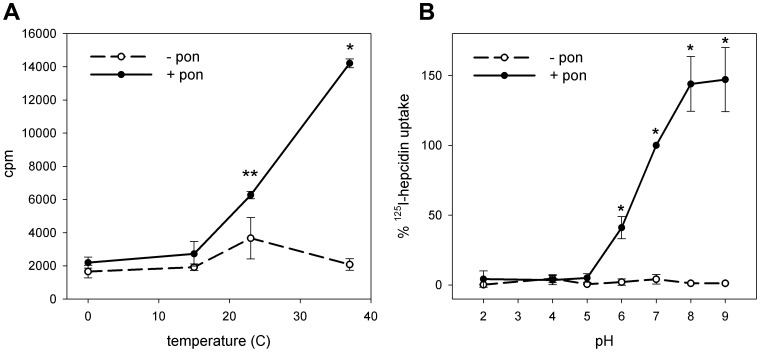
Figure 1. Effect of temperature and pH on the uptake of 125I-hepcidin by cells expressing Fpn-GFP.
ECR293cells were either not induced (-pon) or induced with ponasterone (+pon) to express Fpn-GFP. (A) Cells were incubated with 125I-hepcidin for 1 h at 0°C, 15°C, 23°C and 37°C, and the amount of radioactivity bound to cells was measured by gamma counting. *p<0.001, **p = 0.024 compared to uninduced cells at the same temperature. (B) Cells were incubated with 125I-hepcidin for 1 h at pH 2, 4, 5, 6, 7, 8 and 9, and the amount of radioactivity bound to cells was measured by gamma counter. Radioactivity in uninduced cells was subtracted as background. Because of the variation in absolute counts between separate experiments, data within each experiment were normalized to 125I-hepcidin uptake at pH 7. *p<0.01. All experiments were repeated a minimum of three times, and the error bars represent the standard deviation.
Figure 2
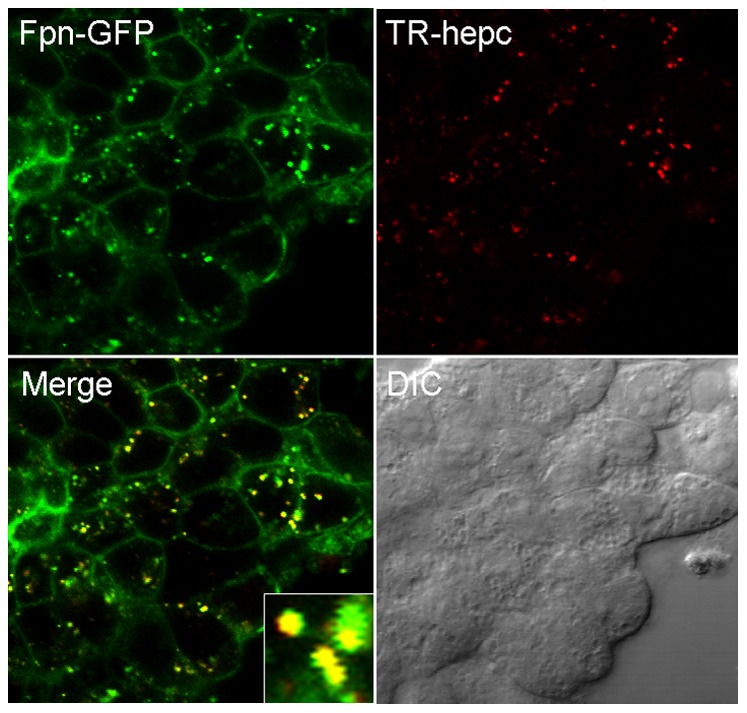
Figure 2. Hepcidin is co-internalized together with ferroportin.
TR labeled hepcidin was added to cells expressing Fpn-GFP, and incubated at 37°C for 1 h protected from light. Cells were imaged by fluorescence confocal microscopy. Uninduced cells treated with TR hepcidin had no detectable red fluorescence (data not shown).
Figure 3
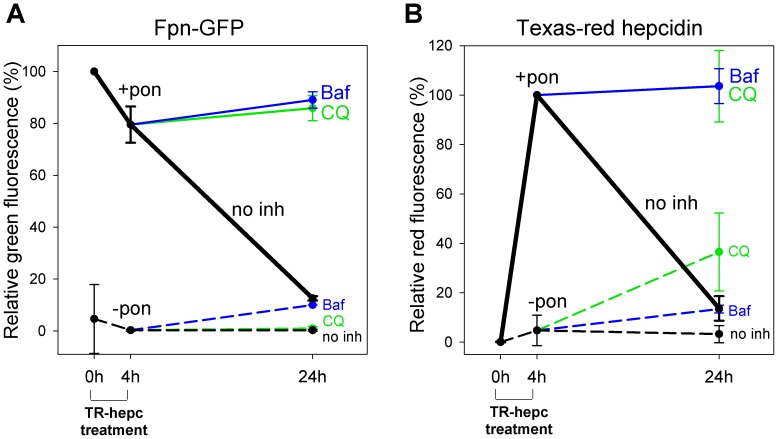
Figure 3. Hepcidin is degraded together with ferroportin.
ECR293cells were either not induced (-pon, dashed lines) or were induced with ponasterone to express Fpn-GFP (+pon, solid lines). Cells were treated with Texas Red-labeled hepcidin (TR-hepc) for 4 h, the peptide was then removed, and cells were incubated for another 20 h in the absence or presence of lysosomal inhibitors chloroquine (100 µM, green lines) or bafilomycin (100 nM, blue lines). Cells treated with hepcidin but not inhibitors are represented as black lines (no inh). The amount of cellular Fpn-GFP or Texas Red-hepcidin was determined by flow cytometry. Uninduced cells were used to establish a gate to exclude background fluorescence. (A) Quantitation of Fpn-GFP. Data are expressed relative to the green fluorescence of induced cells not treated with hepcidin. (B) Quantitation of Texas Red-hepcidin. Data are expressed relative to the red fluorescence of induced cells treated with Texas Red-hepcidin for 4 h.
Figure 4
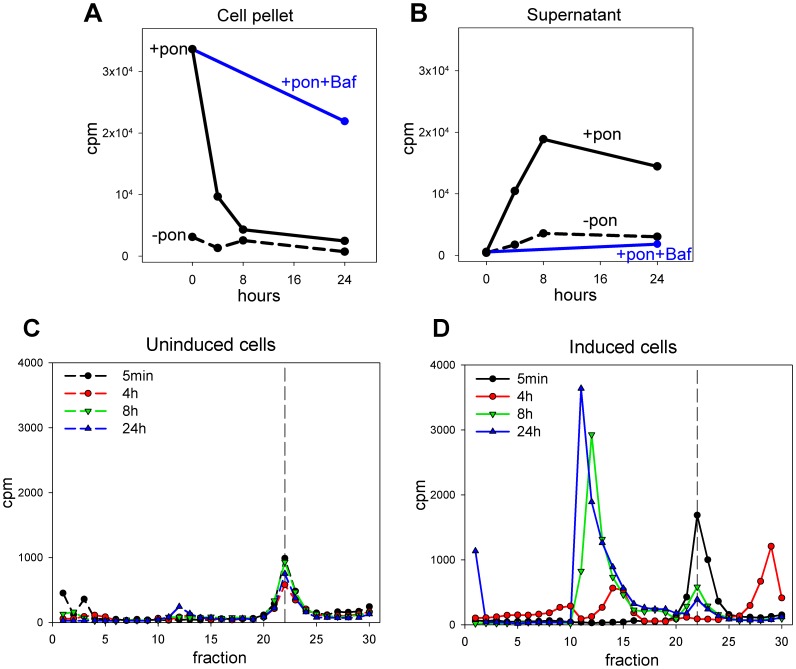
Figure 4. Hepcidin is not recycled.
ECR293 cells were either not induced (-pon, dashed lines) or were induced with ponasterone to express Fpn-GFP (+pon, solid lines). 125I-hepcidin was added for 2 h to load the cells, excess hepcidin was washed off and fresh media added to the cells. Cell pellets and supernatants were collected after 5 min and 4, 8, and 24 h and radioactivity measured by gamma counting. (A) Counts in cell pellets. (B) Counts in supernatants. (C) and (D) Supernatants harvested at 5 min, 4, 8 and 24 h from uninduced and induced cells respectively were analyzed by reverse-phase HPLC using an acetonitrile gradient (1 fraction per minute). Radioactivity of each fraction was determined by gamma counting. Dashed vertical line indicates the elution fraction of native hepcidin.

References

    1. Nemeth E, Tuttle MS, Powelson J, Vaughn MB, Donovan A, et al. (2004) Hepcidin regulates cellular iron efflux by binding to ferroportin and inducing its internalization. Science 306: 2090–2093. - PubMed
    1. Ganz T, Nemeth E (2012) Hepcidin and iron homeostasis. Biochim Biophys Acta 1823: 1434–1443. - PMC - PubMed
    1. Carpentier JL, Gorden P, Robert A, Orci L (1986) Internalization of polypeptide hormones and receptor recycling. Experientia 42: 734–744. - PubMed
    1. Qiao B, Sugianto P, Fung E, Del-Castillo-Rueda A, Moran-Jimenez MJ, et al. (2012) Hepcidin-induced endocytosis of ferroportin is dependent on ferroportin ubiquitination. Cell Metab 15: 918–924. - PMC - PubMed
    1. Rice AE, Mendez MJ, Hokanson CA, Rees DC, Bjorkman PJ (2009) Investigation of the biophysical and cell biological properties of ferroportin, a multipass integral membrane protein iron exporter. J Mol Biol 386: 717–732. - PMC - PubMed

Publication types