The western painted turtle genome, a model for the evolution of extreme physiological adaptations in a slowly evolving lineage

H Bradley Shaffer et al. Genome Biol. .

Abstract

Background: We describe the genome of the western painted turtle, Chrysemys picta bellii, one of the most widespread, abundant, and well-studied turtles. We place the genome into a comparative evolutionary context, and focus on genomic features associated with tooth loss, immune function, longevity, sex differentiation and determination, and the species' physiological capacities to withstand extreme anoxia and tissue freezing.

Results: Our phylogenetic analyses confirm that turtles are the sister group to living archosaurs, and demonstrate an extraordinarily slow rate of sequence evolution in the painted turtle. The ability of the painted turtle to withstand complete anoxia and partial freezing appears to be associated with common vertebrate gene networks, and we identify candidate genes for future functional analyses. Tooth loss shares a common pattern of pseudogenization and degradation of tooth-specific genes with birds, although the rate of accumulation of mutations is much slower in the painted turtle. Genes associated with sex differentiation generally reflect phylogeny rather than convergence in sex determination functionality. Among gene families that demonstrate exceptional expansions or show signatures of strong natural selection, immune function and musculoskeletal patterning genes are consistently over-represented.

Conclusions: Our comparative genomic analyses indicate that common vertebrate regulatory networks, some of which have analogs in human diseases, are often involved in the western painted turtle's extraordinary physiological capacities. As these regulatory pathways are analyzed at the functional level, the painted turtle may offer important insights into the management of a number of human health disorders.


Figures
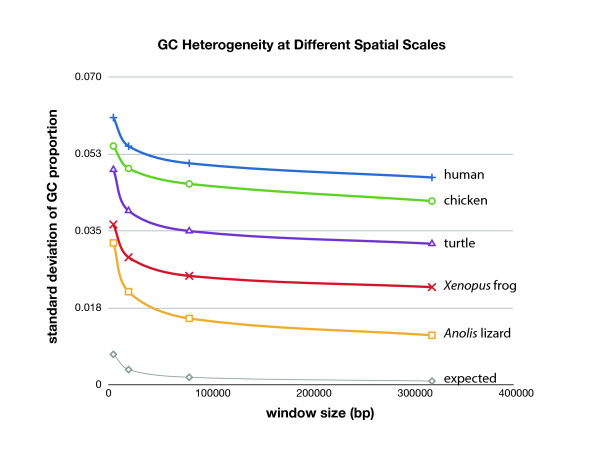
Figure 1
Figure 1
Standard deviation of GC content at different spatial scales. Genomes were partitioned into non-overlapping windows (5-, 20-, 80-, and 320-kb). As window size increases, variation in GC content naturally decreases. The western painted turtle exhibits a pattern consistent with high variation in nucleotide composition at smaller scales, rather than sustained isochoric variation at larger scales seen in mammals and birds. The expected pattern of decreasing standard variation assumes a compositionally homogeneous genome with a mean GC proportion of 0.41.
Figure 2
Figure 2
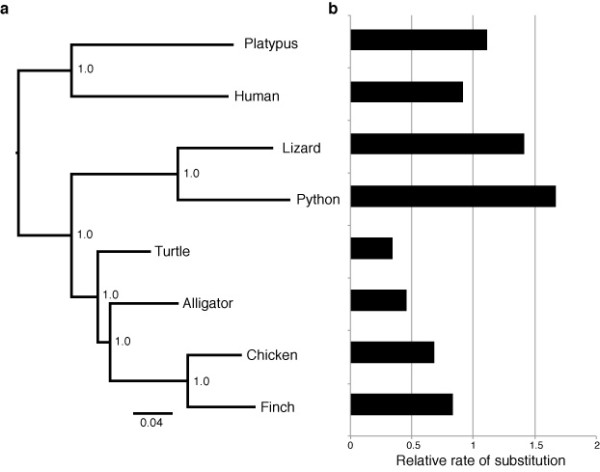
A revised phylogeny of major amniote lineages and their rates of molecular evolution. (a) Bayesian phylogram depicting the relationships of the eight primary amniote lineages, and their rates of molecular evolution. The phylogeny demonstrates the sister group relationship of turtle and archosaurs (allligator plus birds). The numbers at nodes denote posterior probabilities (all are at the maximum of 1.0). (b) The histogram shows the relative rate of substitution inferred for each lineage under a relaxed clock. For analysis details, see Materials and Methods, Phylogeny and substitution rate).
Figure 3
Figure 3
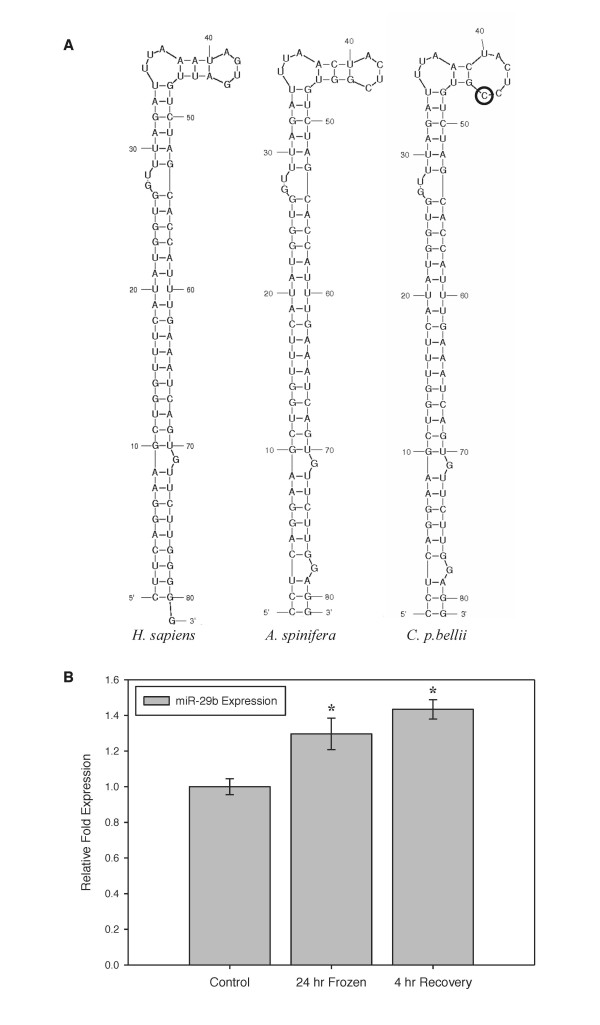
Western painted turtle miR-29b and response to freezing. (a) Nucleotide sequence and predicted secondary structure of pre-miR-29b transcripts from H. sapiens, A. spinifera, and C. p. bellii at 25 C. Nucleotide substitution which leads to differential terminal stem-loop formation that is unique to C. p. bellii is circled. (b) Relative expression levels of miR-29b as assessed by quantitative RT-PCR in liver samples of hatchling western painted turtles under control (5°C acclimated), 24 h frozen (at -2.5°C), or 4 h thawed (at 5°C) conditions. Data are means ± s.e.m. (n = 5 different animals). Parallel analysis of 5S rRNA found no significant changes between control and experimental conditions for this reference RNA. * Significantly different from the corresponding control (P <0.05).
Figure 4
Figure 4
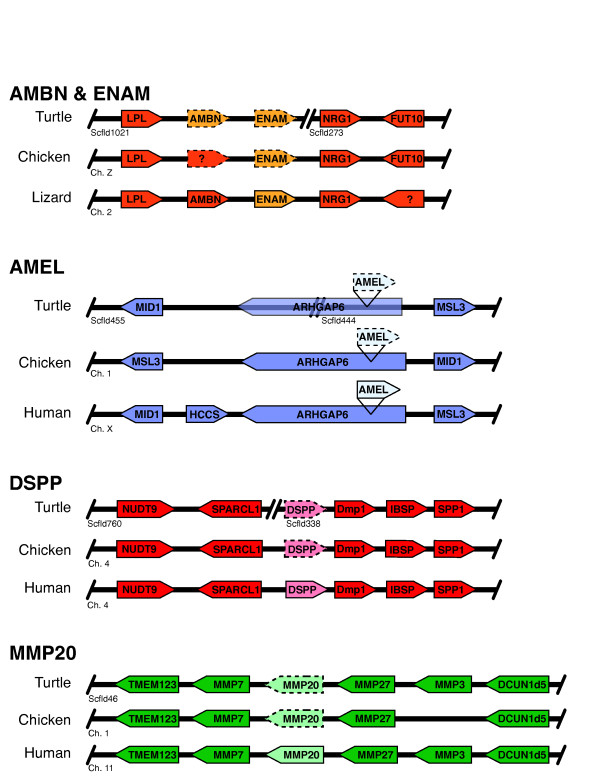
Conserved syntenic regions containing tooth-specific genes across toothed (human, anole) and edentulous (turtle, chicken) vertebrates. AMBN and ENAM are in a reptile-specific chromosomal region, precluding the use of human as a reference sequence for these genes. Dashed outlines indicate pseudogenization.
Figure 5
Figure 5
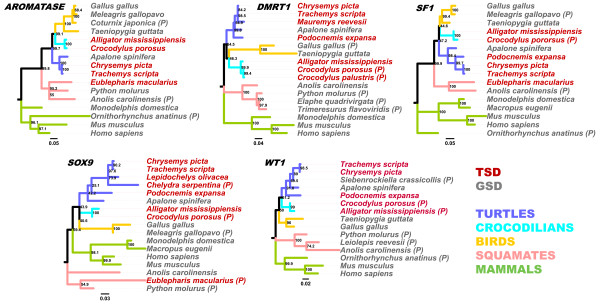
Maximum likelihood estimates of the phylogenetic relationships among taxa for five genes involved in gonadogenesis. Branch lengths are proportional to the number of substitutions per site; numbers at nodes are bootstrap proportions based on 500 pseudoreplicates. Colored branches denote the taxonomic group for each taxon. Tip font colors denote sex-determining mechanisms (red = TSD, gray = GSD). For all species, the full coding region was utilized except where only partial sequences were available, in which case the tip is denoted as (P).
Figure 6
Figure 6
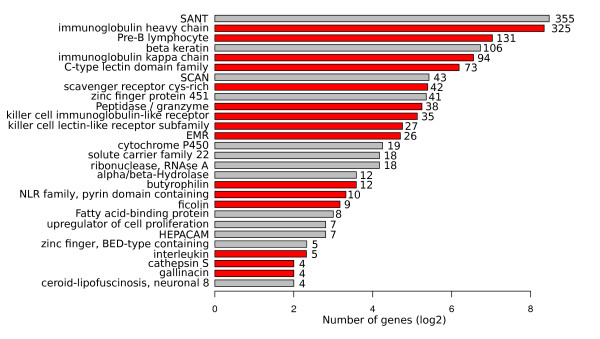
Gene families showing expansion in the western painted turtle lineage. The number of genes within a family is provided in front of each bar. Gene families associated with the immune response are shown in red.

References

    1. Romer AS. Vertebrate paleontology. 3. Chicago, IL: University of Chicago Press; 1967.
    1. Li C, Wu X-C, Rieppel O, Wang L-T, Zhao L-J. An ancestral turtle from the Late Triassic of southwestern China. Nature. 2008;14:497–501. doi: 10.1038/nature07533. - DOI - PubMed
    1. Gaffney ES, Jenkins FA. The cranial morphology of Kayentachelys, an Early Jurassic cryptodire, and the early history of turtles. Acta Zoologica. 2010;14:335–368.
    1. Ultsch GR, Jackson DC. Long-term submergence at 3-degrees-C of the turtle, Chrysemys picta bellii, in normoxic and severely hypoxic water. 1. Survival, gas-exchange and acid-base status. J Exp Biol. 1982;14:11–28. - PubMed
    1. Johlin JM, Moreland FB. Studies of the blood picture of the turtle after complete anoxia. J Biol Chem. 1933;14:107–114.

Publication types

MeSH terms