


Randomized controlled trial to evaluate the effects of progressive resistance training compared to progressive muscle relaxation in breast cancer patients undergoing adjuvant radiotherapy: the BEST study
- PMID: 23537231
- PMCID: PMC3617011
- DOI: 10.1186/1471-2407-13-162
Randomized controlled trial to evaluate the effects of progressive resistance training compared to progressive muscle relaxation in breast cancer patients undergoing adjuvant radiotherapy: the BEST study
Abstract
Background: Cancer-related fatigue (CRF) is one of the most common and distressing side effects of cancer and its treatment. During and after radiotherapy breast cancer patients often suffer from CRF which frequently impairs quality of life (QoL). Despite the high prevalence of CRF in breast cancer patients and the severe impact on the physical and emotional well-being, effective treatment methods are scarce.Physical activity for breast cancer patients has been reported to decrease fatigue, to improve emotional well-being and to increase physical strength. The pathophysiological and molecular mechanisms of CRF and the molecular-biologic changes induced by exercise, however, are poorly understood.In the BEST trial we aim to assess the effects of resistance training on fatigue, QoL and physical fitness as well as on molecular, immunological and inflammatory changes in breast cancer patients during adjuvant radiotherapy.
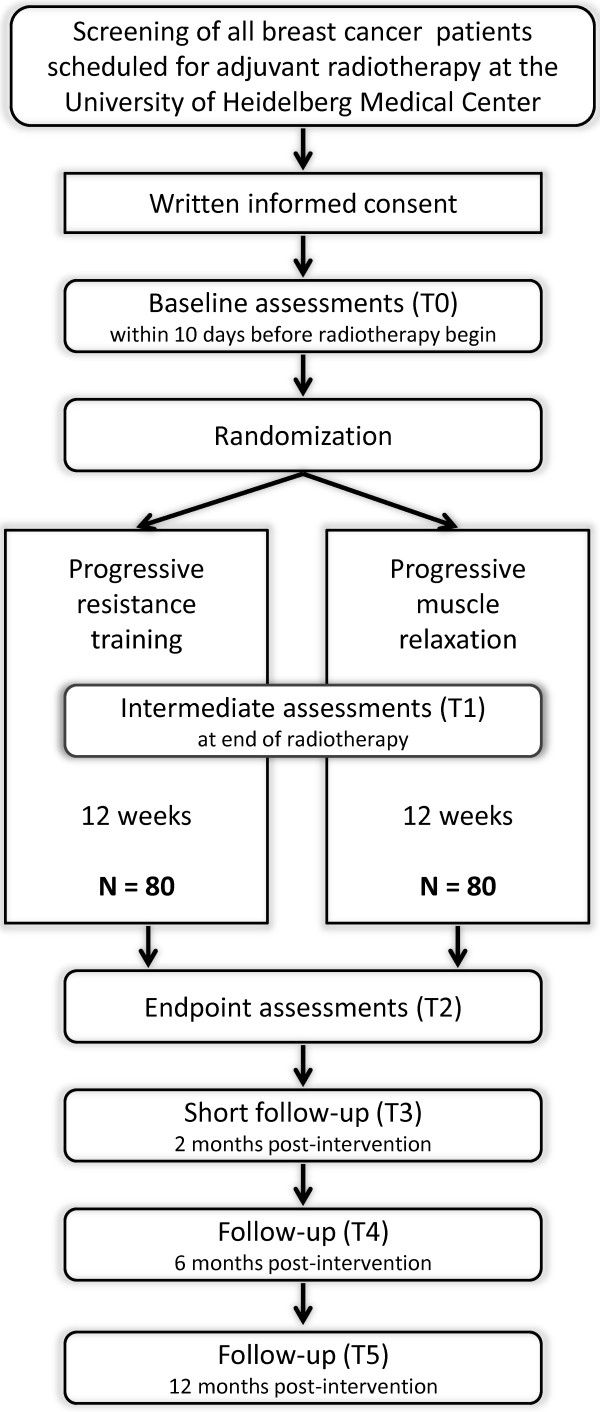
Methods/design: The BEST study is a prospective randomized, controlled intervention trial investigating the effects of a 12-week supervised progressive resistance training compared to a 12-week supervised muscle relaxation training in 160 patients with breast cancer undergoing adjuvant radiotherapy. To determine the effect of exercise itself beyond potential psychosocial group effects, patients in the control group perform a group-based progressive muscle relaxation training. Main inclusion criterion is histologically confirmed breast cancer stage I-III after lumpectomy or mastectomy with indication for adjuvant radiotherapy. Main exclusion criteria are acute infectious diseases, severe neurological, musculosceletal or cardiorespiratory disorders. The primary endpoint is cancer-related fatigue; secondary endpoints include immunological and inflammatory parameters analyzed in peripheral blood, saliva and urine. In addition, QoL, depression, physical performance and cognitive capacity will be assessed.
Discussion: The BEST study is the first randomized controlled trial comparing progressive resistance training with muscle relaxation training in breast cancer patients during adjuvant radiotherapy. Based on the analysis of physiological, immunological and inflammatory parameters it will contribute to a better understanding of the physiological and psychosocial effects and the biological mechanisms of resistance training. The ultimate goal is the implementation of optimized intervention programs to reduce fatigue, improve quality of life and potentially the prognosis after breast cancer.
Trial registration: ClinicalTrials.gov NCT01468766.
Figures

References
-
- Darby S, McGale P, Correa C, Taylor C, Arriagada R, Clarke M, Cutter D, Davies C, Ewertz M, Godwin J, Gray R, Pierce L, Whelan T, Wang Y, Peto R. Effect of radiotherapy after breast-conserving surgery on 10-year recurrence and 15-year breast cancer death: meta-analysis of individual patient data for 10,801 women in 17 randomised trials. Lancet. 2011;378:1707–16. - PMC - PubMed
-
- Noal S, Levy C, Hardouin A, Rieux C, Heutte N, Segura C, Collet F, Allouache D, Switsers O, Delcambre C, Delozier T, Henry-Amar M, Joly F. One-year longitudinal study of fatigue, cognitive functions, and quality of life after adjuvant radiotherapy for breast cancer. Int J Radiat Oncol Biol Phys. 2011;81:795–803. doi: 10.1016/j.ijrobp.2010.06.037. - DOI - PubMed
-
- Tavio M, Milan I, Tirelli U. Cancer-related fatigue (review) Int J Oncol. 2002;21:1093–9. - PubMed
Publication types
MeSH terms
Associated data
LinkOut - more resources
Full Text Sources
Other Literature Sources
Medical
