. 2013 Jul;208(1):139-48.
doi: 10.1093/infdis/jit132. Epub 2013 Mar 28.

HIV treatments have malaria gametocyte killing and transmission blocking activity

Affiliations

HIV treatments have malaria gametocyte killing and transmission blocking activity

Charlotte V Hobbs et al. J Infect Dis. 2013 Jul.

Abstract

Background: Millions of individuals being treated for human immunodeficiency virus (HIV) live in malaria-endemic areas, but the effects of these treatments on malaria transmission are unknown. While drugs like HIV protease inhibitors (PIs) and trimethoprim-sulfamethoxazole (TMP-SMX) have known activity against parasites during liver or asexual blood stages, their effects on transmission stages require further study.

Methods: The HIV PIs lopinavir and saquinavir, the nonnucleoside reverse-transcriptase inhibitor nevirapine, and the antibiotic TMP-SMX were assessed for activity against Plasmodium falciparum transmission stages. The alamarBlue assay was used to determine the effects of drugs on gametocyte viability, and exflagellation was assessed to determine the effects of drugs on gametocyte maturation. The effects of drug on transmission were assessed by calculating the mosquito oocyst count as a marker for infectivity, using standard membrane feeding assays.

Results: Lopinavir and saquinavir have gametocytocidal and transmission blocking activities at or approaching clinically relevant treatment levels, while nevirapine does not. TMP-SMX is not gametocytocidal, but at prophylactic levels it blocks transmission.

Conclusions: Specific HIV treatments have gametocyte killing and transmission-blocking effects. Clinical studies are warranted to evaluate these findings and their potential impact on eradication efforts.

Keywords: HIV; TMP-SMX; antiretrovirals; gametocytes; malaria; transmission.


Figures
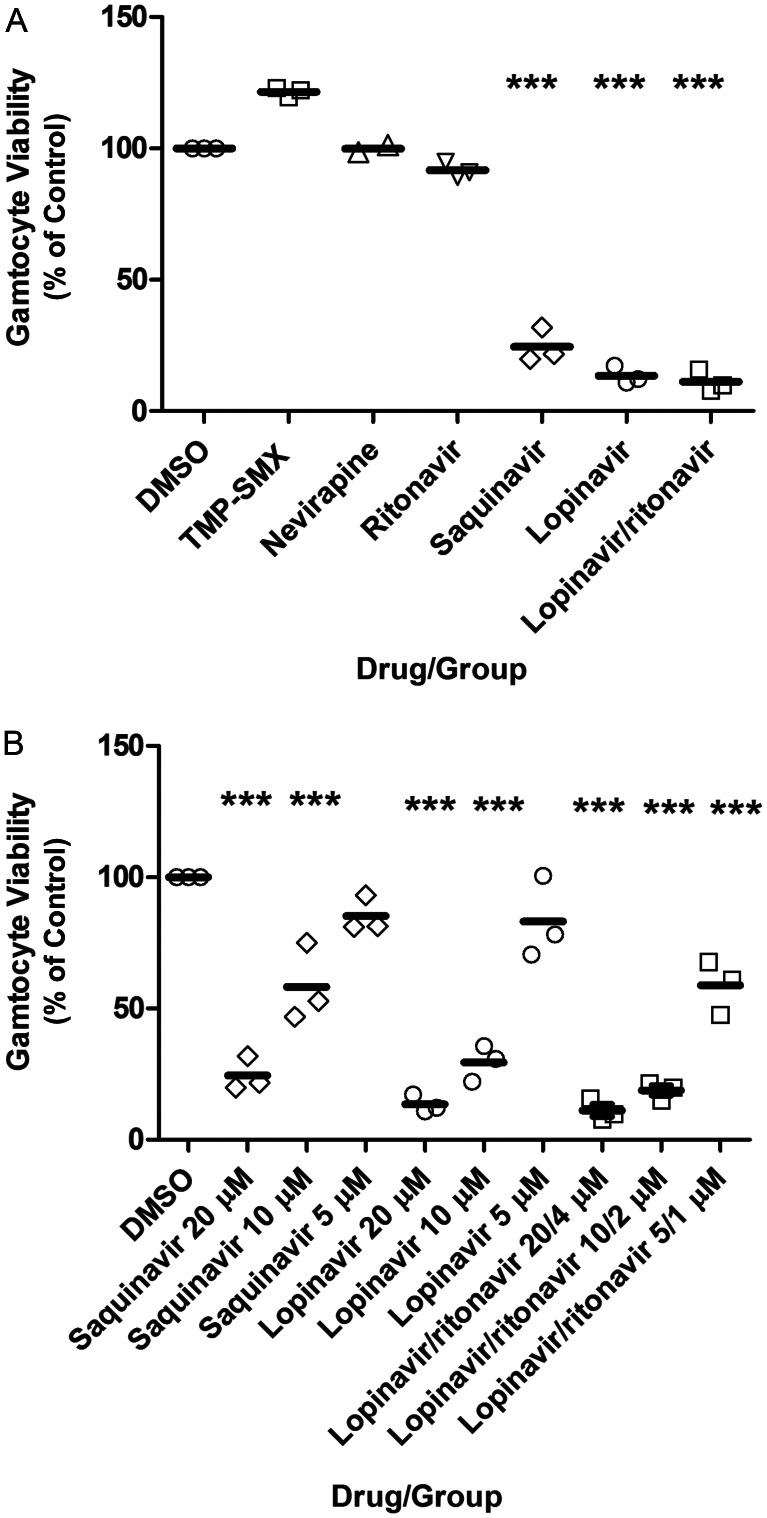
Figure 1.
Figure 1.
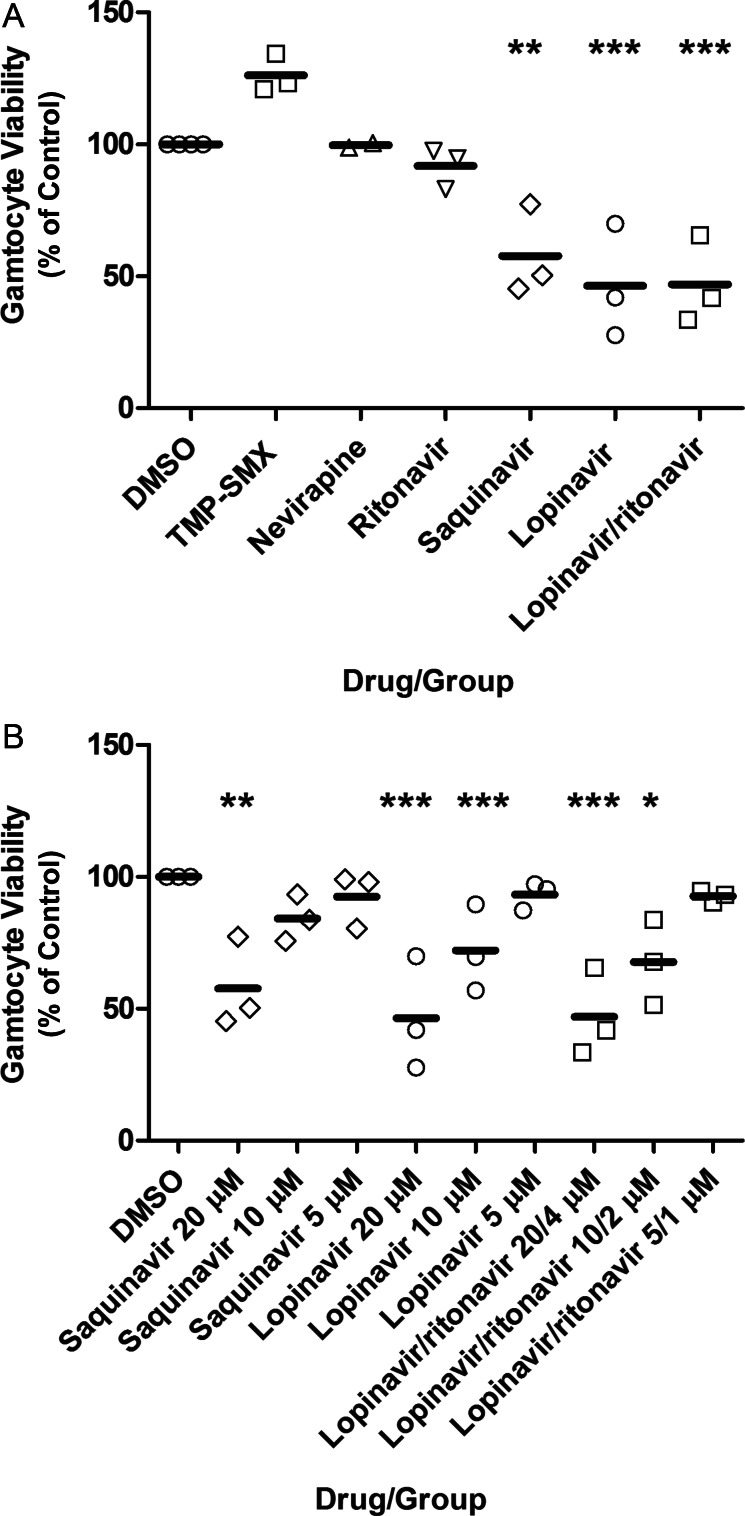
Human immunodeficiency virus (HIV) drug effect on early stage gametocyte viability, as assessed by the alamarBlue assay. Day 10 gametocytes were mixed with dimethyl sulfoxide (DMSO)–diluted HIV drug or DMSO alone, and viability was assessed on day 14. Shown is the mean percentage (±SD) of control fluorescence for 3 independent experiments. A, The highest concentrations for each drug tested is shown. B, The full range of drug concentrations tested with significant effect is shown. The mean well-to-well Z′-factor (±SD) was 0.88 ± 0.02. ***P < .001, vs control. Abbreviation: TMP-SMX, trimethoprim-sulfamethoxazole.
Figure 2.
Figure 2.
Human immunodeficiency virus (HIV) drug effect on late stage gametocyte viability, as assessed by the alamarBlue assay. Day 13 gametocytes were mixed with dimethyl sulfoxide (DMSO)–diluted HIV drug or DMSO alone, with viability assessed on day 17. Shown is the mean percentage (±standard error of the mean) of control fluorescence for 4 independent experiments. A, The highest concentrations for each drug tested is shown. B, The full range of drugs concentrations for the HIV protease inhibitors lopinavir and ritonavir is shown. The mean well-to-well Z′-factor (±SD) was 0.79 ± 0.11. **P < .01 and ***P < .001, vs control. Abbreviation: TMP-SMX, trimethoprim-sulfamethoxazole.
Figure 3.
Figure 3.
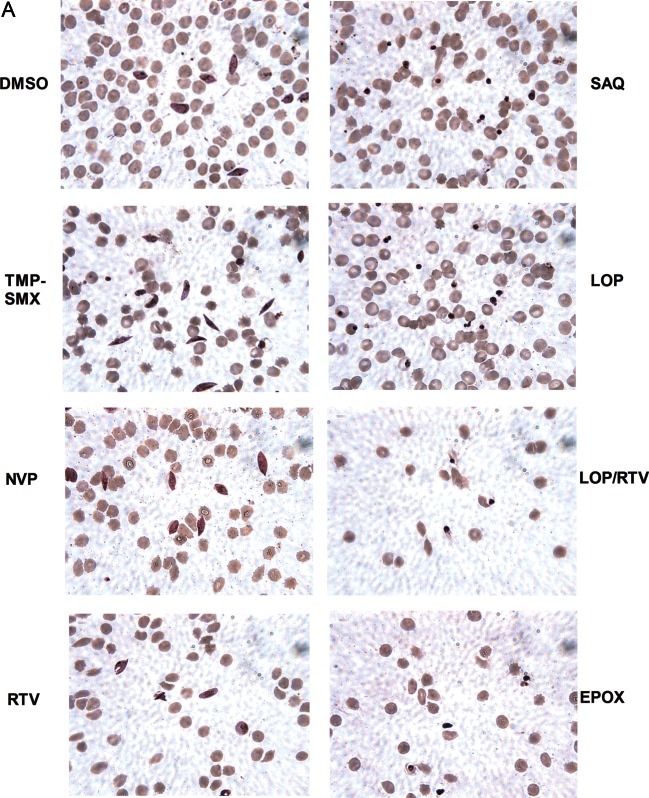
Human immunodeficiency virus (HIV) drug effect on gametocytes, by optical microscopy. Images of representative Giemsa-stained smears of early stage (A) and late stage (B) gametocytes are shown, drawn from assays described in Figure 1A and 2A, respectively. Treatment with dimethyl sulfoxide (DMSO) alone, trimethoprim-sulfamethoxazole (TMP-SMX), or nevirapine (NVP) did not affect gametocyte morphology. In contrast, treatment with ritonavir (RTV), saquinavir (SAQ), lopinavir (LPV), lopinavir/ritonavir (LOP/RTV), and a known gametocytocidal agent, epoxomicin (EPOX), resulted in altered gametocyte morphology (pyknotic cells and decreased nucleus size relative to cytoplasm).
Figure 4.
Figure 4.
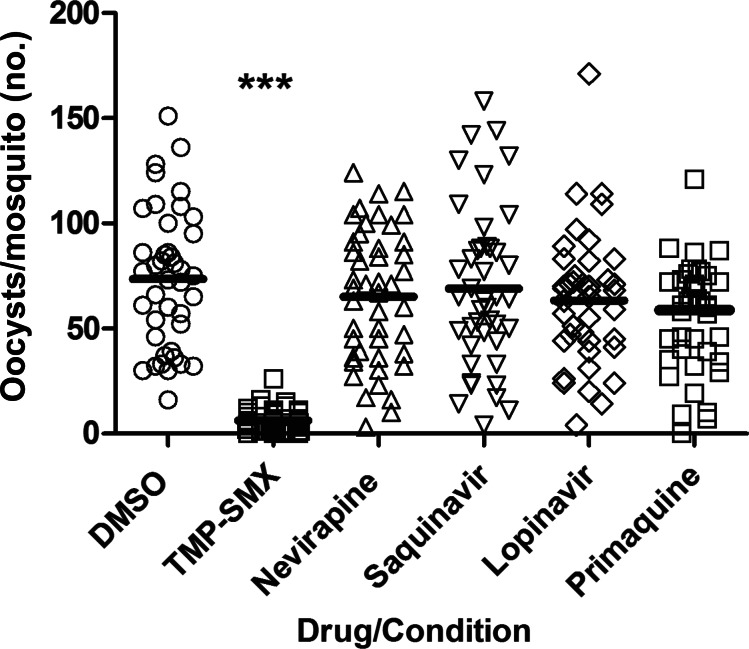
Human immunodeficiency virus (HIV) drug effect on transmission immediately after drug exposure. Day 15 cultures containing stage V gametocytes were mixed with dimethyl sulfoxide (DMSO)–diluted HIV drugs, primaquine, or DMSO alone and immediately fed to 3–5-day-old Anopheles stephensi mosquitoes. Mercurochrome-stained oocysts were counted on the midguts of ≥20 dissected mosquitoes. Pooled results of 2 independent experiments are shown. ***P < .001, vs control. Abbreviation: TMP-SMX, trimethoprim-sulfamethoxazole.
Figure 5.
Figure 5.
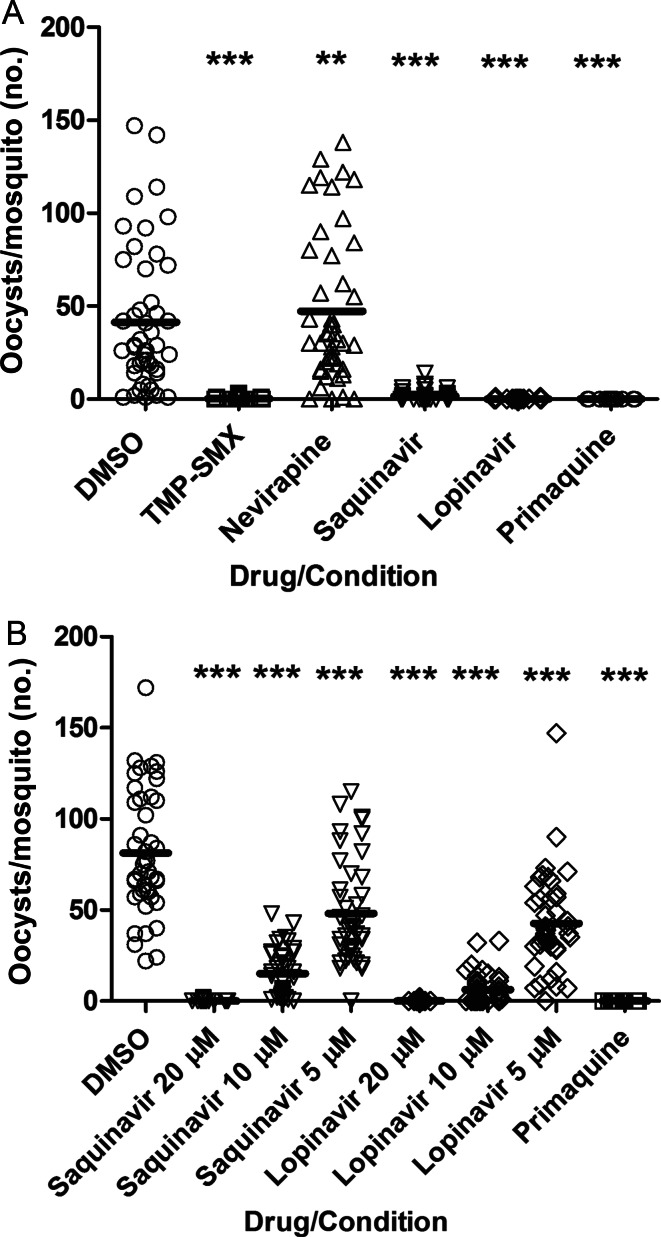
Human immunodeficiency virus (HIV) drug effect on transmission after prolonged parasite-drug exposure. From day 13 of culture, stage V gametocytes were incubated in dimethyl sulfoxide (DMSO)–diluted HIV drugs, primaquine, or DMSO alone, each added daily, and were then fed to 3–5-day-old Anopheles stephensi mosquitoes on day 16. Mercurochrome-stained oocysts were counted on the midguts of ≥20 dissected mosquitoes per condition 8 days later. Pooled results of 2 independent experiments are shown. A, The highest concentrations for each drug tested are shown. B, The full range of tested concentrations of the HIV protease inhibitor lopinavir and ritonavir are shown. **P < .01 and ***P < .001, vs control. Abbreviation: TMP-SMX, trimethoprim-sulfamethoxazole.
Figure 6.
Figure 6.
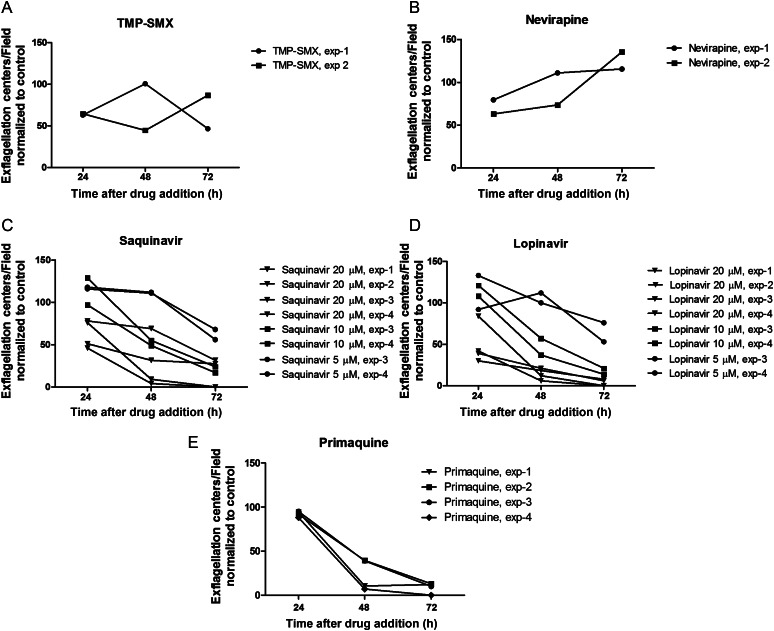
Human immunodeficiency virus (HIV) drug effect on exflagellation after prolonged parasite-drug exposure. Gametocyte maturation was assessed by testing exflagellation capacity after prolonged incubation with drug. The average number of exflagellation centers per field were counted in ≥7 fields. Exflagellation centers were counted after 24, 48, and 72 hours of incubation with drug. Pooled results from 2–4 experiments are shown. A and B, The highest concentrations for each drug tested are shown. C and D, The full range of tested concentrations of the HIV protease inhibitors lopinavir and ritonavir are shown. Lopinavir and saquinavir treatment significantly reduced exflagellation during the 72-hour period of incubation (after 24 hours, P < .01 for saquinavir at 10 µM and 5 µM; after 48 hours, P < .05 for saquinavir at 20 µM and P < .01 for lopinavir at 20 µM; after 72 hours, P < .001 for saquinavir at both 20 µM and 10 µM and P < .001 for lopinavir at both 20 µM and 10 µM). Primaquine showed significant reduction in exflagellation after 48 and 72 hours (P < .05 and P < .001, respectively; CE).

References

    1. Flateau C, Le Loup G, Pialoux G. Consequences of HIV infection on malaria and therapeutic implications: a systematic review. Lancet Infect Dis. 2011;11:541–56. - PubMed
    1. World Health Organization. Antiretroviral therapy for HIV infection in adults and adolescents: recommendations for a public health approach and antiretroviral therapy for HIV infection in infants and children: towards universal access, recommendations for a public health approach. http://whqlibdoc.who.int/publications/2010/9789241599764_eng.pdf. http://whqlibdoc.who.int/publications/2010/9789241599801_eng.pdf. Accessed 1 March 2012. - PubMed
    1. World Health Organization. Guidelines on co-trimoxazole prophylaxis for HIV-related infections among children, adolescents, and adults: recommendations for a public health approach (2006) and co-trimoxazole prophylaxis for HIV-exposed and HIV-infected infants and children: practical approaches to implementation and scale-up (2009) http://www.who.int/hiv/pub/guidelines/ctxguidelines.pdf. http://www.who.int/hiv/pub/paediatric/cotrimoxazole.pdf. Accessed 1 March 2012.
    1. Hobbs CV, Voza T, Coppi A, et al. HIV protease inhibitors inhibit the development of preerythrocytic-stage plasmodium parasites. J Infect Dis. 2009;199:134–41. - PMC - PubMed
    1. Parikh S, Gut J, Istvan E, Goldberg DE, Havlir DV, Rosenthal PJ. Antimalarial activity of human immunodeficiency virus type 1 protease inhibitors. Antimicrob Agents Chemother. 2005;49:2983–5. - PMC - PubMed

Publication types

MeSH terms