


Pilot study of a physician-delivered education tool to increase patient knowledge about CKD
- PMID: 23540261
- PMCID: PMC3686835
- DOI: 10.1053/j.ajkd.2013.01.023
Pilot study of a physician-delivered education tool to increase patient knowledge about CKD
Abstract
Background: Limited research exists on physician-delivered education interventions. We examined the feasibility and impact of an educational tool on facilitating physician-patient kidney disease communication.
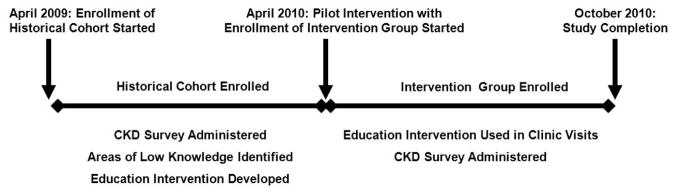
Study design: Pilot feasibility clinical trial with a historical control to examine effect size on patient knowledge and structured questions to elicit physician and patient feedback.
Setting & participants: Adults with chronic kidney disease (CKD) stages 1-5, seen in nephrology clinic.
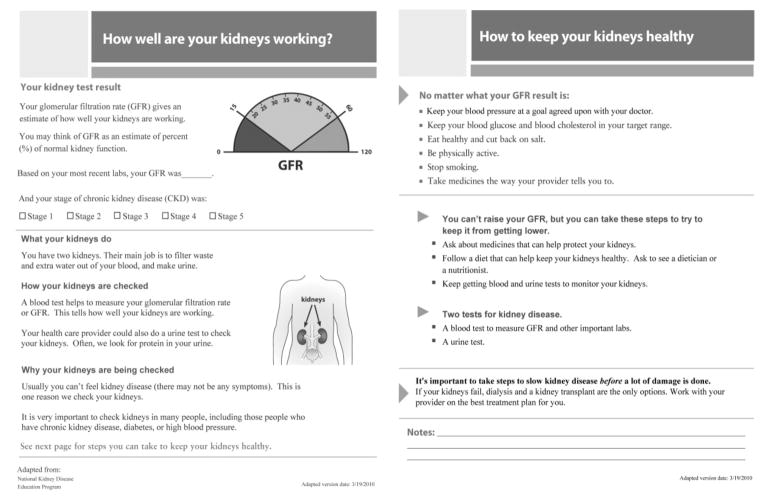
Intervention: 1-page educational worksheet, reviewed by physicians with patients.
Outcomes: Kidney knowledge between patient groups and provider/patient feedback.
Measurements: Patient kidney knowledge was measured using a previously validated questionnaire compared between patients receiving the intervention (April to October 2010) and a historical cohort (April to October 2009). Provider input was obtained using structured interviews. Patient input was obtained through survey questions. Patient characteristics were abstracted from the medical record.
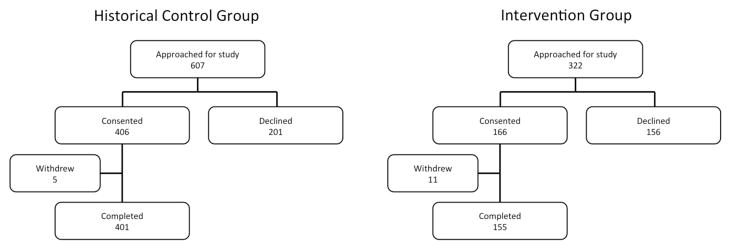
Results: 556 patients were included, with 401 patients in the historical cohort and 155 receiving the intervention. Mean age was 57 ± 16 (SD) years, with 53% men, 81% whites, and 78% with CKD stages 3-5. Compared with the historical cohort, patients receiving the intervention had higher adjusted odds of knowing they had CKD (adjusted OR, 2.20; 95% CI, 1.16-4.17; P = 0.02), knowing their kidney function (adjusted OR, 2.25; 95% CI, 1.27-3.97; P = 0.005), and knowing their stage of CKD (adjusted OR, 3.22; 95% CI, 1.49-6.92; P = 0.003). Physicians found the intervention tool easy and feasible to integrate into practice and 98% of patients who received the intervention recommended it for future use.
Limitations: Study design did not randomly assign patients for comparison and enrollment was performed in clinics at one center.
Conclusions: In this pilot study, a physician-delivered education intervention was feasible to use in practice and was associated with higher patient kidney disease knowledge. Further examination of physician-delivered education interventions for increasing patient disease understanding should be tested through randomized trials.
Copyright © 2013 National Kidney Foundation, Inc. Published by Elsevier Inc. All rights reserved.
Figures
Comment in
-
Those who can do, teach.Am J Kidney Dis. 2013 Jul;62(1):1-2. doi: 10.1053/j.ajkd.2013.04.004. Am J Kidney Dis. 2013. PMID: 23773836 No abstract available.
References
-
- Delivery CotNQRoHC, Services BoHC. Envisioning the National Health Care Quality Report. The National Academies Press; 2001. - PubMed
-
- Devins GM, Mendelssohn DC, Barre PE, Binik YM. Predialysis psychoeducational intervention and coping styles influence time to dialysis in chronic kidney disease. Am J Kidney Dis. 2003;42(4):693–703. - PubMed
-
- Curtin RB, Sitter DC, Schatell D, Chewning BA. Self-management, knowledge, and functioning and well-being of patients on hemodialysis. Nephrol Nurs J. 2004;31(4):378–386. 396. quiz 387. - PubMed
Publication types
MeSH terms
Grants and funding
LinkOut - more resources
Full Text Sources
Other Literature Sources
Medical
Miscellaneous
