. 2013 Apr 23;7(4):3036-44.
doi: 10.1021/nn4006544. Epub 2013 Apr 10.

Biomimetic antigenic nanoparticles elicit controlled protective immune response to influenza

Affiliations

Biomimetic antigenic nanoparticles elicit controlled protective immune response to influenza

Dustin P Patterson et al. ACS Nano. .

Abstract

Here we present a biomimetic strategy toward nanoparticle design for controlled immune response through encapsulation of conserved internal influenza proteins on the interior of virus-like particles (VLPs) to direct CD8+ cytotoxic T cell protection. Programmed encapsulation and sequestration of the conserved nucleoprotein (NP) from influenza on the interior of a VLP, derived from the bacteriophage P22, results in a vaccine that provides multistrain protection against 100 times lethal doses of influenza in an NP specific CD8+ T cell-dependent manner. VLP assembly and encapsulation of the immunogenic NP cargo protein is the result of a genetically programmed self-assembly making this strategy amendable to the quick production of vaccines to rapidly emerging pathogens. Addition of adjuvants or targeting molecules were not required for eliciting the protective response.


Figures
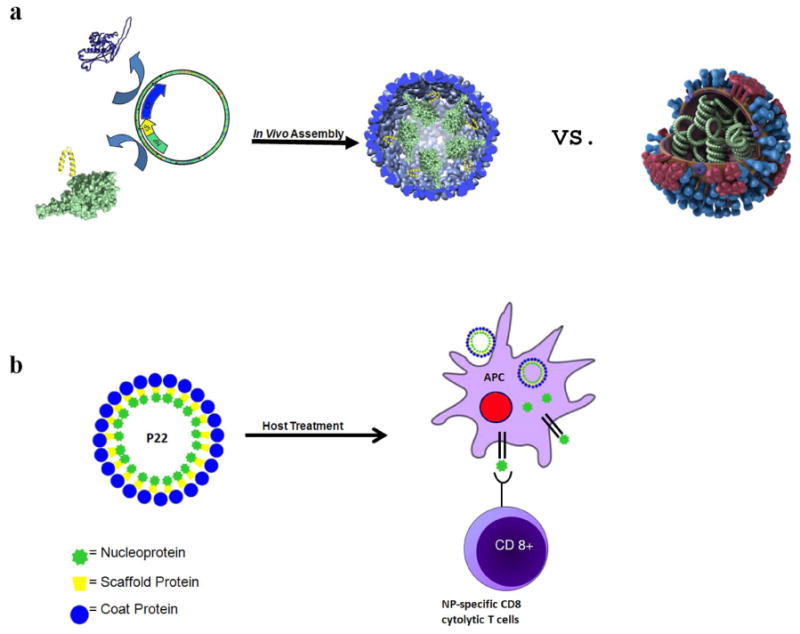
Figure 1
Figure 1. Schematic representations of the expression and in vivo encapsulation of the nucleoprotein through programmed self-assembly of the P22 VLP and the biomimetic display in order to elicit nucleoprotein-specific CD8+T cell response
a) Nucleoprotein (NP; green) fusion with the scaffold protein (SP; yellow) is co-expressed with the coat protein (blue), resulting in assembly of the NP-P22 VLP. A model of the natural influenza virus (made available by the Center for Disease Control) is shown illustrating the display of NP (green), neuraminidase (red), hemagglutinin (blue), and M2 ion channels (purple) to highlight the biomimetic design of the NP-P22. b) Treatment of a host (immunization) with NP-P22, due to its biomimetic display of NP, is expected to be processed by the pathway that generates CD8+ T cells specific for NP.
Figure 2
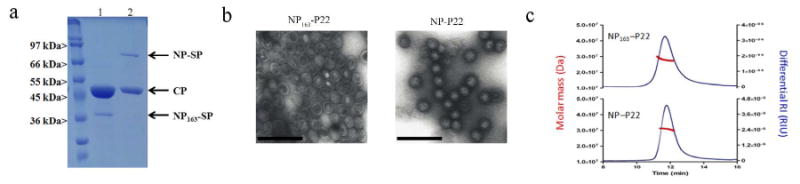
Figure 2. Purification and characterization of the nucleoprotein encapsulated P22 VLP constructs (NP163-P22 and NP-P22)
a) SDS-PAGE analysis of purified NP163-P22 (lane 1) and NP-P22 (lane 2) showing the coat protein (CP) and nucleoprotein-scaffold protein fusion constructs. b) Characterization of NP163-P22 (left) and NP-P22 (right) VLPs by TEM reveal homogeneous particles after purification by cesium chloride gradient ultracentrifugation. The scale bars represent 200 nm. c) Representative SEC elution profile monitored by absorbance and light scattering showing analysis of the molar mass across the elution peak of NP163-P22 (top) and NP-P22 (bottom).
Figure 3
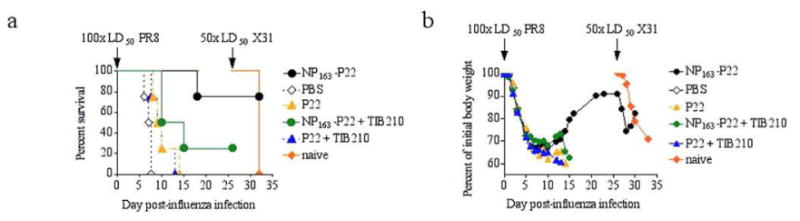
Figure 3. Nasal immunization with NP163-P22 protects mice against 100× the lethal challenge with influenza
a) Survival of mice infected with 100× LD50 of PR8 influenza 26 days after completion of immunization and re-challenged with 50× LD50 of X31 influenza 20 days later. CD8+ T cell-depleted mice are identified with addition of TIB210 (+TIB210, green and blue traces). b) Body weights of infected mice were monitored daily. Decrease in body weight is presented as a percentage of initial body weight (at the time of challenge). Groups where 50% or more mice succumbed to the initial infection with PR8 influenza were excluded from further data collection. Results depict the average of 5 mice per group.
Figure 4
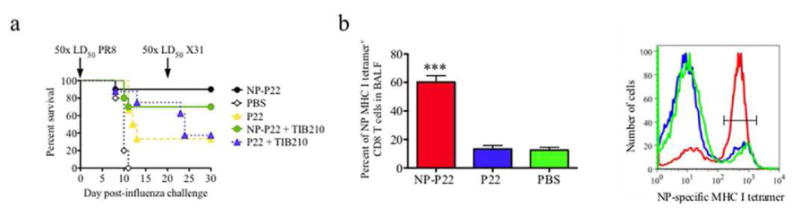
Figure 4. Immunization of mice with NP-P22 induces significant NP-specific CD8+ T cell responses following influenza infection.
a) Survival of mice infected with 50× LD50 of PR8 influenza 26 days after completion of immunization and re-challenged with 50× LD50 of X31 influenza 20 days later. CD8+ T cell-depleted mice are identified with addition of TIB210 (+TIB210, green and blue traces). Survival curves show average survival of 8-10 mice per group. b) Flow cytometry analysis of cells isolated from BALF to determine the percent of NP-specific CD8+ T cells from mice immunized with NP-P22 (red), P22 (green), or PBS (blue). Bar graph (left) shows average percentage of tetramer+ cells from 5 mice per group and a representative histogram (right) shows the number of cells stained with NP-specific tetramer.
Figure 5
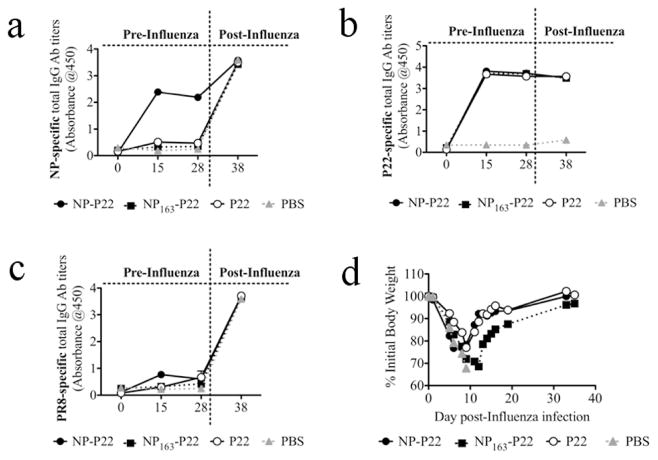
Figure 5. Immunization with NP-P22 but not NP163-P22 induces NP-specific antibody responses prior to challenge with influenza
Mice were intranasally immunized daily for 5 days with 100 ug of designated protein. At 30 days after initial immunization mice were challenged with 2× LD50 of PR8 influenza. NP- (a), P22- (b), and PR8 membrane preparation-specific IgG antibody titers (c) were measured by ELISA in serum of mice immunized with NP-P22, NP163-P22 and P22 before and after influenza infection. d) Body weights of influenza-infected mice were monitored daily. Decrease in body weight is presented as a percentage of initial body weight (at the time of challenge). Groups where 50% or more mice succumbed to the infection with PR8 influenza (PBS-dosed mice) were excluded from further data collection. The average of 5 mice per group is depicted.

References

    1. Uchida M, Klem MT, Allen M, Suci P, Flenniken M, Gillitzer E, Varpness Z, Liepold LO, Young M, Douglas T. Biological Containers: Protein Cages as Multifunctional Nanoplatforms. Adv Mater. 2007;19:1025–1042.
    1. Shen L, Bao N, Zhou Z, Prevelige PE, Gupta A. Materials Design Using Genetically Engineered Proteins. J Mater Chem. 2011;21:18868–18876.
    1. Yildiz I, Shukla S, Steinmetz NF. Applications of Viral Nanoparticles in Medicine. Curr Opin Biotechnol. 2011;22:901–908. - PMC - PubMed
    1. Lee LA, Wang Q. Adaptations of Nanoscale Viruses and Other Protein Cages for Medical Applications. Nanomedicine. 2006;2:137–149. - PubMed
    1. Reichhardt C, Uchida M, O'Neil A, Li R, Prevelige PE, Douglas T. Templated Assembly of Organic-Inorganic Materials Using the Core Shell Structure of the P22 Bacteriophage. Chem Commun. 2011;47:6326–6328. - PubMed

Publication types

MeSH terms

Substances