


Ventral striatum binding of a dopamine D2/3 receptor agonist but not antagonist predicts normal body mass index
- PMID: 23540907
- PMCID: PMC3783412
- DOI: 10.1016/j.biopsych.2013.02.017
Ventral striatum binding of a dopamine D2/3 receptor agonist but not antagonist predicts normal body mass index
Erratum in
- Biol Psychiatry. 2015 Mar 15;77(6):597
Abstract
Background: Positron emission tomography research has shown that dopamine D2/3 receptor (D2/3R) availability is negatively correlated with body mass index (BMI) in obese but not in healthy subjects. However, previous positron emission tomography studies have not looked specifically at the ventral striatum (VS), which plays an important role in motivation and feeding. Furthermore, these studies have only used antagonist radiotracers. Normal-weight rats given free access to high-fat diets demonstrate behavioral sensitization to D2/3R agonists but not to antagonists. Sensitization is associated with increased D2/3R affinity, which affects binding of agonists but not antagonists.
Methods: We examined the association between BMI within the nonobese range (18.6-27.8) and D2/3R availability in the VS with the use of the agonist radiotracer [(11)C]-(+)-PHNO (n = 26) and the antagonist [(11)C]-raclopride (n = 35) in healthy humans.
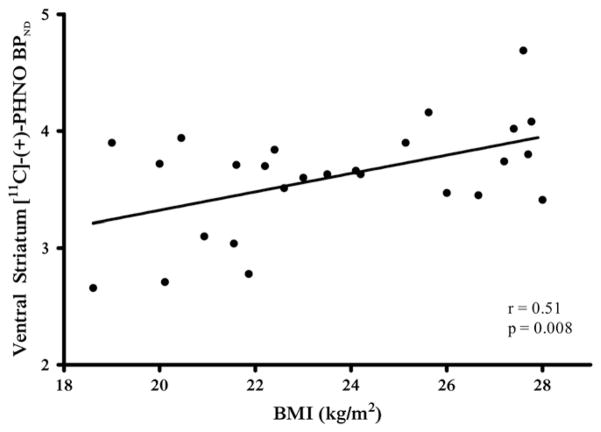
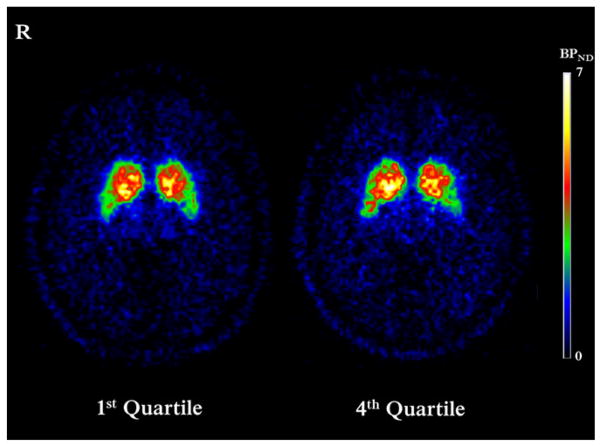
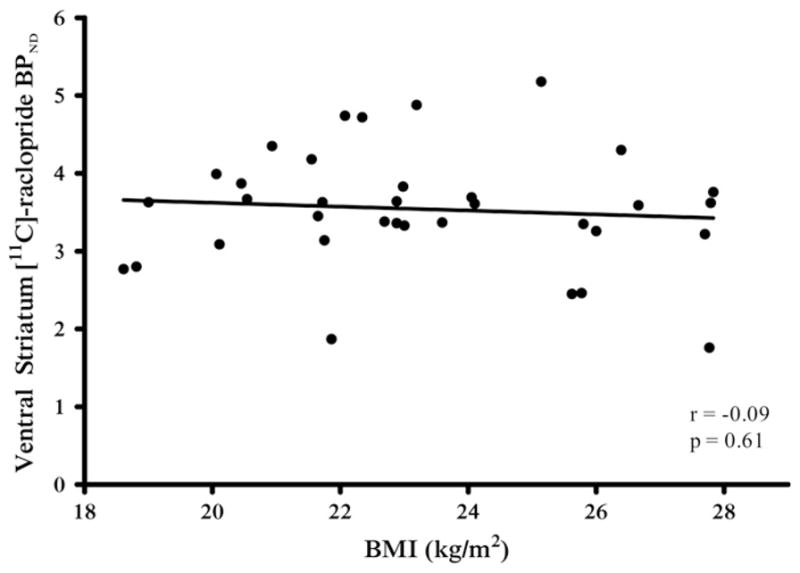
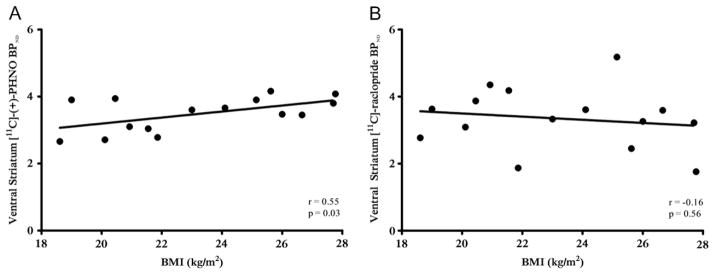
Results: In the VS, we found a positive correlation between BMI and [(11)C]-(+)-PHNO binding but no relationship with [(11)C]-raclopride binding. Secondary analyses revealed no relationship between BMI and binding in the dorsal striatum with either radiotracer.
Conclusions: We propose that in nonobese individuals, higher BMI may be associated with increased D2R affinity in the VS. This increased affinity may potentiate the incentive salience of food cues and counteract the effects of satiety cues, thereby increasing feeding.
Keywords: Body mass index; Dopamine D(2) receptor; Food addiction; Obesity; PET; Ventral striatum.
Copyright © 2015 Society of Biological Psychiatry. Published by Elsevier Inc. All rights reserved.
Conflict of interest statement
Dr. Nakajima reports having received grants from Japan Society for the Promotion of Science and Inokashira Hospital Research Fund and speaker’s honoraria from GlaxoSmith Kline, Janssen Pharmaceutical, Pfizer, and Yoshitomiyakuhin within the past 3 years. Dr. Graff-Guerrerro currently receives research support from the following external funding agencies: Canadian Institutes of Health Research, the U.S. National Institute of Health, and the Mexico Instituto de Ciencia y Tecnología para la Capital del Conocimiento en el Distrito Federal (ICyTDF). He has also received professional services compensation from Abbott Laboratories, Gedeon-Richter Plc, and Lundbeck; grant support from Janssen; and speaker compensation from Eli Lilly. Mr. Caravaggio, Ms. Raitsin, Dr. Gerretsen, and Dr. Wilson reported no biomedical financial interests or potential conflicts of interest.
Figures
References
-
- Ogden CLCM, Kit BK, Flegal KM. Prevalence of Obesity in the United States, 2009–2010. NCHS Data Brief, No 82. Hyattsville, MD: National Center for Health Statistics; 2012. - PubMed
-
- Huang XF, Zavitsanou K, Huang X, Yu Y, Wang H, Chen F, et al. Dopamine transporter and D2 receptor binding densities in mice prone or resistant to chronic high fat diet-induced obesity. Behav Brain Res. 2006;175:415–419. - PubMed
-
- Wang GJ, Volkow ND, Logan J, Pappas NR, Wong CT, Zhu W, et al. Brain dopamine and obesity. Lancet. 2001;357:354–357. - PubMed
Publication types
MeSH terms
Substances
Grants and funding
LinkOut - more resources
Full Text Sources
Other Literature Sources
