Associations of linear growth and relative weight gain during early life with adult health and human capital in countries of low and middle income: findings from five birth cohort studies
- PMID: 23541370
- PMCID: PMC3744751
- DOI: 10.1016/S0140-6736(13)60103-8
Associations of linear growth and relative weight gain during early life with adult health and human capital in countries of low and middle income: findings from five birth cohort studies
Abstract
Background: Fast weight gain and linear growth in children in low-income and middle-income countries are associated with enhanced survival and improved cognitive development, but might increase risk of obesity and related adult cardiometabolic diseases. We investigated how linear growth and relative weight gain during infancy and childhood are related to health and human capital outcomes in young adults.
Methods: We used data from five prospective birth cohort studies from Brazil, Guatemala, India, the Philippines, and South Africa. We investigated body-mass index, systolic and diastolic blood pressure, plasma glucose concentration, height, years of attained schooling, and related categorical indicators of adverse outcomes in young adults. With linear and logistic regression models, we assessed how these outcomes relate to birthweight and to statistically independent measures representing linear growth and weight gain independent of linear growth (relative weight gain) in three age periods: 0-2 years, 2 years to mid-childhood, and mid-childhood to adulthood.
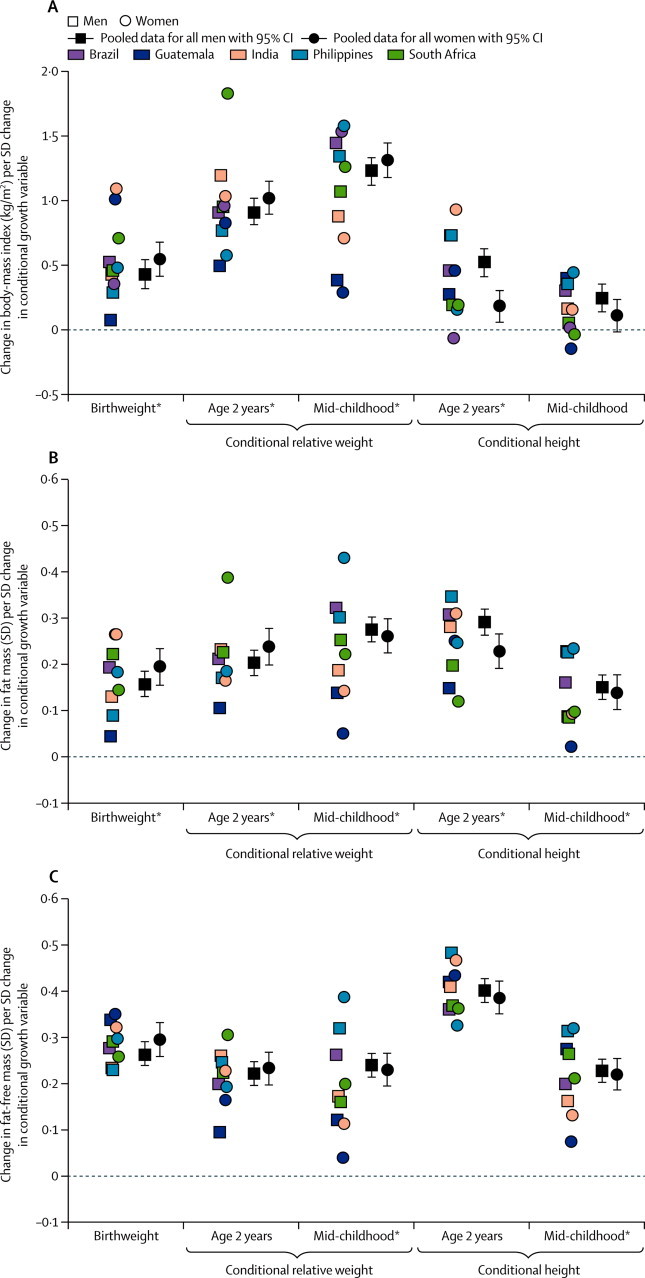
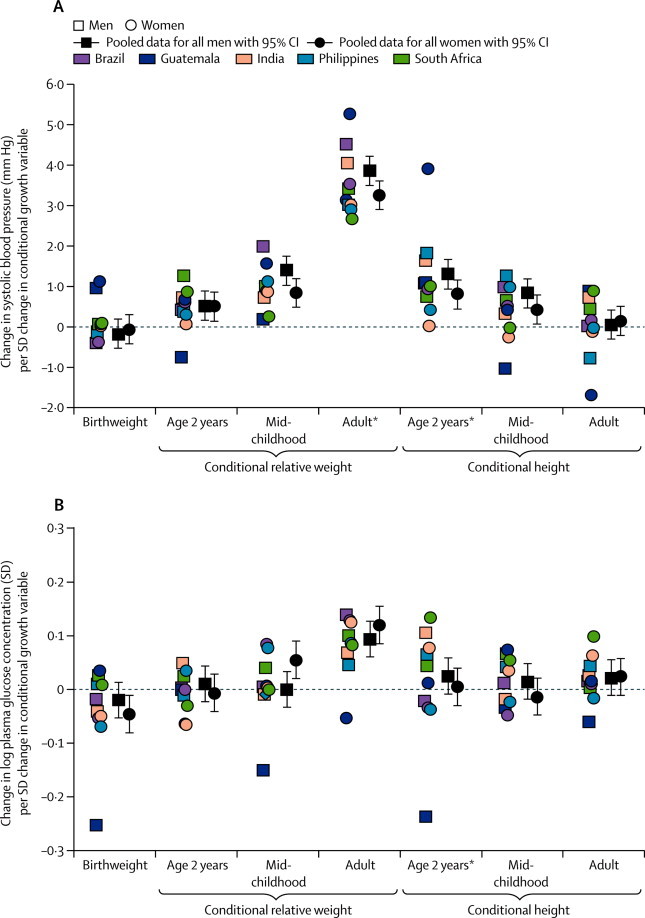
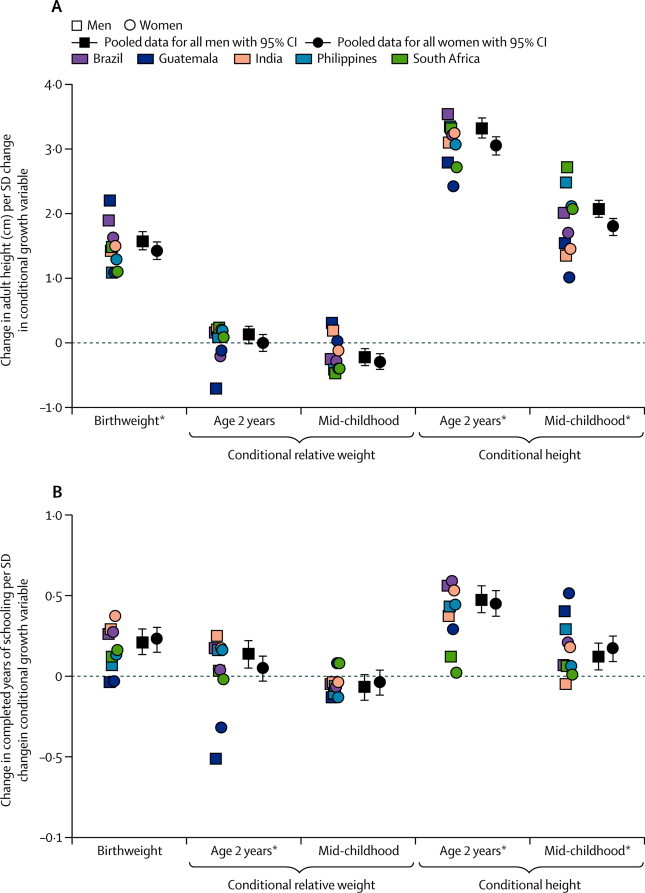
Findings: We obtained data for 8362 participants who had at least one adult outcome of interest. A higher birthweight was consistently associated with an adult body-mass index of greater than 25 kg/m(2) (odds ratio 1·28, 95% CI 1·21-1·35) and a reduced likelihood of short adult stature (0·49, 0·44-0·54) and of not completing secondary school (0·82, 0·78-0·87). Faster linear growth was strongly associated with a reduced risk of short adult stature (age 2 years: 0·23, 0·20-0·52; mid-childhood: 0·39, 0·36-0·43) and of not completing secondary school (age 2 years: 0·74, 0·67-0·78; mid-childhood: 0·87, 0·83-0·92), but did raise the likelihood of overweight (age 2 years: 1·24, 1·17-1·31; mid-childhood: 1·12, 1·06-1·18) and elevated blood pressure (age 2 years: 1·12, 1·06-1·19; mid-childhood: 1·07, 1·01-1·13). Faster relative weight gain was associated with an increased risk of adult overweight (age 2 years: 1·51, 1·43-1·60; mid-childhood: 1·76, 1·69-1·91) and elevated blood pressure (age 2 years: 1·07, 1·01-1·13; mid-childhood: 1·22, 1·15-1·30). Linear growth and relative weight gain were not associated with dysglycaemia, but a higher birthweight was associated with decreased risk of the disorder (0·89, 0·81-0·98).
Interpretation: Interventions in countries of low and middle income to increase birthweight and linear growth during the first 2 years of life are likely to result in substantial gains in height and schooling and give some protection from adult chronic disease risk factors, with few adverse trade-offs.
Funding: Wellcome Trust and Bill & Melinda Gates Foundation.
Copyright © 2013 Elsevier Ltd. All rights reserved.
Figures
Comment in
-
Early nutrition and adult outcomes: pieces of the puzzle.Lancet. 2013 Aug 10;382(9891):486-7. doi: 10.1016/S0140-6736(13)60716-3. Epub 2013 Mar 28. Lancet. 2013. PMID: 23541369 No abstract available.
References
-
- Stettler N, Iotova V. Early growth patterns and long-term obesity risk. Curr Opin Clin Nutr Metab Care. 2010;13:294–299. - PubMed
-
- Leunissen RW, Stijnen T, Hokken-Koelega AC. Influence of birth size on body composition in early adulthood: the programming factors for growth and metabolism (PROGRAM)-study. Clin Endocrinol (Oxf) 2009;70:245–251. - PubMed
-
- Dulloo AG. Thrifty energy metabolism in catch-up growth trajectories to insulin and leptin resistance. Best Pract Res Clin Endocrinol Metab. 2008;22:155–171. - PubMed
-
- Ong KK. Catch-up growth in small for gestational age babies: good or bad? Curr Opin Endocrinol Diabetes Obes. 2007;14:30–34. - PubMed
Publication types
MeSH terms
Substances
Grants and funding
LinkOut - more resources
Full Text Sources
Other Literature Sources