Review
. 2013 Apr;13(2):168-79.
doi: 10.1016/j.coph.2013.02.005. Epub 2013 Mar 28.

Oxidation-specific epitopes and immunological responses: Translational biotheranostic implications for atherosclerosis

Affiliations
Review

Oxidation-specific epitopes and immunological responses: Translational biotheranostic implications for atherosclerosis

Gregor Leibundgut et al. Curr Opin Pharmacol. 2013 Apr.

Abstract

Oxidation-specific epitopes (OSE), present on oxidized LDL (OxLDL), apoptotic cells, cell debris and modified proteins in the vessel wall, accumulate in response to hypercholesterolemia, and generate potent pro-inflammatory, disease-specific antigens. They represent an important class of 'danger associated molecular patterns' (DAMPs), against which a concerted innate immune response is directed. OSE are recognized by innate 'pattern recognition receptors', such as scavenger receptors present on dendritic cells and monocyte/macrophages, as well as by innate proteins, such as IgM natural antibodies and soluble proteins, such as C-reactive protein and complement factor H. These innate immune responses provide a first line of defense against atherosclerosis-specific DAMPs, and engage adaptive immune responses, provided by T and B-2 cells, which provide a more specific and definitive response. Such immune responses are ordinarily directed to remove foreign pathogens, such as those found on microbial pathogens, but when persistent or maladaptive, lead to host damage. In this context, atherosclerosis can be considered as a systemic chronic inflammatory disease initiated by the accumulation of OSE type DAMPs and perpetuated by maladaptive response of the innate and adaptive immune system. Understanding this paradigm leads to new approaches to defining cardiovascular risk and suggests new modes of therapy. Therefore, OSE have become potential targets of diagnostic and therapeutic agents. Human and murine OSE-targeting antibodies have been developed and are now being used as biomarkers in human studies and experimentally in translational applications of non-invasive molecular imaging of oxidation-rich plaques and immunotherapeutics.


Figures

Figure 1
Figure 1
Immunologic targets and receptors in atherosclerosis. (a) Pattern-associated molecular patterns (PAMPs) comprise phosphocholines (PC) on bacterial cell membranes, lipopeptides and lipopolysaccharides (LPS). (b) Danger-associated molecular patterns (DAMPs) include oxidized phosphocholine (OxPC), advanced glycation end-products (AGE). (c) OxLDL defines a variety of oxidative modifications various components of LDL, the best characterized of which are oxidized phospholipids (OxPL), Malondialdehyde (MDA), and 4-hydroxynonenal (4-HNE) epitopes. Lp(a) is composed of apolipoprotein B-100 (apoB) and apolipoprotein(a) [apo(a)] and carries OxPL in both the lipid and protein phases. OxPL are also present on plasminogen. (d) Cellular innate immunity is provided by T and B cells, dendritic cells and macrophages/foam cells, which communicate via cytokines. (e) Membrane bound PRRs include trans membrane proteins on members of cellular innate immunity and recognize DAMPs, PAMPs, and OSEs. (f) Natural antibodies (NAbs) of IgM (EO6/T15) and IgG isotypes, complement factor H (CFH), and C-reactive protein (CRP) constitute soluble pattern recognition receptors (PRRs). (g) OxPL, MDA and 4-HNE moieties represent well described oxidation specific epitopes (OSEs).
Figure 2
Figure 2
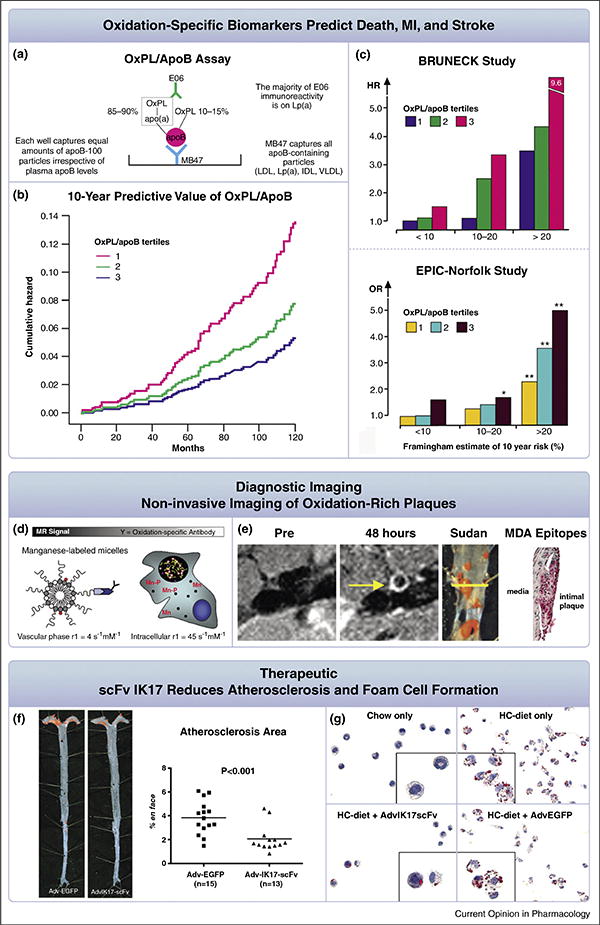
Biotheranostic applications of oxidation-specific antibodies. Panels (a–c) summarize oxidized phospholipid (OxPL) biomarkers. The OxPL/apo B assay (OxPL/apoB) reflects the content of OxPL on apoB particles captured on microtiter well plates (a). The assay is set up so that all plates capture a similar amount of apoB and therefore the assay is normalized to and independent of plasma apoB and LDL-C levels. Designed this way, the assay is highly sensitive to the number of moles of OxPL on apoB and primarily reflects the OxPL content on the most atherogenic Lp(a) particles (high Lp(a) levels mediated by small apo(a) isoforms). (b) shows the 10-year predictive value of OxPL/apoB in death, MI and stroke in the prospectively followed Bruneck population representing a cross-section of the general community. (c) shows the value of OxPL/apoB in enhancing stratification of CVD risk in different categories of the Framingham Risk Score in the Bruneck and EPIC-Norfolk studies. Panels d–e display the molecular imaging of oxidation-specific epitopes (OSE). Nanoparticles (∼10–15 nm) consisting of micelles are generated to contain manganese (Mn) and an oxidation-specific antibody (d). The relaxivity (r1) is increased ∼10-fold when this particle binds to extracellular OxLDL, is then taken up by macrophages and released intracellularly as free Mn, becoming an indirect macrophage-targeting agent. Successful non-invasive magnetic resonance imaging of OSE is accomplished by injection of these nanoparticles and imaging of the abdominal aorta in cholesterol fed apoE–/– mice (e). Note lack of signal at the pre-injection scan and strong signal (white contrast) in the 48 hour scan. The accompanying panels show the Sudan stained aorta where the imaging occurred and the presence of the OSE MDA using immunostaining techniques, confirming both the presence of plaque and MDA epitopes at the imaged area. Panels f–g represent the therapeutic use of the oxidation-specific antibody IK17 used as a single chain fragment. Adenovirus IK17-scFv-mediated hepatic expression was achieved in LDLR/Rag 1 double-knockout mice, leading to a 46% reduction in en face atherosclerosis compared with control mice treated with adenovirus-enhanced green fluorescent protein Adv-GFP) vector (f). Importantly, peritoneal macrophages isolated from Adv-IK17-scFv treated mice had decreased lipid accumulation compared with adv-GFP (g), consistent with the ability of IK17 to inhibit OxLDL uptake by macrophages. Figures reprinted with permission from references: panel b [68], c [68,69], panels d and e [47] and panel f [59••].

References

    1. Lichtman AH, Binder CJ, Tsimikas S, Witztum JL. Adaptive immunity in atherogenesis: new insights and therapeutic approaches. J Clin Invest. 2013;123:27–36. - PMC - PubMed
    1. Moore KJ, Tabas I. Macrophages in the pathogenesis of atherosclerosis. Cell. 2011;145:341–355. - PMC - PubMed
    1. Packard RRS, Lichtman AH, Libby P. Innate and adaptive immunity in atherosclerosis. Semin Immunopathol. 2009;31:5–22. - PMC - PubMed
    1. Hansson GK, Hermansson A. The immune system in atherosclerosis. Nat Immunol. 2011;12:204–212. - PubMed
    1. Miller YI, Choi SH, Wiesner P, Fang L, Harkewicz R, Hartvigsen K, Boullier A, Gonen A, Diehl CJ, Que X, et al. Oxidation-specific epitopes are danger-associated molecular patterns recognized by pattern recognition receptors of innate immunity. Circ Res. 2011;108:235–248. - PMC - PubMed

Publication types