. 2014 Mar 20;33(12):1590-600.
doi: 10.1038/onc.2013.92. Epub 2013 Apr 1.

Incomplete inhibition of phosphorylation of 4E-BP1 as a mechanism of primary resistance to ATP-competitive mTOR inhibitors

Affiliations

Incomplete inhibition of phosphorylation of 4E-BP1 as a mechanism of primary resistance to ATP-competitive mTOR inhibitors

G S Ducker et al. Oncogene. .

Abstract

The mammalian target of rapamycin (mTOR) regulates cell growth by integrating nutrient and growth factor signaling and is strongly implicated in cancer. But mTOR is not an oncogene, and which tumors will be resistant or sensitive to new adenosine triphosphate (ATP) competitive mTOR inhibitors now in clinical trials remains unknown. We screened a panel of over 600 human cancer cell lines to identify markers of resistance and sensitivity to the mTOR inhibitor PP242. RAS and phosphatidylinositol 3-kinase catalytic subunit alpha (PIK3CA) mutations were the most significant genetic markers for resistance and sensitivity to PP242, respectively; colon origin was the most significant marker for resistance based on tissue type. Among colon cancer cell lines, those with KRAS mutations were most resistant to PP242, whereas those without KRAS mutations most sensitive. Surprisingly, cell lines with co-mutation of PIK3CA and KRAS had intermediate sensitivity. Immunoblot analysis of the signaling targets downstream of mTOR revealed that the degree of cellular growth inhibition induced by PP242 was correlated with inhibition of phosphorylation of the translational repressor eIF4E-binding protein 1 (4E-BP1), but not ribosomal protein S6 (rpS6). In a tumor growth inhibition trial of PP242 in patient-derived colon cancer xenografts, resistance to PP242-induced inhibition of 4E-BP1 phosphorylation and xenograft growth was again observed in KRAS mutant tumors without PIK3CA co-mutation, compared with KRAS wild-type controls. We show that, in the absence of PIK3CA co-mutation, KRAS mutations are associated with resistance to PP242 and that this is specifically linked to changes in the level of phosphorylation of 4E-BP1.


Conflict of interest statement

Conflicts of Interest: Kevan Shokat is an inventor on patents from UCSF relating to PP242 and MLN0128 licensed to Millennium Pharmaceuticals and is a member of the Millennium Pharmaceuticals Scientific Advisory Board.

Figures

Figure 1
Figure 1
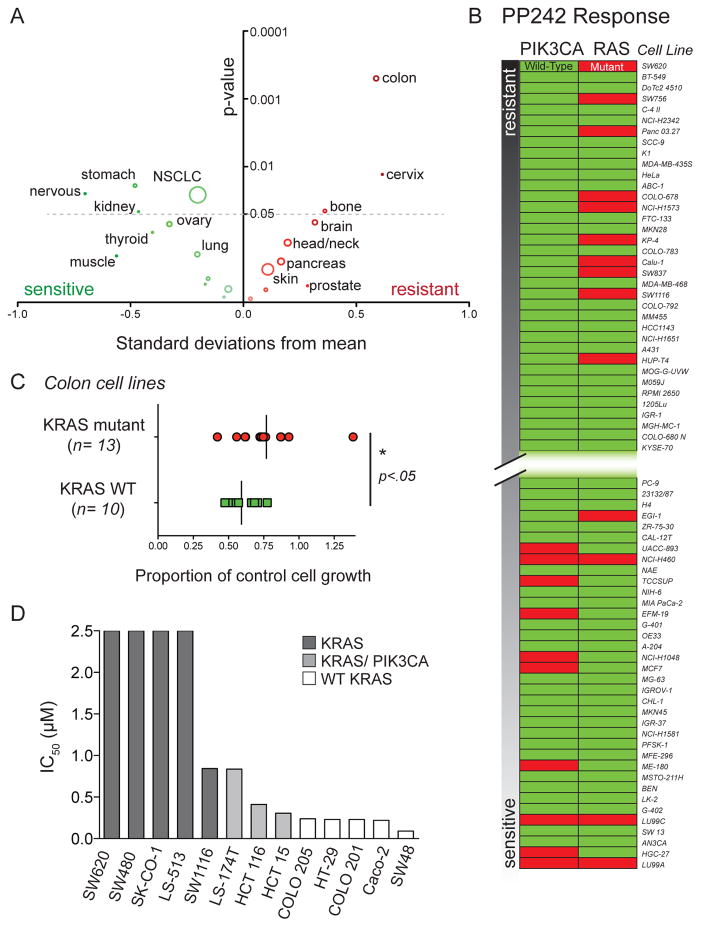
An unbiased cell screen reveals factors leading to resistance and sensitivity to the ATP-competitive mTOR inhibitor PP242 (A) Colon cell origin is a strong predictor for resistance to PP242 treatment. The mean response of each cell type to 500 nM PP242 treatment was plotted as a standard deviation from the population mean. The y-axis indicates the significance of the test-statistic for each independent difference in means (cell type versus population). The size of the circle corresponds to the number of cell lines of each type analyzed. Colon origin (n=39) was the strongest single predictor of resistance or sensitivity to PP242 among all annotated organ types. (B) PIK3CA mutations are prevalent in cell lines sensitive to PP242 while RAS marks cell lines that are resistant to PP242. The set of 357 cell lines with known mutation status for PIK3CA and RAS were assayed for growth inhibition and ranked according to the inhibition results. The 10% most resistant and most sensitive cell lines are shown here in order of increasing response to PP242. (C) KRAS mutant colorectal cells are more resistant to PP242 than cells harboring WT KRAS. Comparison of means was made using Student’s t-test. (D) IC50 values for PP242 in selected colon cancer cell lines. KRAS mutant cell lines with concomitant PIK3CA mutations are more sensitive to PP242 than KRAS mutants alone.
Figure 2
Figure 2
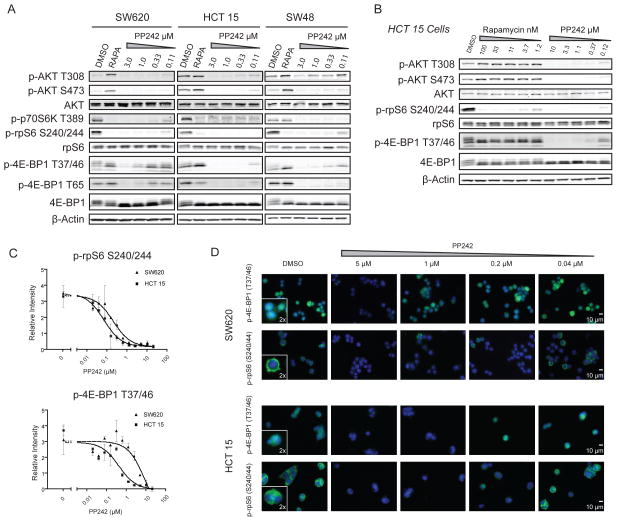
mTORC1 substrates are differentially inhibited in PP242 resistant versus sensitive cell lines (A) 4E-BP1 is differentially inhibited in PP242 resistant and sensitive colon cancer cell lines. Representative cell lines SW620, HCT 15 and SW48 were treated with PP242 or rapamycin (20 nM) for 1 hour and analyzed by western blotting. (B) Differential inhibition is reminiscent of incomplete mTORC1 inhibition by rapamycin. In HCT 15 cells, rapamycin only partially inhibits 4E-BP1 phosphorylation after a 1 hour treatment, despite potently blocking rpS6 phosphorylation. (C) Quantification of mTORC1 substrate inhibition shows that inhibition of p-4E-BP1 and not inhibition of p-rpS6 tracks with growth inhibition. Quantification was performed on western blots of lysed cells after treatment for 1 hour with increasing PP242 concentrations in two independent experiments. (D) Immunofluorescence of mTORC1 substrates reveals consistent subcellular localization despite differential inhibition by PP242. SW620 and HCT 15 cells were treated with increasing concentrations of PP242 for 1 hour, formalin fixed and stained for either p-4E-BP1 or p-rpS6 (both green) and counterstained with DAPI (blue). PP242 treatment does not alter the subcellular localization of either phosphorylated substrate.
Figure 3
Figure 3
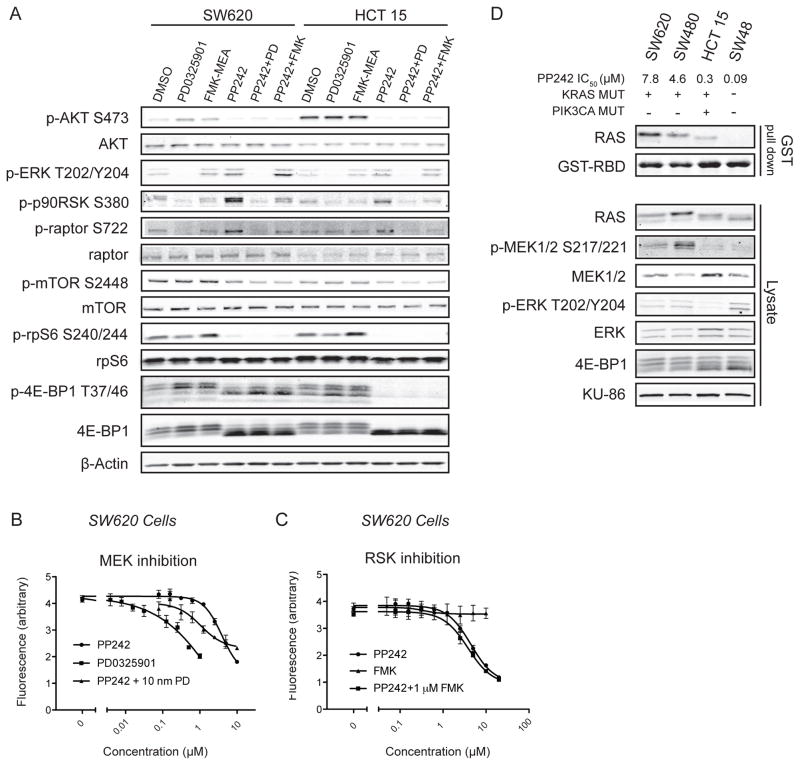
Inhibition of MAPK signaling does not alter mTORC1 substrate phosphorylation (A) Treatment of cell lines with MAPK inhibitors does not sensitize mTOR substrates to PP242 inhibition. Cells were treated with the MEK inhibitor PD0325901 (20 nM), the p90RSK inhibitor FMK-MEA (3 μM), PP242 (1 μM) singly or in combination for 1 hour. Neither FMK-MEA nor PD0325901 sensitize mTOR substrates to PP242 treatment. (B–C) Inhibition of ERK but not p90RSK augments the cell growth arrest induced by PP242. The MEK inhibitor PD0325901 is a potent inhibitor of cell growth, but selective inhibition of ERK substrate p90RSK by FMK-MEA does not recapitulate this phenotype in a three-day cell growth assay measured using a resazurin assay. (D) RAS-GTP loading, but not MAPK pathway activation, correlates with resistance to PP242. Glutathione pull down of RAS-GTP with GST-RBD shows high RAS-GTP levels in unstimulated KRAS mutant PP242 resistant cell lines. Significantly different levels of RAS-GTP activation were observed within KRAS mutant cells.
Figure 4
Figure 4
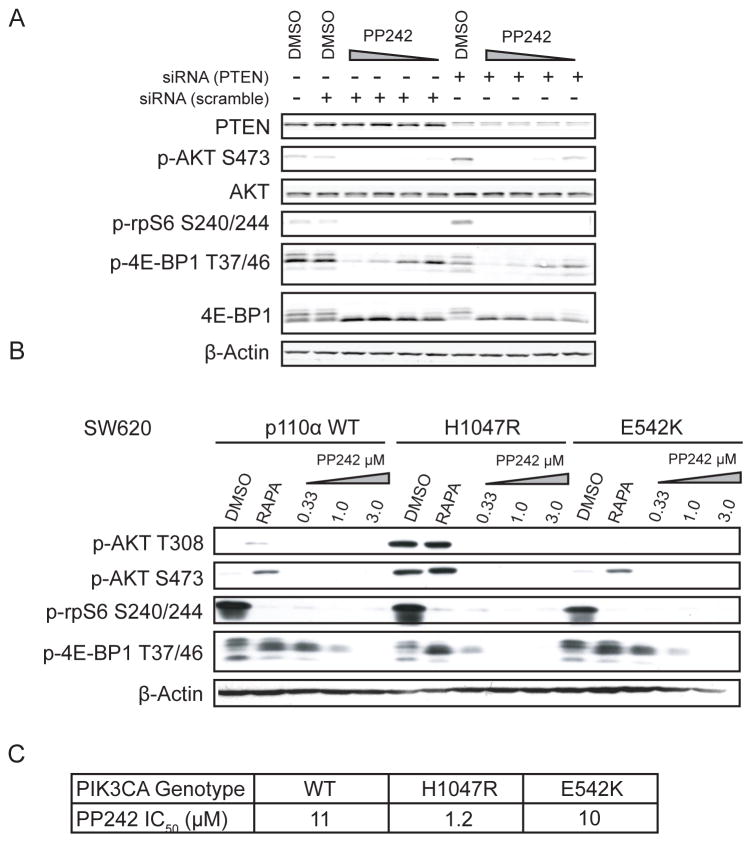
PIK3CA mutation but not PTEN loss sensitizes KRAS mutant cells to PP242 (A) siRNA against PTEN does not sensitize KRAS mutant CRC cells to PP242. SW620 cells were treated with siRNA against PTEN for 72 hours prior to 1 hour drug treatment with PP242 (3.0, 1.0, 0.33 and 0.1 μM). (B) Addition of mutant PIK3CA to the KRAS mutant cell line SW620 increases sensitivity to PP242. Retroviral insertion of either WT PIK3CA, helical (E542K) or kinase (H1047R) domain mutations only resulted in elevated basal AKT activation in the H1047R case. Cells were treated with rapamycin (20 nM) or PP242 (3.0, 1.0, 0.3 μM) for 1 h before lysis. (C) IC50s for SW620 cell lines engineered to contain additional PIK3CA mutations.
Figure 5
Figure 5
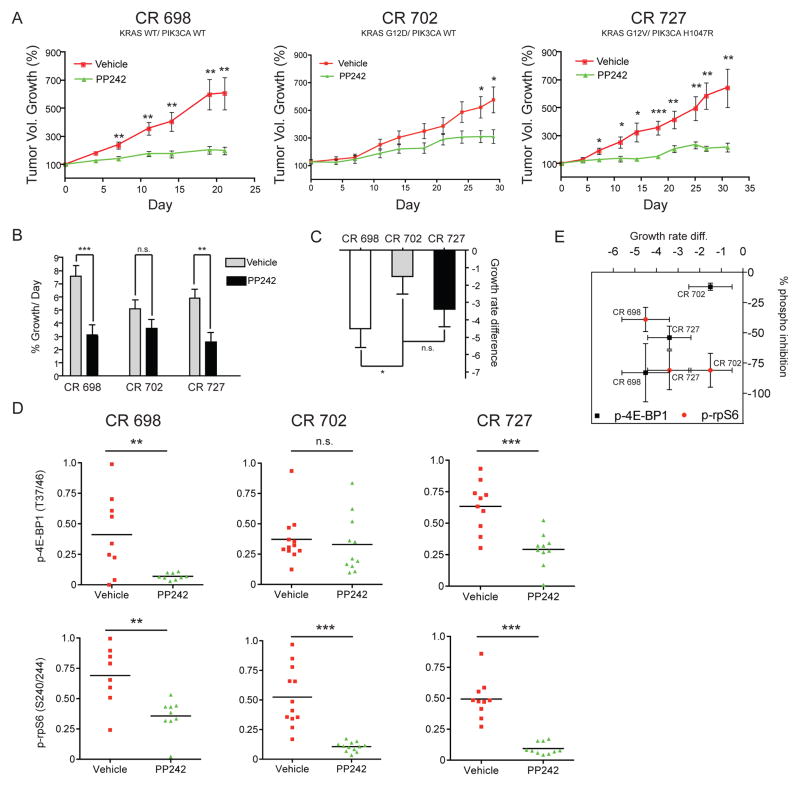
KRAS mutant patient-derived xenografts are resistant to PP242 by incomplete inhibition of 4E-BP1 phosphorylation. (A) Percent growth curves of three xenografts show differences in response to PP242 treatment. KRAS and PIK3CA genotypes are as follows: CR 698 (KRAS WT/PIK3CA WT), CR 702 (KRAS Mut/PIK3CA WT), CR 727 (KRAS Mut/PIK3CA Mut). Mice were given 100 mg/kg PP242 once daily or vehicle for the indicated time. Tumors were normalized to 100 percent at the beginning of dosing and percent growth ±SEM was plotted for each day when tumor volume measurements were taken. Asterisks indicate significant differences in tumor growth at each measurement point as determined by an unpaired t-test (* p< .05, ** p< .01, *** p< .001). (B) Treatment effect is significant in tumors CR 698 and CR 727. Tumor growth rates were calculated using a linear mixed effects model. PP242 led to a significant reduction in growth rate as calculated using a Wald test (asterisks represent the same p values as in A) in the KRAS WT tumor CR 698 and the double mutant tumor CR 727, but not the KRAS single-mutant tumor CR 727. (C) PP242 is most effective at inhibiting growth of the KRAS WT tumor CR 698. Comparison of the growth rate difference calculated from the model shows that PP242 is significantly more effective at inhibiting growth in CR 698 than in CR 702. The growth rate difference is the growth rate of the PP242 treated tumors minus the control growth rate. All other comparisons were not statistically significant. (D) Whole-tumor western blots show that p-4E-BP1 levels were significantly more reduced by PP242 treatment in KRAS WT and KRAS/PIK3CA double mutant tumors but not in KRAS single-mutant tumors. After treatment with either PP242 or vehicle for 30 days, tumors were removed and analyzed by western blot for phosphoprotein analysis. Bands were quantified by fluorescent antibodies and intensities internally normalized to those of β-actin. Intensities are reported as arbitrary normalized fluorescence units. Statistical comparisons were made using two-tailed t-tests as in Figure 3A. (E) Changes in p-4E-BP1 but not p-rpS6 correlate with changes in tumor growth. A plot of the tumor growth rate difference (Figure 5C) versus percent inhibition of p-4E-BP1 and p-rpS6 shows that the efficiency in inhibiting 4E-BP1 phosphorylation correlates linearly with the percent growth defect between treated and untreated tumors. Percent inhibition of p-rpS6 does not vary significantly with genotype or tumor growth defect as calculated from linear mixed effects model.

References

    1. Kantarjian H, Sawyers C, Hochhaus A, Guilhot F, Schiffer C, Gambacorti-Passerini C, et al. Hematologic and cytogenetic responses to imatinib mesylate in chronic myelogenous leukemia. N Engl J Med. 2002 Feb 28;346(9):645–52. - PubMed
    1. Kwak EL, Bang Y-J, Camidge DR, Shaw AT, Solomon B, Maki RG, et al. Anaplastic lymphoma kinase inhibition in non-small-cell lung cancer. N Engl J Med. 2010 Oct 28;363(18):1693–703. - PMC - PubMed
    1. Chapman PB, Hauschild A, Robert C, Haanen JB, Ascierto P, Larkin J, et al. Improved survival with vemurafenib in melanoma with BRAF V600E mutation. N Engl J Med. 2011 Jun 30;364(26):2507–16. - PMC - PubMed
    1. Jänne PA, Gray N, Settleman J. Factors underlying sensitivity of cancers to small-molecule kinase inhibitors. Nat Rev Drug Discov. 2009 Mar 8;8(9):709–23. - PubMed
    1. Joseph EW, Pratilas CA, Poulikakos PI, Tadi M, Wang W, Taylor BS, et al. The RAF inhibitor PLX4032 inhibits ERK signaling and tumor cell proliferation in a V600E BRAF-selective manner. Proc Natl Acad Sci USA. 2010 Aug 17;107(33):14903–8. - PMC - PubMed

Publication types

MeSH terms

Substances