


Manipulation of small Rho GTPases is a pathogen-induced process detected by NOD1
- PMID: 23542589
- PMCID: PMC3625479
- DOI: 10.1038/nature12025
Manipulation of small Rho GTPases is a pathogen-induced process detected by NOD1
Abstract
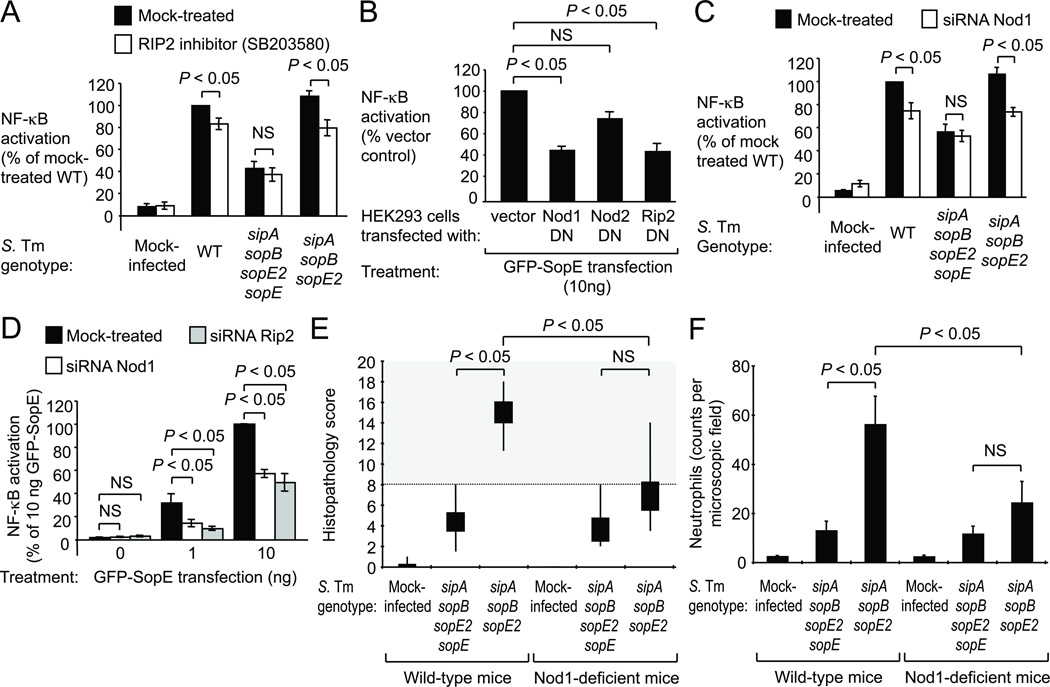
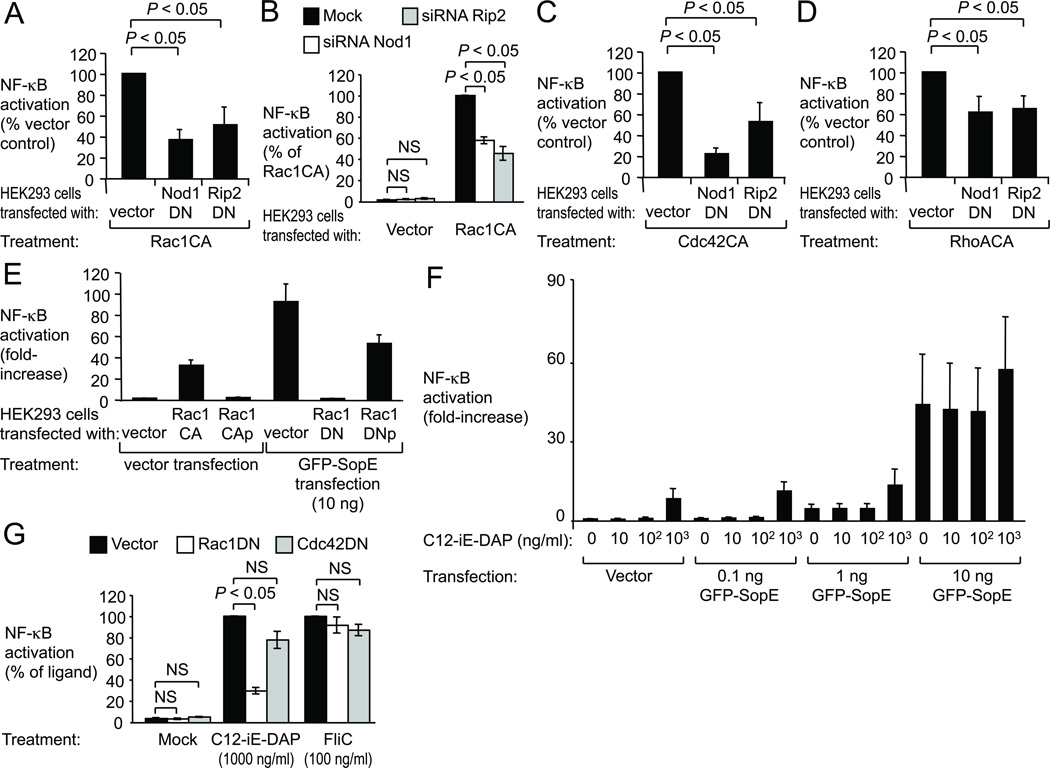
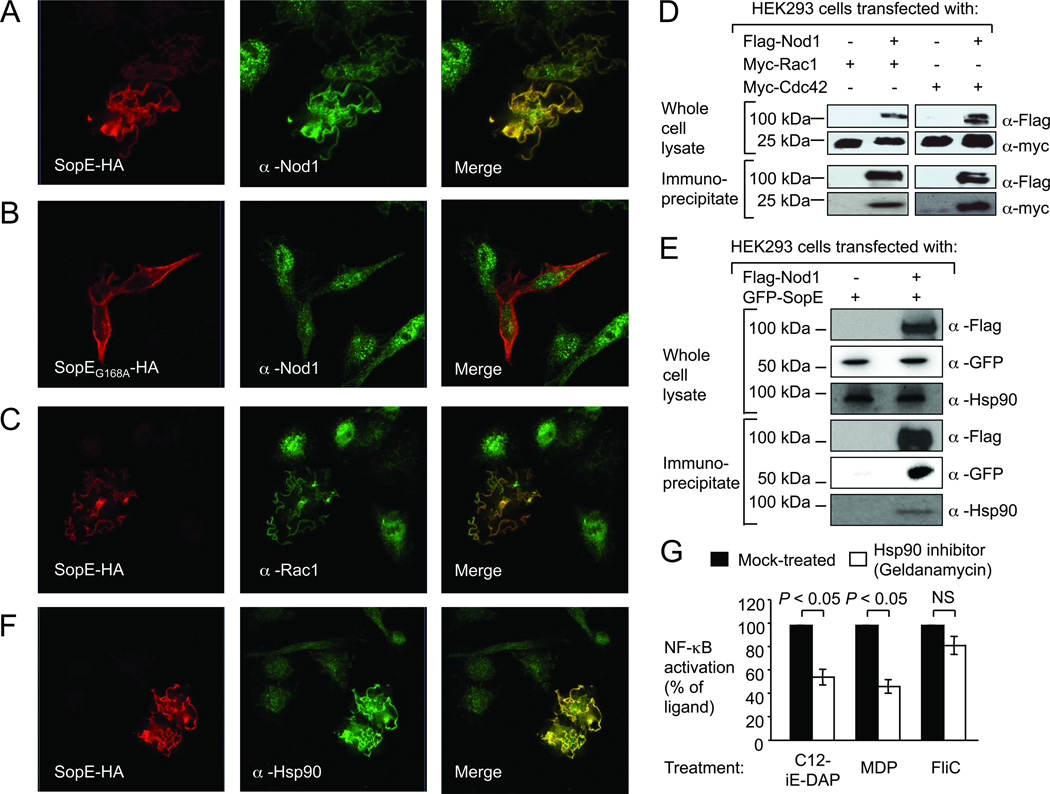
Our innate immune system distinguishes microbes from self by detecting conserved pathogen-associated molecular patterns. However, these are produced by all microbes, regardless of their pathogenic potential. To distinguish virulent microbes from those with lower disease-causing potential the innate immune system detects conserved pathogen-induced processes, such as the presence of microbial products in the host cytosol, by mechanisms that are not fully resolved. Here we show that NOD1 senses cytosolic microbial products by monitoring the activation state of small Rho GTPases. Activation of RAC1 and CDC42 by bacterial delivery or ectopic expression of SopE, a virulence factor of the enteric pathogen Salmonella, triggered the NOD1 signalling pathway, with consequent RIP2 (also known as RIPK2)-mediated induction of NF-κB-dependent inflammatory responses. Similarly, activation of the NOD1 signalling pathway by peptidoglycan required RAC1 activity. Furthermore, constitutively active forms of RAC1, CDC42 and RHOA activated the NOD1 signalling pathway. Our data identify the activation of small Rho GTPases as a pathogen-induced process sensed through the NOD1 signalling pathway.
Figures
Comment in
-
RhoGTPases--NODes for effector-triggered immunity in animals.Cell Res. 2013 Aug;23(8):980-1. doi: 10.1038/cr.2013.68. Epub 2013 May 21. Cell Res. 2013. PMID: 23689278 Free PMC article.
References
-
- Janeway CA., Jr Approaching the asymptote? Evolution and revolution in immunology. Cold Spring Harb Symp Quant Biol. 1989;54(Pt 1):1–13. - PubMed
-
- Fu Y, Galan JE. The Salmonella typhimurium tyrosine phosphatase SptP is translocated into host cells and disrupts the actin cytoskeleton. Molecular microbiology. 1998;27:359–368. - PubMed
-
- Hardt WD, Chen LM, Schuebel KE, Bustelo XR, Galan JE. S. typhimurium encodes an activator of Rho GTPases that induces membrane ruffling and nuclear responses in host cells. Cell. 1998;93:815–826. - PubMed
REFERENCES FOR METHODS
-
- Sambrook J, Fritsch EF, Maniatis T. Molecular cloning. Cold Spring Harbor Laboratory Press; New York: 1989.
-
- Schmieger H. Phage P22-mutants with increased or decreased transduction abilities. Mol Gen Genet. 1972;119:75–88. - PubMed
-
- Keller A, Nesvizhskii AI, Kolker E, Aebersold R. Empirical statistical model to estimate the accuracy of peptide identifications made by MS/MS and database search. Anal Chem. 2002;74:5383–5392. - PubMed
Publication types
MeSH terms
Substances
Grants and funding
LinkOut - more resources
Full Text Sources
Other Literature Sources
Molecular Biology Databases
Research Materials
Miscellaneous
