. 2013 May;14(5):509-13.
doi: 10.1038/ni.2568. Epub 2013 Mar 31.

Sensing and alarm function of resident memory CD8⁺ T cells

Affiliations

Sensing and alarm function of resident memory CD8⁺ T cells

Jason M Schenkel et al. Nat Immunol. 2013 May.

Erratum in

  • Nat Immunol. 2013 Aug;14(8):876

Abstract

CD8(+) T cells eliminate intracellular infections through two contact-dependent effector functions: cytolysis and secretion of antiviral cytokines. Here we identify the following additional function for memory CD8(+) T cells that persist at front-line sites of microbial exposure: to serve as local sensors of previously encountered antigens that precipitate innate-like alarm signals and draw circulating memory CD8(+) T cells into the tissue. When memory CD8(+) T cells residing in the female mouse reproductive tract encountered cognate antigen, they expressed interferon-γ (IFN-γ), potentiated robust local expression of inflammatory chemokines and induced rapid recruitment of circulating memory CD8(+) T cells. Anamnestic responses in front-line tissues are thus an integrated collaboration between front-line and circulating populations of memory CD8(+) T cells, and vaccines should establish both populations to maximize rapid responses.


Figures

Figure 1
Figure 1. Local antigen re-challenge precipitates rapid accumulation of antigen-specific CD8+ T cells within the female reproductive tract (FRT)
Widely disseminated Thy1.1+ memory P14 CD8+ T cells were established after LCMV infection. Immune mice were challenged transcervically (t.c.) with 4×10⁵ p.f.u. VV-gp33 or VV-OVA, 50μg gp33 or SIINFEKL peptide, or left untreated. (a) 48 h later, P14 cells in FRT were enumerated relative to total nucleated cells. (b) Representative images show α-Thy1.1 (red) and DAPI (blue) staining. Scale bars = 100 μm. n = 6, one representative of three experiments. n = 6, pooled from 2 experiments. *, P < 0.05, **, P <0.001, unpaired two-tailed t-test, mean±SEM.
Figure 2
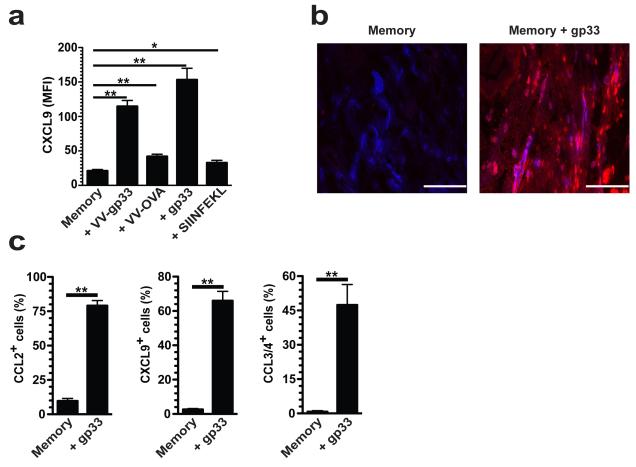
Figure 2. Local antigen re-challenge precipitates rapid inflammatory chemokine expression within the female reproductive tract (FRT)
Widely disseminated Thy1.1+ memory P14 CD8+ T cells were established after LCMV infection. Immune mice were challenged transcervically (t.c.) with 4×10⁵ p.f.u. VV-gp33 or VV-OVA, 50μg gp33 or SIINFEKL peptide, or left untreated. (a) 48 h later, mean fluorescence intensity (MFI) of CXCL9 expression on CD31+ vessels was determined 12 h after t.c. challenge. (b) Representative images show α-CXCL9 (red) and α-CD31 (blue). Scale bars = 100 μm. (c) 12 h after t.c. gp33 challenge, CCL2, CXCL9 and CCL3/4 expression was evaluated on the indicated cell populations by flow cytometry. (a,b) n = 6, one representative of three experiments. (c) n = 6, pooled from 2 experiments. *, P < 0.05, **, P < 0.001, unpaired two-tailed t-test, mean±SEM.
Figure 3
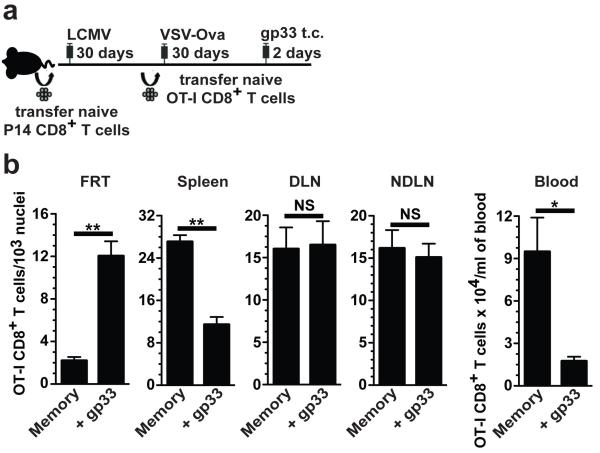
Figure 3. Unstimulated memory CD8+ T cells redistribute when other memory CD8+ T cells are reactivated
(a) Two populations of memory CD8+ T cells with different specificities, Thy1.1+ P14 cells (gp33-specific) and CD45.1+ OT-I cells (SIINFEKL-specific), were established. (b) Mice were challenged with gp33. 48 h later, OT-I cells were enumerated in the FRT, spleen, blood, draining lymph node (DLN) and non-draining lymph node (NDLN). n ≥ 5, *, P < 0.05, **, P < 0.001, unpaired two-tailed t-test, mean±SEM.
Figure 4
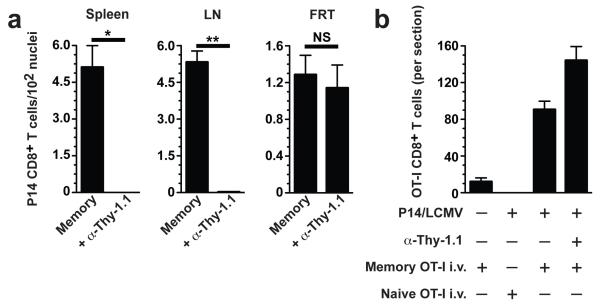
Figure 4. Memory CD8+ T cells within nonlymphoid tissue orchestrate rapid recruitment of unstimulated memory, but not naïve, CD8+ T cells to the site of antigen re-exposure
(a) Thy1.1+ memory P14 cells were depleted from recirculating compartments but preserved in the FRT via administration of complement fixing α-Thy1.1 Ab. P14 cells were evaluated in tissues 72 h after Ab treatment. (b) Naïve mice, P14 immune chimeras, and P14 immune chimeras depleted of circulating P14 cells received i.v. transfers of naïve or memory OT-I CD8+ T cells, as indicated. 24 h after OT-I transfer, mice were challenged t.c. with gp33 and transferred OT-I cells were enumerated 48 h later within 7 μm coronal sections through the entire FRT. n = 3, representative of 2-3 independent experiments. *, P < 0.01, **, P <0.001, unpaired two-tailed t-test, mean±SEM.
Figure 5
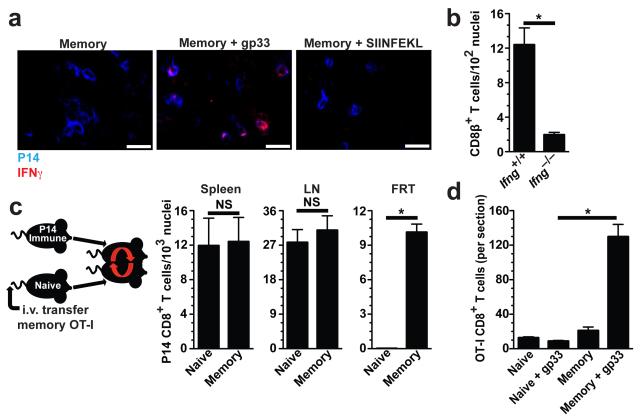
Figure 5. IFN-γ and resident memory CD8+ T cells are required for rapid recruitment of memory T cells to the site of antigen reexposure
(a) OT-I immune chimeras were challenged t.c. with SIINFEKL. 12 h later, OT-I cells and IFN-γ were visualized by immunofluorescence microscopy. (b) OT-I.Ifng+/+ and OT-I.Ifng−/− immune chimeras were challenged t.c. with SIINFEKL. 48 h later, CD8β+ cells were enumerated in FRT. (c) CD45.1+ memory OT-I cells were transferred to naïve recipients, which were then conjoined to Thy1.1+ P14 immune chimeric mice via parabiosis. 14-16 days after surgery, memory P14 cells were enumerated in both conjoined parabionts. (d) Parabionts (as in c) were challenged with gp33 t.c. and 48 h later OT-Is were quantified within 7 μm coronal sections through the entire FRT. Scale bars = 50 μm.. Data pooled from two independent experiments totaling 5-6 mice per group. *, P <0.001, unpaired two-tailed t-test, mean±SEM.

References

    1. Obar JJ, Khanna KM, Lefrançois L. Endogenous Naive CD8+ T Cell Precursor Frequency Regulates Primary and Memory Responses to Infection. Immunity. 2008;28:859–869. - PMC - PubMed
    1. Sallusto F, Geginat J, Lanzavecchia A. Central memory and effector memory T cell subsets: function, generation, and maintenance. Annu. Rev. Immunol. 2004;22:745–763. - PubMed
    1. Andrian, von UH, Mackay CR. T-cell function and migration. Two sides of the same coin. N. Engl. J. Med. 2000;343:1020–1034. - PubMed
    1. Seder RA, Ahmed R. Similarities and differences in CD4+ and CD8+ effector and memory T cell generation. Nat Immunol. 2003;4:835–842. - PubMed
    1. Akira S, Uematsu S. Pathogen recognition and innate immunity. Cell. 2006;240:783–801. - PubMed

Publication types

MeSH terms

Substances