


Reason for revision TKA predicts clinical outcome: prospective evaluation of 150 consecutive patients with 2-years followup
- PMID: 23543418
- PMCID: PMC3676611
- DOI: 10.1007/s11999-013-2940-8
Reason for revision TKA predicts clinical outcome: prospective evaluation of 150 consecutive patients with 2-years followup
Abstract
Background: There is limited knowledge regarding the relationship between the reason for revising a TKA and the clinical outcome in terms of satisfaction, pain, and function with time.
Questions/purposes: In a cohort of patients receiving a fully revised TKA, we hypothesized (1) outcomes would differ according to reason for revision at 2 years, (2) outcomes would improve gradually during those 2 years, (3) rates of complications differ depending on the reason for revision, and (4) patients with complications have lower scores.
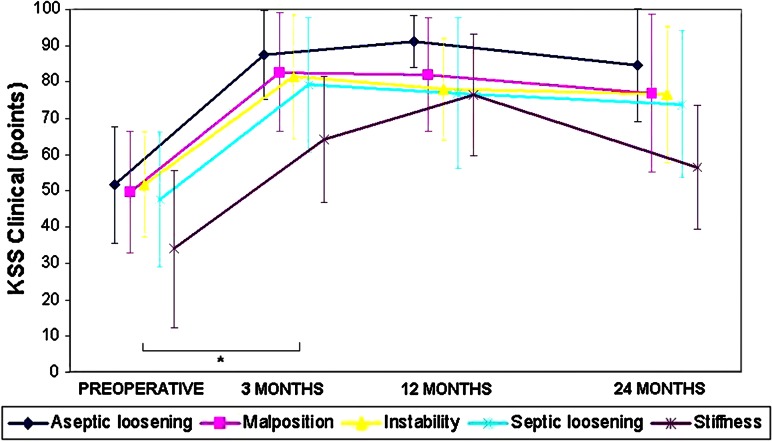
Methods: We studied a prospective cohort of 150 patients receiving a fully revised TKA using a single implant system in two high-volume centers at 24 months of followup. VAS satisfaction, VAS pain, The Knee Society Scoring System(©) (KSS) clinical and functional scores, and complication rate were correlated with their reasons for revision, including septic loosening, aseptic loosening, component malposition, instability, and stiffness.
Results: The aseptic loosening group showed better outcomes compared with the instability, malposition, and septic loosening groups, which showed intermediate results (p < 0.05). The stiffness group performed significantly worse on all outcome measures. The outcome for patients with a complication, after treatment of the complication, was less favorable.
Conclusions: The reason for revision TKA predicts clinical outcomes. Satisfaction, pain reduction, and functional improvement are better and complication rates are lower after revision TKA for aseptic loosening than for other causes of failure. For component malposition, instability, and septic loosening groups, there may be more pain and a higher complication rate. For stiffness, the outcomes are less favorable in all scores.
Level of evidence: Level III, prognostic study. See Guidelines for Authors for a complete description of levels of evidence.
Figures




Comment in
-
CORR Insights®: Reason for revision TKA predicts clinical outcome: prospective evaluation of 150 consecutive patients with 2-years followup.Clin Orthop Relat Res. 2013 Jul;471(7):2303-4. doi: 10.1007/s11999-013-2986-7. Epub 2013 Apr 19. Clin Orthop Relat Res. 2013. PMID: 23604601 Free PMC article. No abstract available.
References
-
- Brander V, Gondek S, Martin E, Stulberg SD. Pain and depression influence outcome 5 years after knee replacement surgery. Clin Orthop Relat Res. 2007;464:21–26. - PubMed
-
- Elson DW, Brenkel IJ. A conservative approach is feasible in unexplained pain after knee replacement: a selected cohort study. J Bone Joint Surg Br. 2007;89:1042–1045. - PubMed
Publication types
MeSH terms
LinkOut - more resources
Full Text Sources
Other Literature Sources
Medical
Research Materials
