


Early trophic feeding versus enteral fasting for very preterm or very low birth weight infants
- PMID: 23543508
- PMCID: PMC11480887
- DOI: 10.1002/14651858.CD000504.pub4
Early trophic feeding versus enteral fasting for very preterm or very low birth weight infants
Abstract
Background: The introduction of enteral feeds for very preterm (< 32 weeks) or very low birth weight (< 1500 grams) infants is often delayed due to concern that early introduction may not be tolerated and may increase the risk of necrotising enterocolitis. However, prolonged enteral fasting may diminish the functional adaptation of the immature gastrointestinal tract and extend the need for parenteral nutrition with its attendant infectious and metabolic risks. Trophic feeding, giving infants very small volumes of milk to promote intestinal maturation, may enhance feeding tolerance and decrease the time taken to reach full enteral feeding independently of parenteral nutrition.
Objectives: To determine the effect of early trophic feeding versus enteral fasting on feed tolerance, growth and development, and the incidence of neonatal morbidity (including necrotising enterocolitis and invasive infection) and mortality in very preterm or VLBW infants.
Search methods: We used the standard search strategy of the Cochrane Neonatal Review Group. This included electronic searches of the Cochrane Central Register of Controlled Trials (CENTRAL) (The Cochrane Library 2012, Issue 12), MEDLINE, EMBASE and CINAHL (1980 until December 2012), conference proceedings and previous reviews.
Selection criteria: Randomised or quasi-randomised controlled trials that assessed the effects of early trophic feeding (milk volumes up to 24 ml/kg/day introduced before 96 hours postnatal age and continued until at least one week after birth) versus a comparable period of enteral fasting in very preterm or very low birth weight infants.
Data collection and analysis: We extracted data using the standard methods of the Cochrane Neonatal Review Group with separate evaluation of trial quality and data extraction by two authors and synthesis of data using risk ratio, risk difference and mean difference.
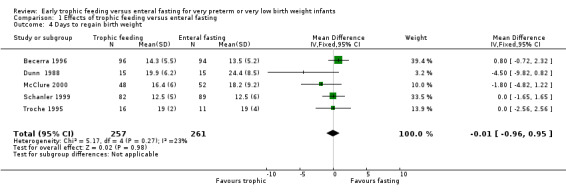
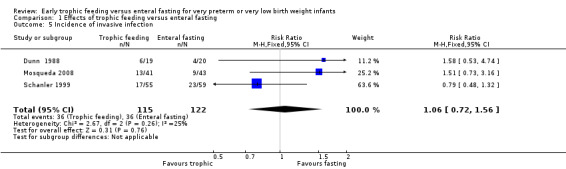
Main results: Nine trials in which a total of 754 very preterm or very low birth weight infants participated were eligible for inclusion. Few participants were extremely preterm (< 28 weeks) or extremely low birth weight (< 1000 grams) or growth restricted. These trials did not provide any evidence that early trophic feeding affected feed tolerance or growth rates. Meta-analysis did not detect a statistically significant effect on the incidence of necrotising enterocolitis: typical risk ratio 1.07 (95% confidence interval 0.67 to 1.70); risk difference 0.01 (-0.03 to 0.05).
Authors' conclusions: The available trial data do not provide evidence of important beneficial or harmful effects of early trophic feeding for very preterm or very low birth weight infants. The applicability of these findings to extremely preterm, extremely low birth weight or growth restricted infants is limited. Further randomised controlled trials would be needed to determine how trophic feeding compared with enteral fasting affects important outcomes in this population.
Conflict of interest statement
None.
Figures
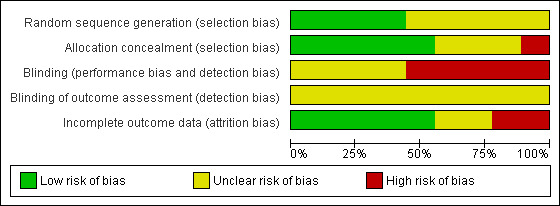
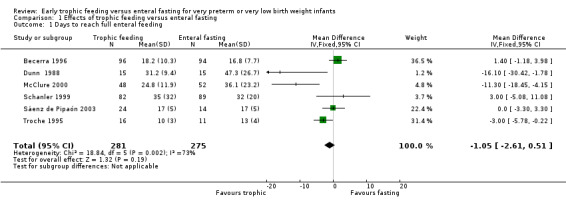
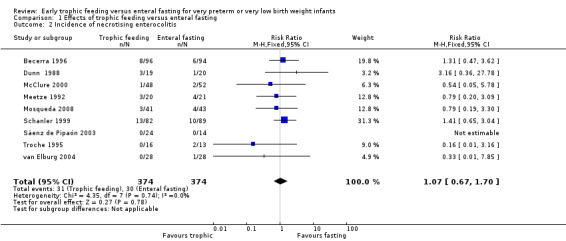
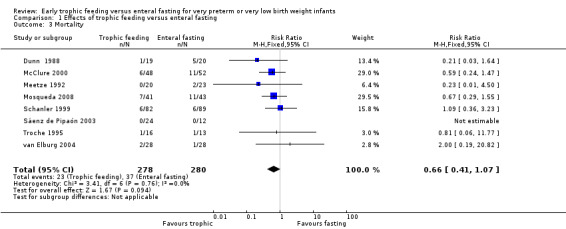
Update of
-
Early trophic feeding for very low birth weight infants.Cochrane Database Syst Rev. 2009 Jul 8;(3):CD000504. doi: 10.1002/14651858.CD000504.pub3. Cochrane Database Syst Rev. 2009. Update in: Cochrane Database Syst Rev. 2013 Mar 28;(3):CD000504. doi: 10.1002/14651858.CD000504.pub4. PMID: 19588318 Updated.
References
References to studies included in this review
Becerra 1996 {published and unpublished data}
-
- Becerra M, Ambiado S, Kuntsman G, Figueroa A, Balboa P, Fernandez P, et al. Feeding VLBW infants; Effect of early enteral stimulation (EES) [abstract]. Pediatric Research 1996;39:304A.
Dunn 1988 {published data only}
-
- Dunn L, Hulman S, Weiner J, Kleigman R. Beneficial effects of early hypocaloric enteral feeding on neonatal gastrointestinal function: preliminary report of a randomized trial. Journal of Pediatrics 1988;112(4):622‐9. - PubMed
McClure 2000 {published and unpublished data}
-
- McClure RJ, Newell SJ. Randomized controlled study of digestive enzyme activity following trophic feeding. Acta Paediatrica 2002;91(3):292‐6. - PubMed
Meetze 1992 {published data only}
-
- Meetze WH, Valentine C, McGuigan JE, Conlon M, Sacks N, Neu J. Gastrointestinal priming prior to full enteral nutrition in very low birth weight infants. Journal of Pediatric Gastroenterology and Nutrition 1992;15(2):163‐70. - PubMed
Mosqueda 2008 {published data only}
-
- Mosqueda E, Sapiegiene L, Glynn L, Wilson‐Costello D, Weiss M. The early use of minimal enteral nutrition in extremely low birth weight newborns. Journal of Perinatology 2008;28(4):264‐9. - PubMed
Sáenz de Pipaón 2003 {published and unpublished data}
-
- Sáenz de Pipaón M, VanBeek RH, Quero J, Perez J, Wattimena DJ, Sauer PJ. Effect of minimal enteral feeding on splanchnic uptake of leucine in the postabsorptive state in preterm infants. Pediatric Research 2003;53(2):281‐7. - PubMed
Schanler 1999 {published and unpublished data}
-
- Schanler RJ, Shulman RJ, Lau C, Smith EO, Heitkemper MM. Feeding strategies for premature infants: randomized trial of gastrointestinal priming and tube‐feeding method. Pediatrics 1999;103(2):434‐9. - PubMed
-
- Shulman RJ, Schanler RJ, Lau C, Heitkemper M, Ou C, Smith EO. Early feeding, antenatal glucocorticoids, and human milk decrease intestinal permeability in preterm infants. Pediatric Research 1998;44(4):519‐23. - PubMed
-
- Shulman RJ, Schanler RJ, Lau C, Heitkemper M, Ou C, Smith EO. Early feeding, feeding tolerance, and lactase activity in preterm infants. Journal of Pediatrics 1998;133(5):645‐9. - PubMed
Troche 1995 {published data only}
-
- Troche B, Harvey‐Wilkes K, Engle WD, Nielsen HC, Frantz ID, Mitchell ML, et al. Early minimal feedings promote growth in critically ill premature infants. Biology of the Neonate 1995;67(3):172‐81. - PubMed
van Elburg 2004 {published data only}
-
- Elburg RM, Berg A, Bunkers CM, Lingen RA, Smink EW, Eyck J, et al. Minimal enteral feeding, fetal blood flow pulsatility, and postnatal intestinal permeability in preterm infants with intrauterine growth retardation. Archives of Disease in Childhood, Fetal and Neonatal Edition 2004;89(4):F293‐6. - PMC - PubMed
References to studies excluded from this review
Berseth 1992 {published data only}
-
- Berseth CL. Effect of early feeding on maturation of the preterm infant's small intestine. Journal of Pediatrics 1992;120(6):947‐53. - PubMed
Berseth 1993 {published data only}
-
- Berseth CL, Nordyke C. Enteral nutrients promote postnatal maturation of intestinal motor activity in preterm infants. American Journal of Physiology 1993;264(6 Pt 1):G1046‐51. - PubMed
Berseth 2003 {published and unpublished data}
-
- Berseth CL, Bisquera JA, Paje VU. Prolonging small feeding volumes early in life decreases the incidence of necrotizing enterocolitis in very low birth weight infants. Pediatrics 2003;111(3):529‐34. - PubMed
LaGamma 1985 {published data only}
-
- LaGamma EF, Ostertag S, Birenbaum H. Failure of delayed oral feedings to prevent necrotizing enterocolitis. American Journal of Diseases of Children 1985;139(4):385‐9. - PubMed
Ostertag 1986 {published data only}
-
- Ostertag SG, LaGamma EF, Reisen CE, Ferrentino FL. Early enteral feeding does not affect the incidence of necrotizing enterocolitis. Pediatrics 1986;77(3):275‐80. - PubMed
Said 2008 {published data only}
-
- Said H, Elmetwally D, Said D. Randomised controlled trial of early versus late enteral feeding of prematurely born infants with birth weight <1200 grams. Kasr El Aini Medical Journal 2008;14:1‐10.
Slagle 1988 {published data only}
-
- Slagle TA, Gross SJ. Effect of early low‐volume enteral substrate on subsequent feeding tolerance in very low birth weight infants. Journal of Pediatrics 1988;113(3):526‐31. - PubMed
Weiler 2006 {published data only}
-
- Weiler HA, Fitzpatrick‐Wong SC, Schellenberg JM, Fair DE, McCloy UR, Veitch RR, et al. Minimal enteral feeding within 3 d of birth in prematurely born infants with birth weight < or = 1200 g improves bone mass by term age. American Journal of Human Nutrition 2006;83(1):155‐62. - PubMed
Additional references
Aynsley‐Green 1983
-
- Aynsley‐Green A. Hormones and postnatal adaptation to enteral nutrition. Journal of Pediatric Gastroenterology and Nutrition 1983;2(3):418‐27. - PubMed
Bernstein 2000
-
- Bernstein IM, Horbar JD, Badger GJ, Ohlsson A, Golan A. Morbidity and mortality among very‐low‐birth‐weight neonates with intrauterine growth restriction. The Vermont Oxford Network. American Journal of Obstetrics and Gynecology 2000;182(1 Pt 1):198‐206. - PubMed
Berseth 1990
-
- Berseth CL. Neonatal small intestinal motility: the motor responses to feeding in term and preterm infants. Journal of Pediatrics 1990;117(5):777‐82. - PubMed
Dorling 2005
Flidel‐Rimon 2004
Flidel‐Rimon 2006
-
- Flidel‐Rimon O, Branski D, Shinwell ES. The fear of necrotizing enterocolitis versus achieving optimal growth in preterm infants‐‐an opinion. Acta Paediatrica 2006;95(11):1341‐4. - PubMed
Henderson 2009
-
- Henderson G, Craig S, Brocklehurst P, McGuire W. Enteral feeding regimens and necrotising enterocolitis in preterm infants: a multicentre case‐control study. Archives of Disease in Childhood. Fetal and Neonatal Edition 2009;94(2):F120‐3. - PubMed
Johnson 1976
-
- Johnson CR. The trophic action of gastrointestinal hormones. Gastroenterology 1976;70(2):278‐88. - PubMed
Klingenberg 2012
-
- Klingenberg C, Embleton ND, Jacobs SE, O’Connell LAF, Kuschel CA. Enteral feeding practices in very preterm infants: an international survey. Archives of Disease in Childhood. Fetal and Neonatal Edition 2012;97(1):F56‐61. - PubMed
Lucas 1990
-
- Lucas A, Cole TJ. Breast milk and neonatal necrotising enterocolitis. Lancet 1990;336(8730):1519‐23. - PubMed
McClure 2001
-
- McClure RJ. Trophic feeding of the preterm infant. Acta Paediatrica. Supplement 2001;90(436):19‐21. - PubMed
McHale 2010
-
- McHale SM, McCarthy R, O'Donnel CPF. How minimal is "minimal" enteral feeding?. Archives of Disease in Childhood. Fetal and Neonatal Edition 2010;95(2):F149‐50. - PubMed
Meinzen‐Derr 2009
Morgan 2011a
Morgan 2011b
Patole 2005
Premji 2011
Quigley 2007
Rees 2007
Tyson 2007
-
- Tyson JE, Kennedy KA, Lucke JF, Pedroza C. Dilemmas initiating enteral feedings in high risk infants: how can they be resolved?. Seminars in Perinatology 2007;31(2):61‐73. - PubMed
References to other published versions of this review
Bombell 2009
Tyson 1997
Publication types
MeSH terms
LinkOut - more resources
Full Text Sources
Other Literature Sources
Medical
