


Multidimensional rehabilitation programmes for adult cancer survivors
- PMID: 23543556
- PMCID: PMC6457813
- DOI: 10.1002/14651858.CD007730.pub2
Multidimensional rehabilitation programmes for adult cancer survivors
Abstract
Background: Multidimensional rehabilitation programmes (MDRPs) have developed in response to the growing number of people living with and surviving cancer. MDRPs comprise a physical component and a psychosocial component. Studies of the effectiveness of these programmes have not been reviewed and synthesised.
Objectives: To conduct a systematic review of studies examining the effectiveness of MDRPs in terms of maintaining or improving the physical and psychosocial well-being of adult cancer survivors.
Search methods: We conducted electronic searches in the Cochrane Central Register of Controlled Trials (CENTRAL), MEDLINE, EMBASE, CINAHL and PsychINFO up to February 2012.
Selection criteria: Selection criteria focused on randomised controlled trials (RCTs) of multidimensional interventions for adult cancer survivors. Interventions had to include a physical component and a psychosocial component and to have been carried out on two or more occasions following completion of primary cancer treatment. Outcomes had to be assessed using validated measures of physical health and psychosocial well-being. Non-English language papers were included.
Data collection and analysis: Pairs of review authors independently selected trials, rated their methodological quality and extracted relevant data. Although meta-analyses of primary and secondary endpoints were planned there was a high level of study heterogeneity and only one common outcome measure (SF-36) could be statistically synthesised. In addition, we conducted a narrative analysis of interventions, particularly in terms of inspecting and identifying intervention components, grouping or categorising interventions and examining potential common links and outcomes.
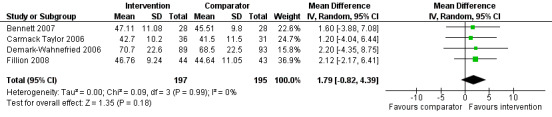
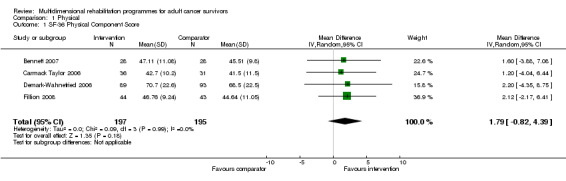
Main results: Twelve RCTs (comprising 1669 participants) met the eligibility criteria. We judged five studies to have a moderate risk of bias and assessed the remaining seven as having a high risk of bias. It was possible to include SF-36 physical health component scores from five studies in a meta-analysis. Participating in a MDRP was associated with an increase in SF-36 physical health component scores (mean difference (MD) 2.22, 95% confidence interval (CI) 0.12 to 4.31, P = 0.04). The findings from the narrative analysis suggested that MDRPs with a single domain or outcome focus appeared to be more successful than programmes with multiple aims. In addition, programmes that comprised participants with different types of cancer compared to cancer site-specific programmes were more likely to show positive improvements in physical outcomes. The most effective mode of service delivery appeared to be face-to-face contact supplemented with at least one follow-up telephone call. There was no evidence to indicate that MDRPs which lasted longer than six months improved outcomes beyond the level attained at six months. In addition, there was no evidence to suggest that services were more effective if they were delivered by a particular type of health professional.
Authors' conclusions: There is some evidence to support the effectiveness of brief, focused MDRPs for cancer survivors. Rigorous and methodologically sound clinical trials that include an economic analysis are required.
Conflict of interest statement
None
Figures



Update of
References
References to studies included in this review
Bai 2004 {published data only}
-
- Bai S, Ma C, Liu Y, Xue W, Luo M, Ou Z. Effects of cognitive behavior intervention and cinesiateics on the quality of life of patients with nasopharyngeal carcinoma after radiotherapy. Chinese Journal of Clinical Rehabilitation 2004;8(29):6312‐3.
Bennett 2007 {published data only}
-
- Bennett JA, Lyons KS, Winters‐Stone K, Nail LM, Scherer J. Motivational interviewing to increase physical activity in long‐term cancer survivors. Nursing Research 2007;56(1):18‐27. - PubMed
Berglund 2007 {published data only}
-
- Berglund G, Petersson LM, Eriksson KC, Wallenius I, Roshanai A, Nordin KM, et al. "Between Men": a psychosocial rehabilitation programme for men with prostate cancer. Acta Oncologica 2007;46(1):83‐9. - PubMed
Carmack Taylor 2006 {published data only}
-
- Carmack Taylor CL, Demoor C, Smith MA, Dunn AL, Basen‐Engquist K, Nielsen I, et al. Active for life after cancer: a randomized trial examining a lifestyle physical activity program for prostate cancer patients. Psycho‐Oncology 2006;15(10):847‐62. - PubMed
Daubenmier 2006 {published data only}
-
- Daubenmier JJ, Weidner G, Marlin R, Crutchfield L, et al. Lifestyle and health related quality of life of men with prostate cancer managed with active surveillance. Urology 2006;67(1):125‐130. - PubMed
Demark‐Wahnefried 2006 {published data only}
Demark‐Wahnefried 2007 {published data only}
-
- Demark‐Wahnefried W, Clipp EC, Lipkus IM, Lobach D, Snyder DC, Sloane R, et al. Main outcomes of the FRESH START Trial: a sequentially tailored, diet and exercise mailed print intervention among breast and prostate cancer survivors. Journal of Clinical Oncology 2007;25(19):2709‐18. - PubMed
Fillion 2008 {published data only}
-
- Fillion L, Gagnon P, Leblond F, Gelinas C, Savard J, Dupuis R, et al. A brief intervention for fatigue management in breast cancer survivors. Cancer Nursing 2008;31(2):145‐59. - PubMed
Giesler 2005 {published data only}
-
- Giesler RB, Given B, Given RW, Rawl S, Monaghan P, Burns B, et al. Improving the quality of life of patients with prostate carcinoma: a randomized trial testing the efficacy of a nurse‐driven intervention. Cancer 2005;104(4):752‐62. - PubMed
Lepore 1999 {published data only}
-
- Lepore SJ, Helgeson VS. Psychoeducational support group enhances quality of life after prostate cancer. Cancer Research Therapy and Control 1999;8(1‐2):81‐91.
May 2008a {published data only}
-
- Korstjens I, May AM, Weert E, Mesters I, Tan F, Ros WJG, et al. Quality of life after self‐management cancer rehabilitation: a randomized controlled trial comparing physical and cognitive‐behavioral training versus physical training. Psychosomatic Medicine 2008;70(4):422‐9. - PubMed
-
- May AM, Korstjens I, Weert E, Borne B, Hoekstra‐Weebers J, et al. Long‐term effects on cancer survivors' quality of life of physical training versus physical training combined with cognitive behavioral therapy: results from a randomised trial. Supportive Care in Cancer 2009;17(6):653‐63. - PubMed
-
- May AM, Weert E, Korstjens I, Hoekstra‐Weebers JEHM, Schans CP, Zonderland ML, et al. Improved physical fitness of cancer survivors: a randomised controlled trial comparing physical training with physical and cognitive‐behavioural training. Acta Oncologica 2008;47(5):825‐34. - PubMed
-
- Weert E, May AM, Korstjens I, Post WJ, Schans CP, Borne B, et al. Cancer‐related fatigue and rehabilitation: a randomised controlled multi‐centre trial comparing physical training combined with cognitive behavioral therapy with physical training only and with no intervention.. Physical Therapy 2010;90:1413‐25. - PubMed
Rogers 2009 {published data only}
-
- Rogers LQ, Hopkins‐Price P, Vicari S, Pamenter R, Courneya KS, Markwell S, et al. A randomised trial to increase physical activity in breast cancer survivors. Medicine and Science in Sport and Exercise 2009;41(4):935‐46. - PubMed
References to studies excluded from this review
Berglund 1994 {published data only}
-
- Berglund G, Bolund C, Gustafsson U‐L, Sjoden P‐O. A randomized study of a rehabilitation program for cancer patients: the 'Starting again' group. Psycho‐Oncology 1994;3(2):109‐20.
Bloom 2008 {published data only}
-
- Bloom JR. Addressing the needs of young breast cancer survivors at the 5 year milestone: can a short‐term, low intensity intervention produce change?. Journal of Cancer Survivorship 2008;2(3):190‐240. - PubMed
Cain 1986 {published data only}
-
- Cain EN, Kohorn EI, Quinlan DM, Latimer K, Schwartz PE. Psychosocial benefits of a cancer support group. Cancer 1986;57:183‐9. - PubMed
Cho 2006 {published data only}
-
- Cho O‐H, Yoo Y‐S, Kim N‐C. Efficacy of comprehensive group rehabilitation for women with early breast cancer in South Korea. Nursing and Health Sciences 2006;8(3):140‐6. - PubMed
Courneya 2003 {published data only}
-
- Courneya KS, Friedenreich CM, Sela RA, Quinney HA, Rhodes RE, Handman M. The group psychotherapy and home‐based physical exercise (Group‐Hope) trial in cancer survivors: physical fitness and quality of life outcomes. Psycho‐Oncology 2003;12(4):357‐74. - PubMed
Cunningham 1989 {published data only}
-
- Cunningham AJ, Tocco EK. A randomized trial of group psychoeducational therapy for cancer patients. Patient Education and Counselling 1989;14(2):101‐14.
Fan 2006 {published data only}
-
- Fan J‐C, He X‐M, Li J‐Y. Effects of combined interventional treatment on quality of life in patients with nasopharyngeal carcinoma. Chinese Journal of Clinical Rehabilitation 2006;10(20):16‐8.
Hartmann 2007 {published data only}
-
- Hartmann U, Muche R, Reuss‐Borst M. Effects of a step‐by‐step inpatient rehabilitation programme on quality of life in breast cancer patients. a prospective randomised study. Onkologie 2007;30(4):177‐82. - PubMed
Heim 2007 {published data only}
-
- Heim ME, v d Malsburg ML, Niklas A. Randomized controlled trial of a structured training program in breast cancer patients with tumor‐related chronic fatigue. Onkologie 2007;30(8‐9):429‐34. - PubMed
Johansson 2008 {published data only}
van Weert 2005 {published data only}
-
- Weert E, Hoekstra‐Weebers J, Grol B, Otter R, Arendzen HJ, Postema K, et al. A multidimensional cancer rehabilitation program for cancer survivors: effectiveness on health‐related quality of life. Journal of Psychosomatic Research 2005;58(6):485‐96. - PubMed
Zhang Tong 2005 {published data only}
-
- Zhang T, Chang X‐M, He Y‐G, Huang H‐X, Fan K‐S. Effects of rehabilitation therapy in relieving pain and improving quality of life in patients with advanced cancer. Chinese Journal of Clinical Rehabilitation 2005;9(40):59‐61.
Additional references
Abraham 2008
-
- Abraham C, Michie S. A taxonomy of behavior change techniques used in interventions. Health Psychology 2008;27(3):379‐87. - PubMed
Aziz 2002
-
- Aziz N. Cancer survivorship research: challenge and opportunity. Journal of Nutrition 2002;132(Suppl 11):3494S‐503S. - PubMed
Aziz 2003
-
- Aziz NM, Rowland JH. Trends and advances in cancer survivorship research: challenge and opportunity. Seminars in Radiation Oncology 2003;13(3):248‐66. - PubMed
Berglund 2003
-
- Berglund G, Petersson LM, Eriksson KR, Haggman M. "Between Men": patient perceptions and priorities in a rehabilitation program for men with prostate cancer. Patient Education & Counseling 2003;49(3):285‐92. - PubMed
Bultz 2008
-
- Bultz BD, Carlson LE. Emotional distress: the sixth vital sign in cancer care. Journal of Clinical Oncology 2008;15(2):93‐5. - PubMed
Cancer Reform Strategy 2007
-
- Department of Health. Cancer Reform Strategy. www.dh.gov.uk/en/Healthcare/NationalServiceFrameworks/Cancer/index.htm 2007.
Cardy 2006
-
- Cardy P, Corner J, Evans J. Worried Sick: The Emotional Impact of Cancer. London: Macmillan Cancer Support, 2006.
Carmack 2004
-
- Carmack Taylor CL, Smith MA, Moor C, Dunn AL, Pettaway C, Sellin R, et al. Quality of life intervention for prostate cancer patients: design and baseline characteristics of the active for life after cancer trial. Controlled Clinical Trials 2004;25(3):265‐85. - PubMed
Carmack 2007
-
- Carmack Taylor CL, Moor C, Basen‐Engquist K, Smith MA, Dunn AL, Badr H, et al. Moderator analyses of participants in the active for life after cancer trial: implications for physical activity group intervention studies. Annals of Behavioral Medicine 2007;33(1):99‐104. - PubMed
Cockle‐Hearne 2010
-
- Cockle‐Hearne J, Faithfull S. Self‐management for men surviving prostate cancer: a review of behavioural and psychosocial interventions to understand what strategies can work, for whom and in what circumstances. Psycho‐oncology 2010;19(9):909‐22. - PubMed
Corner 2007
-
- Corner J, Richardson A. Cancer Survivorship Briefing Paper. http://www.macmillan.org.uk/Documents/GetInvolved/Campaigns/Campaigns/ca... 2007.
Cramp 2012
CRUK 2008
-
- Cancer Research UK. Cancer Survival Rates for Patients Diagnosed 1996‐1999. www.cancerresearchuk.org/cancerstats/survival/latestrates (accessed September 2008).
CRUK, 2011
-
- Cancer Research UK. Cancer Incidence Statistics. http://info.cancerresearchuk.org/prod_consump/groups/cr_common/@nre/@sta... 2011.
Davies 2010
De Boer 2011
Demark‐Wahnefried 2003
-
- Demark‐Wahnefried W, Clipp EC, McBride C, Lobach DF, Lipkus I, Peterson B, et al. Design of FRESH START: a randomized trial of exercise and diet among cancer survivors. Medicine and Science in Sports and Exercise 2003;35(3):415‐24. - PubMed
Demark‐Wahnefried 2003a
-
- Demark‐Wahnefried W, Morey MC, Clipp EC, Pieper CF, Snyder DC, Sloane R, et al. Leading the way in exercise and diet (project lead): intervening to improve function among older breast and prostate cancer survivors. Controlled Clinical Trials 2003;24(2):206‐3. - PubMed
Demark‐Wahnefried 2005
Edwards 2008
Fawzy 1993
-
- Fawzy FI, Fawzy NW, Hyun CS, Elashoff R, Guthrie D, Fahey JL. Malignant melanoma: effects of an early structured psychiatric intervention, coping and affective state on recurrence and survival 6 years later. Archives of General Psychiatry 1993;50:681‐9. - PubMed
Fong 2012
Fors 2011
-
- Fors EA, Bertheussen GF, Thune I, Juvet LK, Elvaas IK, Oldervoll L, et al. Psychosocial interventions as part of breast cancer rehabilitation programs? Results from a systematic review. Psycho‐Oncology 2011;20(9):909‐18. - PubMed
Frattaroli 2008
-
- Frattaroli J, Weidner G, Dnistrian AM, Kemp C, et al. Clinical events in prostate cancer lifestyle trial: results from two years follow‐up. Urology 2008;72(6):1319‐1323. - PubMed
Galway 2012
Hewitt 2006
-
- Hewitt M, Ganz PA. From Cancer Patient to Cancer Survivor: Lost in Transition. Washington, D.C.: The National Academies Press, 2006.
Higgins 2011
-
- Higgins JPT, Green S (editors). Cochrane Handbook for Systematic Reviews of Interventions Version 5.1.0 [updated March 2011]. The Cochrane Collaboration, 2011. Available from www.cochrane‐handbook.org.
Hodges 2011
-
- Hodges LJ, Walker J, Kliboer AM, Ramirez AJ, Richardson A, Velikova G, et al. What is a psychological intervention? A meta‐review and practical proposal. Psycho‐Oncology 2011;20(5):470‐8. - PubMed
Jefford 2008
-
- Jefford M, Karahalios E, Pollard A, Baravelli C, Carey M, Franklin J, et al. Survivorship issues following treatment completion ‐ results from focus groups with Australian cancer survivors and health professionals. Journal of Cancer Survivorship 2008;2:20‐32. - PubMed
Jolliffe 2001
Khan 2008
Korstjens 2008
-
- Korstjens I, May AM, Weert E, Tan F, et al. Quality of life after self‐management cancer rehabilitation: a randomised controlled trial comapring physical and cognitive‐behavioral training versus physical training. Psychosomatic Medicine 2008;70(4):422‐429. - PubMed
Lacasse 2006
Louie 2010
Markes 2006
May 2008b
-
- May AM, Duivenvoorden HJ, Korstjens I, Weert E, Hoekstra‐Weebers J, Borne B, et al. The effect of group cohesion on rehabilitation outcome in cancer survivors. Psycho‐Oncology 2008;17(9):917‐25. - PubMed
May 2009
-
- May AM, Korstjens I, Weert E, Borne B, et al. Long‐term effects on cancer survivors' quality of life of of ohysical training versus physical training combined with cognitive behavioral therapy: results from a randomised trial.. Supportive Care in Cancer 2009;17(6):653‐663. - PubMed
Mewes 2012
Mosher 2008
NCCS 2009
-
- NCCS. National Coalition for Cancer Survivorship. http://www.canceradvocacy.org/ 2009.
NCI 2004
-
- National Cancer Institute. About Survivorship Research: Survivorship Definitions. http://cancercontrol.cancer.gov/ocs/definitions.html (accessed 17 September 2008).
Ornish 2005
-
- Ornish D, Weidner G, Fair WR, Marlin, et al. Intensive lifestyle changes may affect the progression of prostate cancer. Journal of Urology 2005;174(3):1065‐1069. - PubMed
Pettigrew 2006
-
- Pettigrew M, Roberts H. Systematic Reviews in the Social Sciences: A Practical Guide. Oxford: Blackwell, 2006.
RevMan 2011 [Computer program]
-
- The Nordic Cochrane Centre, The Cochrane Collaboration. Review Manager (RevMan). Version 5.1. Copenhagen: The Nordic Cochrane Centre, The Cochrane Collaboration, 2011.
Roper 1987
-
- Roper N. Pocket Medical Dictionary. 14th Edition. Edinburgh: Churchill Livingstone, 1987.
Schroevers 2006
-
- Schroevers M, Ranchor AV, Sanderman R. Adjustment to cancer in the 8 years following diagnosis: a longitudinal study comparing cancer survivors with healthy individuals. Social Science and Medicine 2006;63(6):598‐610. - PubMed
Schultz 2003
-
- Schultz PN, Beck ML, Stava C, Vassilopoulou‐Sellin R. Health profiles in 5,836 long‐term cancer survivors. International Journal of Cancer 2003;104(4):488‐95. - PubMed
Snyder 2008
-
- Snyder DC, Sloane R, Lobach D, Lipkus P, Peterson B, Kraus W, et al. Differences in baseline characteristics and outcomes at 1‐ and 2‐year follow‐up of cancer survivors accrued via self‐referral versus cancer registry in the FRESH START Diet and exercise trial. Cancer Epidemiology, Biomarkers & Prevention 2008;17(5):1288‐94. - PMC - PubMed
Speck 2010
-
- Speck RM, Courneya KS, Masse LC, Duval S, Schmitz KH. An update of controlled physical activity trials in cancer survivors: a systematic review and meta‐analysis. Journal of Cancer Survivorship 2010;4(2):87‐100. - PubMed
Spence 2010
-
- Spence RR, Heesch KC, Brown WJ. Exercise and cancer rehabilitation: a systematic review. Cancer Treatment Reviews 2010;36(2):185‐94. - PubMed
Turner‐Stokes 2005
van Weert 2010
-
- Weert E, May A, Korstjens, et al. Cancer‐related fatigue and rehabilitation: a randomised controlled multi‐centre trial comparing physical training combined with cognitive behavioral therapy with physical training only and with no intervention. Physical therapy 2010;90:1413‐1425. - PubMed
Ware 1993
-
- Ware JE, Snow KK, Kosinski M, Gandek B. SF‐36 Health Survey Manual and Interpretation Guide. Boston: New England Medical Centre, 1993.
Publication types
MeSH terms
Grants and funding
LinkOut - more resources
Full Text Sources
Other Literature Sources
Medical
Miscellaneous
