


Factors predicting reversion from mild cognitive impairment to normal cognitive functioning: a population-based study
- PMID: 23544083
- PMCID: PMC3609866
- DOI: 10.1371/journal.pone.0059649
Factors predicting reversion from mild cognitive impairment to normal cognitive functioning: a population-based study
Abstract
Introduction: Mild cognitive impairment (MCI) is associated with an increased risk of developing dementia. However, many individuals diagnosed with MCI are found to have reverted to normal cognition on follow-up. This study investigated factors predicting or associated with reversion from MCI to normal cognition.
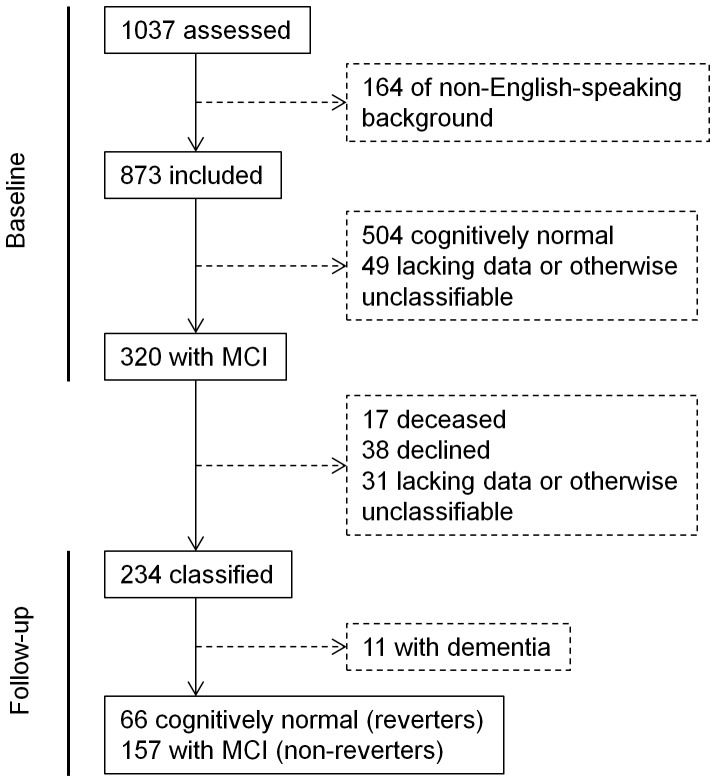
Methods: Our analyses considered 223 participants (48.9% male) aged 71-89 years, drawn from the prospective, population-based Sydney Memory and Ageing Study. All were diagnosed with MCI at baseline and subsequently classified with either normal cognition or repeat diagnosis of MCI after two years (a further 11 participants who progressed from MCI to dementia were excluded). Associations with reversion were investigated for (1) baseline factors that included diagnostic features, personality, neuroimaging, sociodemographics, lifestyle, and physical and mental health; (2) longitudinal change in potentially modifiable factors.
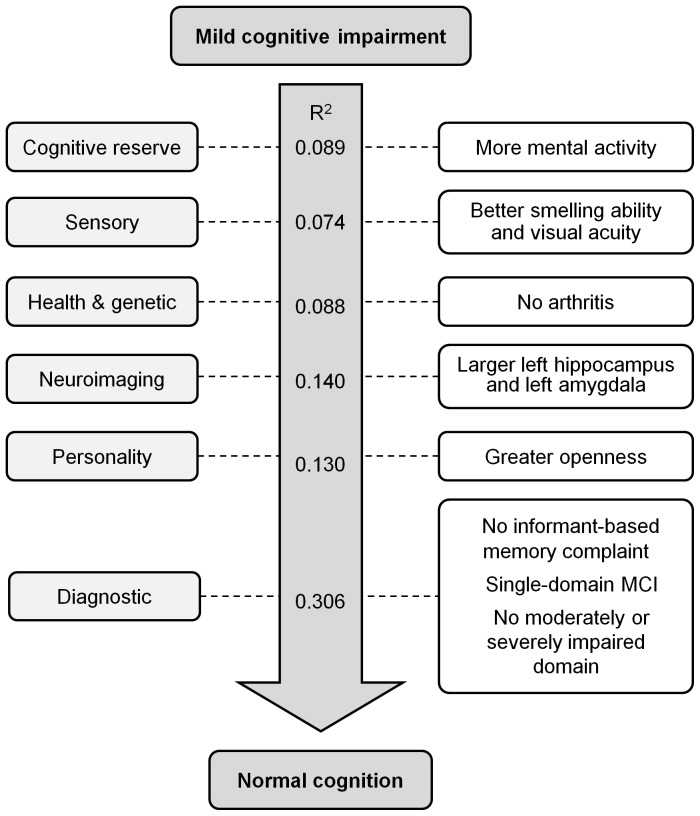
Results: There were 66 reverters to normal cognition and 157 non-reverters (stable MCI). Regression analyses identified diagnostic features as most predictive of prognosis, with reversion less likely in participants with multiple-domain MCI (p = 0.011), a moderately or severely impaired cognitive domain (p = 0.002 and p = 0.006), or an informant-based memory complaint (p = 0.031). Reversion was also less likely for participants with arthritis (p = 0.037), but more likely for participants with higher complex mental activity (p = 0.003), greater openness to experience (p = 0.041), better vision (p = 0.014), better smelling ability (p = 0.040), or larger combined volume of the left hippocampus and left amygdala (p<0.040). Reversion was also associated with a larger drop in diastolic blood pressure between baseline and follow-up (p = 0.026).
Discussion: Numerous factors are associated with reversion from MCI to normal cognition. Assessing these factors could facilitate more accurate prognosis of individuals with MCI. Participation in cognitively enriching activities and efforts to lower blood pressure might promote reversion.
Conflict of interest statement
Figures
References
-
- Petersen RC, Smith GE, Waring SC, Ivnik RJ, Tangalos EG, et al. (1999) Mild cognitive impairment: clinical characterization and outcome. Arch Neurol 56: 303–308. - PubMed
-
- Matthews FE, Stephan BC, McKeith IG, Bond J, Brayne C (2008) Two-year progression from mild cognitive impairment to dementia: to what extent do different definitions agree? J Am Geriatr Soc 56: 1424–1433. - PubMed
-
- Ritchie K, Artero S, Touchon J (2001) Classification criteria for mild cognitive impairment: a population-based validation study. Neurology 56: 37–42. - PubMed
Publication types
MeSH terms
Substances
LinkOut - more resources
Full Text Sources
Other Literature Sources
Medical
