. 2013;8(3):e59660.
doi: 10.1371/journal.pone.0059660. Epub 2013 Mar 27.

Genetic structure of wild bonobo populations: diversity of mitochondrial DNA and geographical distribution

Affiliations

Genetic structure of wild bonobo populations: diversity of mitochondrial DNA and geographical distribution

Yoshi Kawamoto et al. PLoS One. 2013.

Abstract

Bonobos (Pan paniscus) inhabit regions south of the Congo River including all areas between its southerly tributaries. To investigate the genetic diversity and evolutionary relationship among bonobo populations, we sequenced mitochondrial DNA from 376 fecal samples collected in seven study populations located within the eastern and western limits of the species' range. In 136 effective samples from different individuals (range: 7-37 per population), we distinguished 54 haplotypes in six clades (A1, A2, B1, B2, C, D), which included a newly identified clade (D). MtDNA haplotypes were regionally clustered; 83 percent of haplotypes were locality-specific. The distribution of haplotypes across populations and the genetic diversity within populations thus showed highly geographical patterns. Using population distance measures, seven populations were categorized in three clusters: the east, central, and west cohorts. Although further elucidation of historical changes in the geological setting is required, the geographical patterns of genetic diversity seem to be shaped by paleoenvironmental changes during the Pleistocene. The present day riverine barriers appeared to have a weak effect on gene flow among populations, except for the Lomami River, which separates the TL2 population from the others. The central cohort preserves a high genetic diversity, and two unique clades of haplotypes were found in the Wamba/Iyondji populations in the central cohort and in the TL2 population in the eastern cohort respectively. This knowledge may contribute to the planning of bonobo conservation.


Conflict of interest statement

Competing Interests: The authors have declared that no competing interests exist.

Figures

Figure 1
Figure 1. Study area and a population tree.
Right map shows geographical location of study populations in DRC. Rivers indicated here are based on limnological study . Left is a population tree constructed by UPGMA method with net population distances estimated from calculation of FST distances.
Figure 2
Figure 2. Molecular phylogeny of haplotypes and their distribution in study populations.
Left is a tree constructed by neighbor-joining (NJ) method. Three numbers on a tree path indicate percent bootstrap values (1,000 replications) obtained from statistical assessments by neighbor-joining (NJ), maximum likelihood (ML) and maximum parsimony (MP) algorithms in order. Branches corresponding to partitions reproduced in less than 70% bootstrap replicates were collapsed. Each of black bars aside the tree shows a mtDNA clade inferred from the cluster analyses. Right score illustration summarized distribution of mtDNA haplotypes in study populations. Numbers with closed, open circles and without circle mean the observed number of male, female and sex-unknown samples, respectively, for each study population with different color.
Figure 3
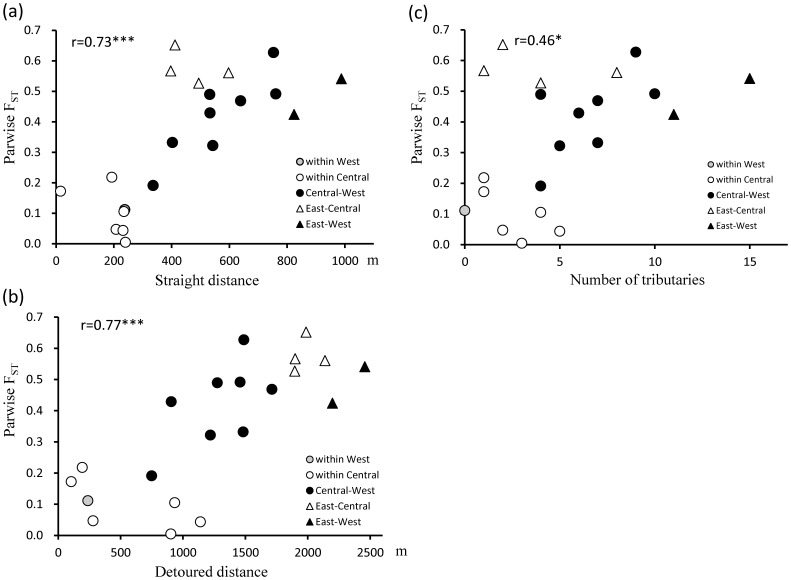
Figure 3. Relation between genetic distance (FST) and geographical indices.
Each pair of seven populations, in all 21 pairs, is dotted as a different symbol according to combination of cohorts. (a) Geographical distance between two populations was measured as a straight line. (b) Geographical distance was measured by detouring headwater of big tributaries or lakes. (c) Number of tributaries on the straight-line between two populations. *p<0.05, ***p<0.001.

References

    1. Zsurka G, Kudina T, Peeva V, Hallmann K, Elger CE, et al. (2010) Distinct patterns of mitochondrial genome diversity in bonobos (Pan paniscus) and humans. BMC Evol Biol 10: 270. - PMC - PubMed
    1. Fischer A, Prüfer K, Good JM, Halbwax M, Wiebe V, et al. (2011) Bonobos fall within the genomic variation of chimpanzees. PLoS ONE 6: e21605. - PMC - PubMed
    1. Hey J (2010) The divergence of chimpanzee species and subspecies as revealed in multipopulation isolation-with-migration analyses. Mol Biol Evol 27: 921–933. - PMC - PubMed
    1. Caswell JL, Mallick S, Richter DJ, Neubauer J, Schirmer C, et al. (2008) Analysis of chimpanzee history based on genome sequence alignments. PLoS Genet 4: e1000057. - PMC - PubMed
    1. Won YJ, Hey J (2005) Divergence population genetics of chimpanzees. Mol Biol Evol 22: 297–307. - PubMed

Publication types

Substances

LinkOut - more resources