


Guided self-help for the treatment of pediatric obesity
- PMID: 23545372
- PMCID: PMC3639455
- DOI: 10.1542/peds.2012-2204
Guided self-help for the treatment of pediatric obesity
Abstract
Background and objective: Clinic-based programs for childhood obesity are not available to a large proportion of the population. The purpose of this study was to evaluate the efficacy of a guided self-help treatment of pediatric obesity (GSH-PO) compared with a delayed treatment control and to evaluate the impact of GSH-PO 6-months posttreatment.
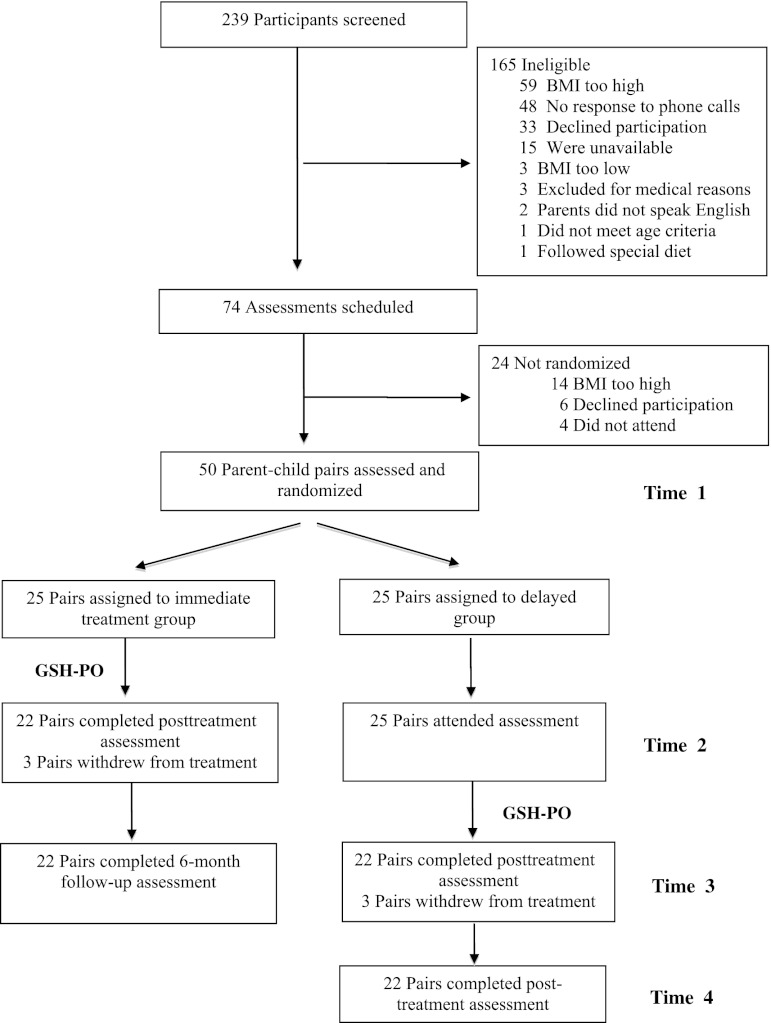
Methods: Fifty overweight or obese 8- to 12-year-old children and their parents were randomly assigned to immediate treatment or to delayed treatment. The GSH-PO includes 12 visits over 5 months and addresses key components included in more intensive clinic-based programs. Children and parents in the immediate treatment arm were assessed at time 1 (T1), participated in GSH-PO between T1 and T2, and completed their 6-month posttreatment assessment at T3. Children and parents in the delayed treatment arm were assessed at T1, participated in GSH-PO between T2 and T3, and completed their 6-month posttreatment assessment at T4. The main outcome measures were BMI, BMI z score, and percentage overweight (%OW).
Results: Children in the immediate treatment GSH-PO arm decreased their BMI significantly more than did the delayed treatment arm (BMI group × time = -1.39; P < .001). Similar results were found for BMI z score and %OW. At the 6-month posttreatment assessment, changes resulting from GSH-PO were maintained for BMI z score and %OW but not BMI (BMI time effect = -0.06, not significant; BMI z score time effect = -0.10, P < .001; %OW time effect = -4.86, P < .05).
Conclusions: The GSH-PO showed initial efficacy in decreasing BMI for children in this study. Additional efficacy and translational studies are needed to additionally evaluate GSH-PO.
Trial registration: ClinicalTrials.gov NCT01145833.
Keywords: childhood; guided self-help; obesity; treatment.
References
-
- Hedley AA, Ogden CL, Johnson CL, Carroll MD, Curtin LR, Flegal KM. Prevalence of overweight and obesity among US children, adolescents, and adults, 1999-2002. JAMA. 2004;291(23):2847–2850 - PubMed
-
- Epstein LH. Family-based behavioural intervention for obese children. Int J Obes Relat Metab Disord. 1996;20(suppl 1):S14–S21 - PubMed
-
- Epstein LH, Valoski A, Wing RR, McCurley J. Ten-year outcomes of behavioral family-based treatment for childhood obesity. Health Psychol. 1994;13(5):373–383 - PubMed
-
- Epstein LH, McCurley J, Wing RR, Valoski A. Five-year follow-up of family-based behavioral treatments for childhood obesity. J Consult Clin Psychol. 1990;58(5):661–664 - PubMed
-
- Dietz WH, Nelson A. Barriers to the treatment of childhood obesity: a call to action. J Pediatr. 1999;134(5):535–536 - PubMed
