


Chemosignals, hormones and mammalian reproduction
- PMID: 23545474
- PMCID: PMC3667964
- DOI: 10.1016/j.yhbeh.2013.03.011
Chemosignals, hormones and mammalian reproduction
Abstract
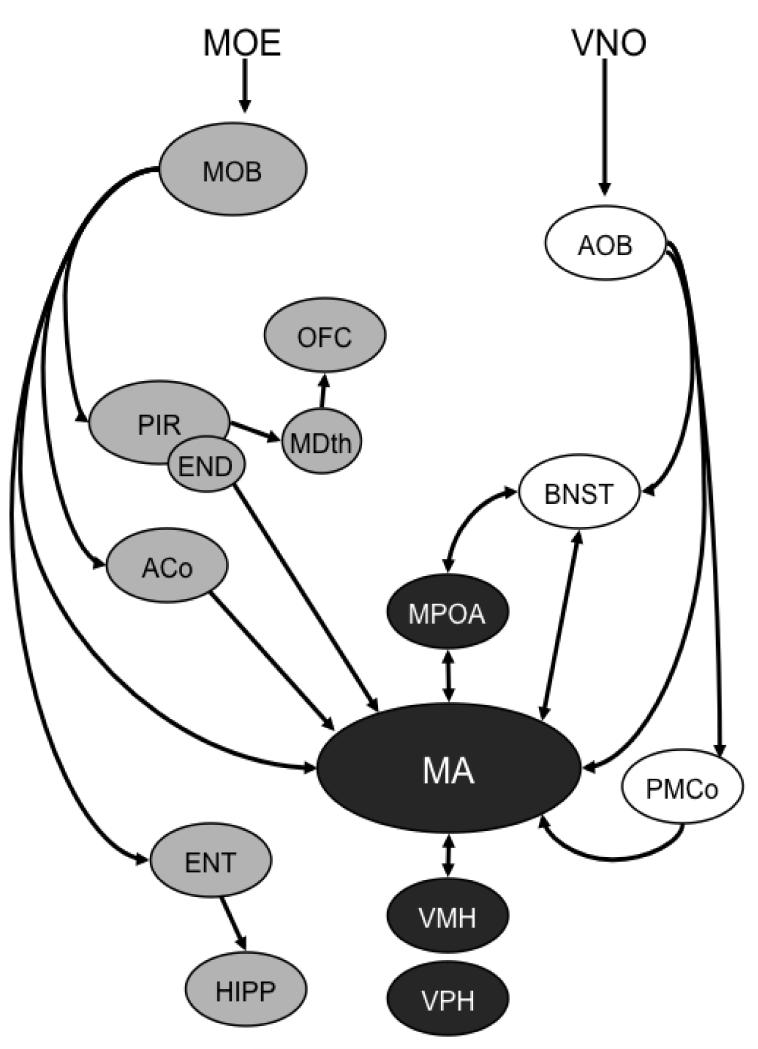
Many mammalian species use chemosignals to coordinate reproduction by altering the physiology and behavior of both sexes. Chemosignals prime reproductive physiology so that individuals become sexually mature and active at times when mating is most probable and suppress it when it is not. Once in reproductive condition, odors produced and deposited by both males and females are used to find and select individuals for mating. The production, dissemination and appropriate responses to these cues are modulated heavily by organizational and activational effects of gonadal sex steroids and thereby intrinsically link chemical communication to the broader reproductive context. Many compounds have been identified as "pheromones" but very few have met the expectations of that term: a unitary, species-typical substance that is both necessary and sufficient for an experience-independent behavioral or physiological response. In contrast, most responses to chemosignals are dependent or heavily modulated by experience, either in adulthood or during development. Mechanistically, chemosignals are perceived by both main and accessory (vomeronasal) olfactory systems with the importance of each system tied strongly to the nature of the stimulus rather than to the response. In the central nervous system, the vast majority of responses to chemosignals are mediated by cortical and medial amygdala connections with hypothalamic and other forebrain structures. Despite the importance of chemosignals in mammals, many details of chemical communication differ even among closely related species and defy clear categorization. Although generating much research and public interest, strong evidence for the existence of a robust chemical communication among humans is lacking.
Copyright © 2013 Elsevier Inc. All rights reserved.
Figures
References
-
- Agmo A. Unconditioned sexual incentive motivation in the male Norway rat (Rattus norvegicus) J Comp Psychol. 2003;117:3–14. - PubMed
-
- Agustin-Pavon C, Martinez-Ricos J, Martinez-Garcia F, Lanuza E. Effects of dopaminergic drugs on innate pheromone-mediated reward in female mice: a new case of dopamine-independent “liking.”. Behav Neurosci. 2007;121:920–932. - PubMed
-
- Agustin-Pavon C, Martinez-Ricos J, Martinez-Garcia F, Lanuza E. Sex versus sweet: opposite effects of opioid drugs on the reward of sucrose and sexual pheromones. Behav Neurosci. 2008;122:416–425. - PubMed
-
- Alberts JR, Brunjes PC. Ontogeny of thermal and olfactory determinants of huddling in the rat. Journal of comparative and physiological psychology. 1978;92:897–906. - PubMed
Publication types
MeSH terms
Substances
Grants and funding
LinkOut - more resources
Full Text Sources
Other Literature Sources
Miscellaneous
