. 2013 Aug;62(8):2773-83.
doi: 10.2337/db12-1306. Epub 2013 Apr 1.

Early postnatal nutrition determines adult physical activity and energy expenditure in female mice

Affiliations

Early postnatal nutrition determines adult physical activity and energy expenditure in female mice

Ge Li et al. Diabetes. 2013 Aug.

Abstract

Decades of research in rodent models has shown that early postnatal overnutrition induces excess adiposity and other components of metabolic syndrome that persist into adulthood. The specific biologic mechanisms explaining the persistence of these effects, however, remain unknown. On postnatal day 1 (P1), mice were fostered in control (C) or small litters (SL). SL mice had increased body weight and adiposity at weaning (P21), which persisted to adulthood (P180). Detailed metabolic studies indicated that female adult SL mice have decreased physical activity and energy expenditure but not increased food intake. Genome-scale DNA methylation profiling identified extensive changes in hypothalamic DNA methylation during the suckling period, suggesting that it is a critical period for developmental epigenetics in the mouse hypothalamus. Indeed, SL mice exhibited subtle and sex-specific changes in hypothalamic DNA methylation that persisted from early life to adulthood, providing a potential mechanistic basis for the sustained physiological effects. Expression profiling in adult hypothalamus likewise provided evidence of widespread sex-specific alterations in gene expression. Together, our data indicate that early postnatal overnutrition leads to a reduction in spontaneous physical activity and energy expenditure in females and suggest that early postnatal life is a critical period during which nutrition can affect hypothalamic developmental epigenetics.


Figures
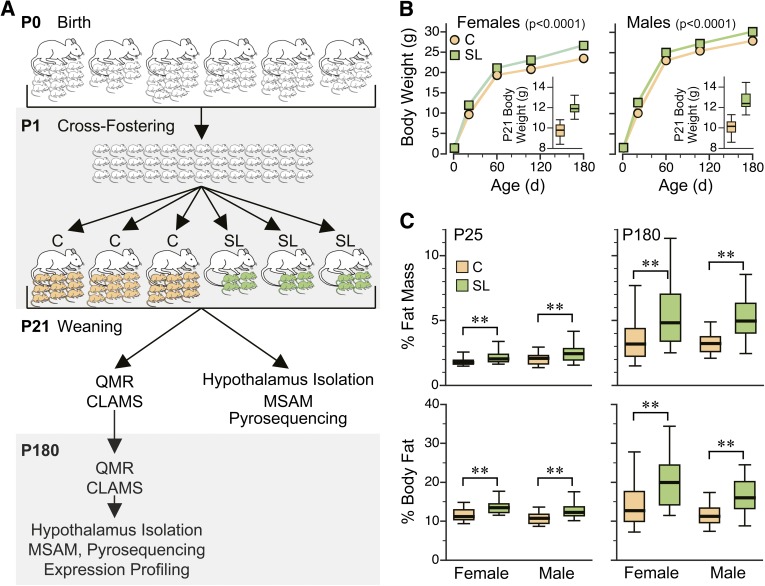
FIG. 1.
FIG. 1.
SL mice are persistently heavier and fatter than C mice. A: Overview of the litter size experiment. FVB mice were cross-fostered at P1 and randomly assigned to SL (green) or C (orange) litters. Quantitative magnetic resonance (QMR) and CLAMS measurements were performed after weaning (P21–P25) and at P180. Hypothalami were isolated at approximately P25 and P180. Four independent batches of SL and C mice were studied over the course of 2 years. B: Body weight of SL and C mice did not differ at P1 (P > 0.7). SL mice showed significantly higher body weight at P21 (insets), which was maintained to adulthood (P180) (P < 0.0001 in both females and males). Data are presented as means ± SEM of 20–94 mice in each group, sex, and age. (Error bars are smaller than symbols.) Box plots (insets) represent median (mid-line), 25th–75th percentiles (box), and 5th–95th percentiles (whiskers). C: Both male and female SL mice have higher adiposity at P25 (left panel) (P < 0.01). By P180 (right panel), group differences in body composition are much greater both in absolute terms (top panel) (P < 0.002) and as percent of body weight (bottom panel) (P < 0.004). Plots represent 20–30 mice of each group, sex, and age (**P < 0.01). d, days.
FIG. 2.
FIG. 2.
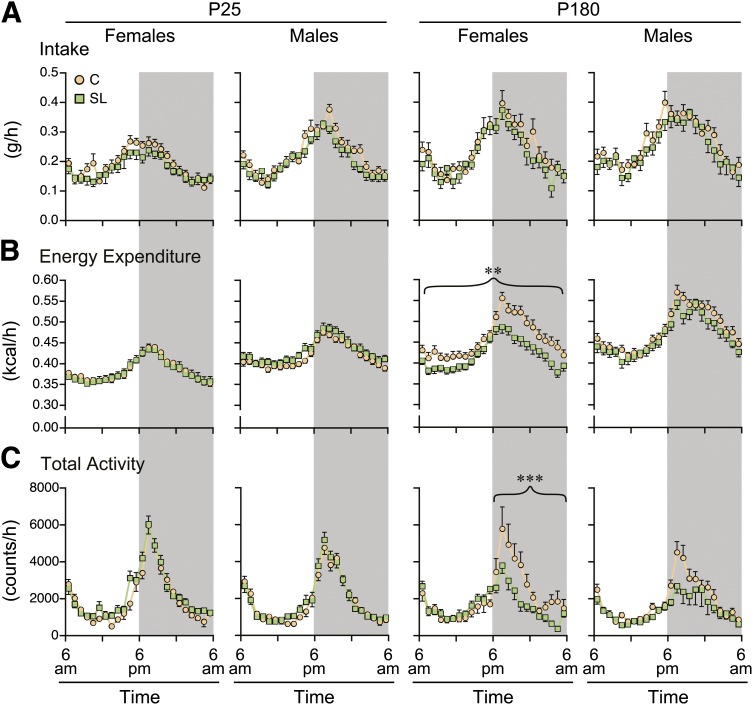
Adult SL females have reduced energy expenditure and physical activity. A: Hourly data on food intake are presented as least squares means, adjusting for lean mass and fat mass. Light/dark cycle is indicated by shading. Food intake of female and male SL mice did not differ from that of C mice at any age. A, B, and C: mean ± SEM of 20–30 mice in each group, sex, and age. B: Hourly data on energy expenditure are presented as least squares means, adjusting for lean mass and fat mass. No group differences were found at P25. At P180, SL females had significantly lower energy expenditure (P = 0.002), and this group difference was seen during both the light and dark cycles. SL males likewise tended to have lower energy expenditure at P180, but this difference was not statistically significant. C: Hourly data on physical activity are presented as least squares means, adjusting for lean mass and fat mass. No group differences were found at P25. At P180, SL females had significantly lower activity, specifically during the dark cycle (P = 0.0009). SL males likewise tended to have lower activity at P180, but this difference was not statistically significant (**P < 0.01; ***P < 0.001).
FIG. 3.
FIG. 3.
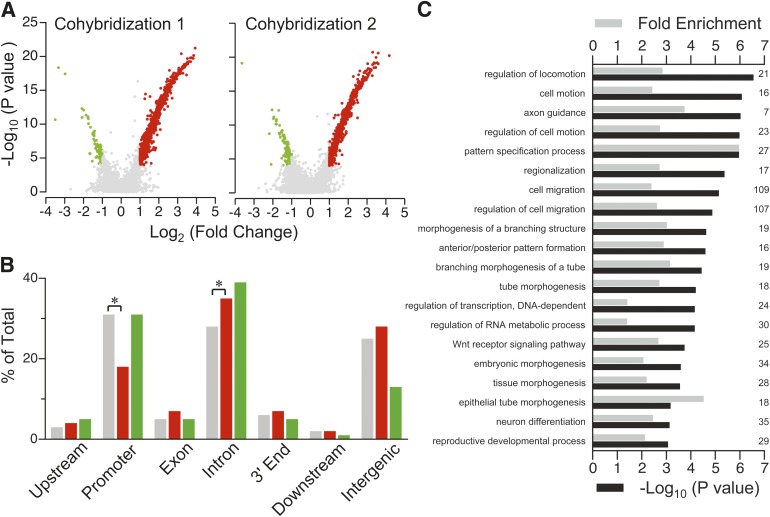
Extensive DNA methylation changes in the early postnatal hypothalamus. A: Volcano plots of the two independent P21 vs. P0 MSAM cohybridizations. Red dots indicate probes showing increased DNA methylation, green dots indicate probes showing decreased DNA methylation, and gray dots indicate no change. DNA methylation increases predominated; few genomic intervals showed decreased DNA methylation. B: Relative to all genomic intervals on the array (gray), those showing increased DNA methylation (red) were significantly enriched in introns and depleted in promoter regions (*P < 0.0001). The genomic distribution of intervals that lost methylation from P0 to P21 (green) did not differ from that of all intervals on array. C: Enriched gene ontology process categories (P < 10−3) of genes associated with methylation increases are almost all related to development. (Numbers on the right side indicate how many genes in the target set are associated with each ontology.)
FIG. 4.
FIG. 4.
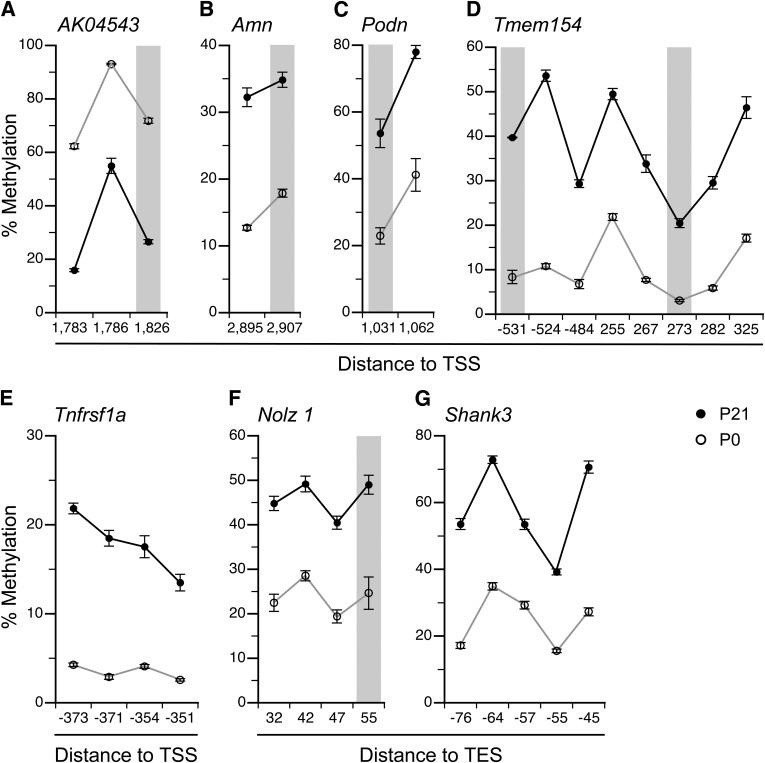
Validation of P21 vs. P0 MSAM by bisulfite pyrosequencing. A: At AK04543, the P0-P21 methylation decrease identified by MSAM was confirmed. At all other regions analyzed, methylation increases identified by MSAM were confirmed: Amn (B), Podn (C), Tmem154 (D), Tnfrsf1a (E), Nolz1 (F), and Shank3 (G). Gray columns indicate the SmaI/XmaI cut sites. Data are represented as means ± SEM of 5–10 mice per age. CpG site locations are provided relative to transcription start site (TSS) or transcription end site (TES).
FIG. 5.
FIG. 5.
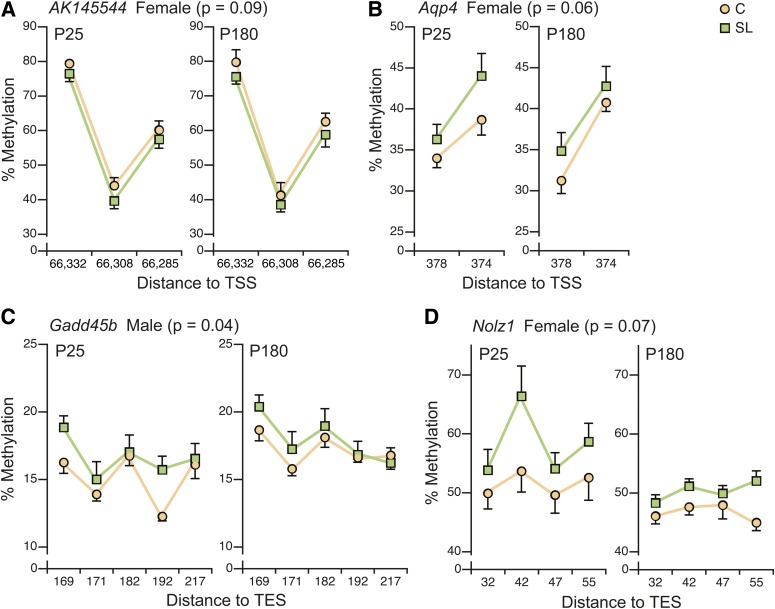
Early postnatal overnutrition causes persistent and sex-specific changes in hypothalamic DNA methylation. A: In SL females, a persistent reduction in DNA methylation was found at AK145544 (P = 0.09). At all other loci, DNA methylation was higher in SL mice: Aqp4 in females (P = 0.06) (B), Gadd45b in males (P = 0.04) (C), and Nolz1 in females (P = 0.07) (D). n = 12 per group per sex at P25, n = 6 per group per sex at P180. CpG site locations are provided relative to transcription start site (TSS) or transcription end site (TES).
FIG. 6.
FIG. 6.
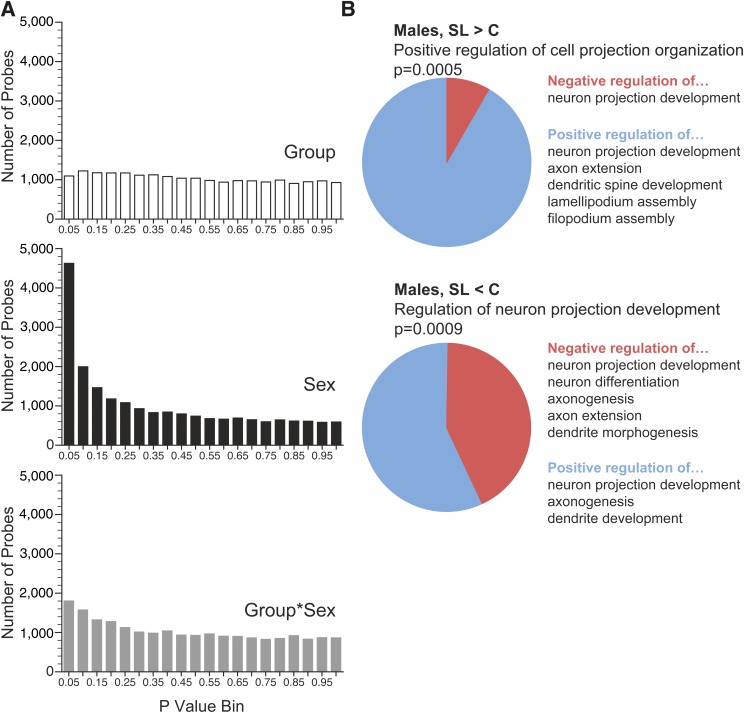
Evidence of sex-specific gene expression alterations in P180 SL hypothalamus. A: P value distribution of array probes by group, sex, and group × sex shows a strong effect of sex. Also, the group × sex interaction shows greater enrichment of low P values than group alone. B: Results of gene ontology analysis in males. Among both the 381 genes upregulated in SL males (SL > C) and the 351 downregulated in SL males (SL < C), the strongest gene ontology association related to development of neuronal projections. (See also Supplementary Table 5.)

References

    1. McAllister EJ, Dhurandhar NV, Keith SW, et al. Ten putative contributors to the obesity epidemic. Crit Rev Food Sci Nutr 2009;49:868–913 - PMC - PubMed
    1. Waterland RA, Michels KB. Epigenetic epidemiology of the developmental origins hypothesis. Annu Rev Nutr 2007;27:363–388 - PubMed
    1. Koletzko B, von Kries R, Closa R, et al. European Childhood Obesity Trial Study Group Lower protein in infant formula is associated with lower weight up to age 2 y: a randomized clinical trial. Am J Clin Nutr 2009;89:1836–1845 - PubMed
    1. Stettler N. Nature and strength of epidemiological evidence for origins of childhood and adulthood obesity in the first year of life. Int J Obes (Lond) 2007;31:1035–1043 - PubMed
    1. West DB, Diaz J, Woods SC. Infant gastrostomy and chronic formula infusion as a technique to overfeed and accelerate weight gain of neonatal rats. J Nutr 1982;112:1339–1343 - PubMed

Publication types