Review
. 2013 Apr 1:10:43.
doi: 10.1186/1742-2094-10-43.

Neuroinflammation and psychiatric illness

Affiliations
Review

Neuroinflammation and psychiatric illness

Souhel Najjar et al. J Neuroinflammation. .

Abstract

Multiple lines of evidence support the pathogenic role of neuroinflammation in psychiatric illness. While systemic autoimmune diseases are well-documented causes of neuropsychiatric disorders, synaptic autoimmune encephalitides with psychotic symptoms often go under-recognized. Parallel to the link between psychiatric symptoms and autoimmunity in autoimmune diseases, neuroimmunological abnormalities occur in classical psychiatric disorders (for example, major depressive, bipolar, schizophrenia, and obsessive-compulsive disorders). Investigations into the pathophysiology of these conditions traditionally stressed dysregulation of the glutamatergic and monoaminergic systems, but the mechanisms causing these neurotransmitter abnormalities remained elusive. We review the link between autoimmunity and neuropsychiatric disorders, and the human and experimental evidence supporting the pathogenic role of neuroinflammation in selected classical psychiatric disorders. Understanding how psychosocial, genetic, immunological and neurotransmitter systems interact can reveal pathogenic clues and help target new preventive and symptomatic therapies.


Figures
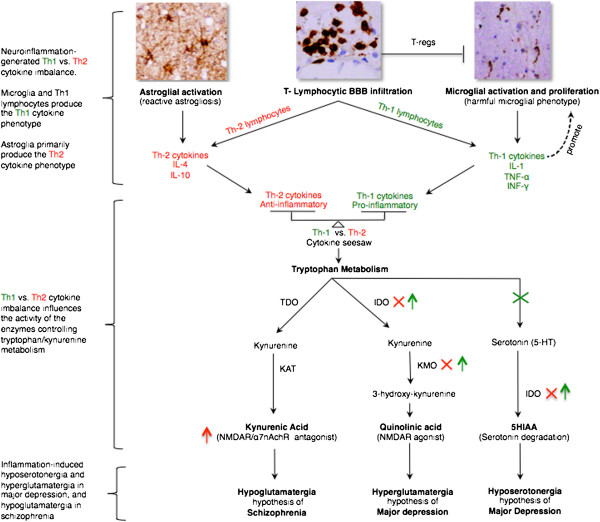
Figure 1
Figure 1
Influence of the ‘Th1-Th2 cytokine seesaw’ generated by glial cells and T lymphocytes on tryptophan/kynurenine metabolism-mediated serotonergic and glutamatergic abnormalities in major depressive disorder and schizophrenia. Influence of the ’Th1-Th2 seesaw’ generated by glial cells and T lymphocytes (first of three bracketed sections) on the enzymes controlling tryptophan/kynurenine metabolism (second of three bracketed sections) leading to serotonergic and glutamatergic abnormalities in major depressive disorder and schizophrenia (third of three bracketed sections). Microglial and astroglial IDO is the rate-limiting enzyme catalyzing the conversion of tryptophan to KYN and serotonin to 5HTT. KMO, which is solely expressed by microglia, is the rate-limiting enzyme catalyzing the conversion of KYN to 3-OH-KYN. TDO, which is solely expressed by astroglia, is the rate-limiting enzyme catalyzing the conversion of tryptophan to KYN. KAT, expressed primarily in astroglial processes, is the rate-limiting enzyme catalyzing the conversion of KYN to KYNA. The microglial enzymes IDO and KMO are upregulated by Th1 cytokines and downregulated by Th2 cytokines. An imbalance of the ‘Th1-Th2 seesaw’ shifts kynurenine catabolism either towards microglial quinolinic acid (NMDA agonist) as in major depressive disorder, or towards astroglial kynurenic acid (NMDA antagonist) as in schizophrenia. 5HIAA, 5-Hydroxyindoleacetic acid; α7nAchR, alpha 7 nicotinic acetylcholine receptors; BBB, blood–brain barrier; IDO, indoleamine-2,3-dioxygenase; IL, interleukin; IFN-γ, interferon gamma; KAT, kynurenine aminotransferase; KMO, kynurenine 3-monooxygenase; KYN, kynurenine; KYNA, kynurenic acid; NMDAR, N-methyl-D-aspartate receptor; TNF-α, tumor necrosis factor alpha; T regs, CD4+CD25+FOXP3+ T regulatory cells; TDO, tryptophan-2,3-dioxygenase; Th, T-helper.
Figure 2
Figure 2
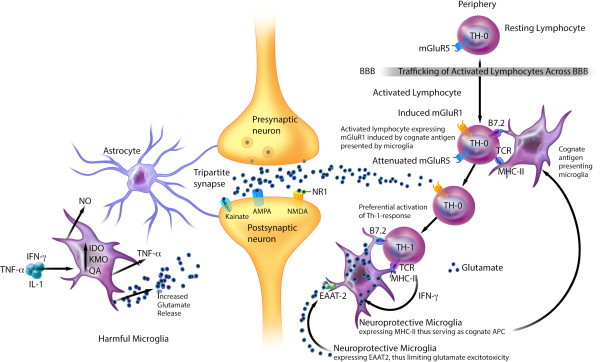
Hypothesis of MDD: excess CNS glutamate may contribute to excess Th1- response promoting neuroprotective microglia. Peripheral resting T lymphocytes constitutively express mGluR5. Activated T lymphocytes, but not resting T lymphocytes, can cross the BBB. In the animal models, the interaction between TCR of activated T lymphocytes and their cognate antigen presenting cells downregulates mGluR5 and induces mGluR1 expressions. Experimental data suggest that excess glutamate can bind to lymphocytic mGluR1 receptors, promoting production of Th1 cytokines. Hypothesis: In some MDD patients, parallel to experimental data, binding of excess CNS glutamate to induced lymphocytic mGluR1 receptors may contribute to an excess Th1 response, including IFN-γ. We further hypothesize that IFN-γ in a small quantity, similar to its in vitro effects on microglia, may induce microglial expression of MHC-II and EAAT-2, allowing microglia to serve as cognate antigen presenting cells and to provide glutamate reuptake function, thereby transforming harmful microglia into neuroprotective phenotype that participate in eliminating excess extracellular glutamate and reducing its excitotoxicity. Therefore, we hypothesize that excess Th1 response in some MDD patients is a double-edged sword; promoting harmful inflammation and serving as a beneficial counter-regulatory mechanism that may limit excess glutamate-related neuroexcitotoxicity? AMPA, 2-amino-3-(5-methyl-3-oxo-1,2-oxazol-4-yl)-propanoic acid; APC, antigen presenting cell; BBB, blood–brain barrier; CNS, central nervous system, EAAT, excitatory amino acid transporter; IDO, indoleamine-2,3-dioxygenase; IFN-γ, interferon gamma; IL, interleukin; KMO, kynurenine 3-monooxygenase; mGluR1/5, metabotropic glutamate receptors 1 and 5; MHC II, major histocompatibility complex class 2; NMDA, N-methyl-D-aspartate; NO, nitric oxide; NR1, glycine site; QA, quinolinic acid; TCR, T-cell receptor; Th, T-helper; TNF-α, tumor necrosis factor alpha.

References

    1. Kayser MS, Dalmau J. The emerging link between autoimmune disorders and neuropsychiatric disease. J Neuropsychiatry Clin Neurosci. 2011;23:90–97. doi: 10.1176/appi.neuropsych.23.1.90. - DOI - PMC - PubMed
    1. Najjar S, Pearlman D, Zagzag D, Golfinos J, Devinsky O. Glutamic acid decarboxylase autoantibody syndrome presenting as schizophrenia. Neurologist. 2012;18:88–91. doi: 10.1097/NRL.0b013e318247b87d. - DOI - PubMed
    1. Graus F, Saiz A, Dalmau J. Antibodies and neuronal autoimmune disorders of the CNS. J Neurol. 2010;257:509–517. doi: 10.1007/s00415-009-5431-9. - DOI - PubMed
    1. Lennox BR, Coles AJ, Vincent A. Antibody-mediated encephalitis: a treatable cause of schizophrenia. Br J Psychiatry. 2012;200:92–94. doi: 10.1192/bjp.bp.111.095042. - DOI - PubMed
    1. Zandi MS, Irani SR, Lang B, Waters P, Jones PB, McKenna P, Coles AJ, Vincent A, Lennox BR. Disease-relevant autoantibodies in first episode schizophrenia. J Neurol. 2011;258:686–688. doi: 10.1007/s00415-010-5788-9. - DOI - PMC - PubMed