Malaria diagnostics and surveillance in the post-genomic era
- PMID: 23548716
- PMCID: PMC4694569
- DOI: 10.1159/000345607
Malaria diagnostics and surveillance in the post-genomic era
Abstract
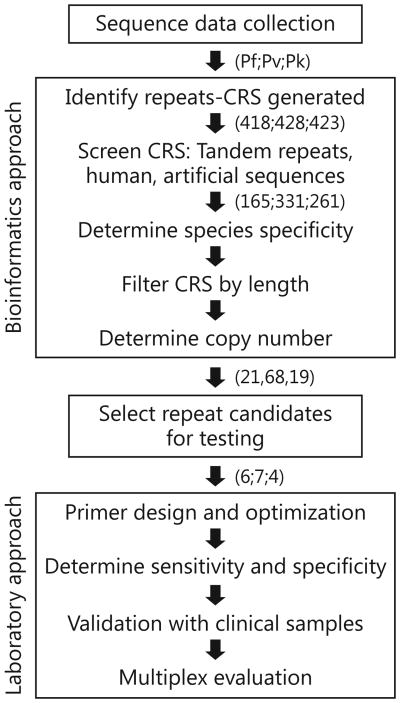
Genome sequences are available for 3 human-infecting malaria parasites, Plasmodium falciparum, P. vivax and P. knowlesi, and population genomics data are available for many endemic regions. This review summarizes how genomic data have been used to develop new, species-specific molecular targets for better malaria diagnosis. The combination of bioinformatics and genomics has been used to identify new sequence targets suitable for diagnostic applications and assess their viability within the context of global Plasmodium sequence variation. The selection criteria maximized the sensitivity and specificity of the novel targets. At least one target from each species was found to be suitable for molecular diagnosis of malaria with some advantages over existing molecular methods. The promise of using genome sequence data to develop sensitive, genus- or species-specific diagnostic methods for other pathogens of public health interest is strong. This undertaking together with what we envision as the future of malaria diagnosis in the 'omic' era is discussed.
Copyright © 2013 S. Karger AG, Basel.
Figures
References
-
- Chen PE, Willner KM, Butani A, Dorsey S, George M, Stewart A, Lentz SM, Cook CE, Akmal A, Price LB, Keim PS, Mateczun A, Brahmbhatt TN, Bishop-Lilly KA, Zwick ME, Read TD, Sozhamannan S. Rapid identification of genetic modifications in Bacillus anthracis using whole genome draft sequences generated by 454 pyrosequencing. PLoS One. 2010;5:el2397. - PMC - PubMed
-
- Gardner MJ, Hall N, Fung E, White O, Berriman M, Hyman RW, Carlton JM, Pain A, Nelson KE, Bowman S, Paulsen IT, James K, Eisen JA, Rutherford K, Salzberg SL, Craig A, Kyes S, Chan MS, Nene V, Shallom SJ, Suh B, Peterson J, Angiuoli S, Pertea M, Allen J, Selengut J, Haft D, Mather MW, Vaidya AB, Martin DM, Fairlamb AH, Fraunholz MJ, Roos DS, Ralph SA, McFadden GI, Cummings LM, Subramanian GM, Mungall C, Venter JC, Carucci DJ, Hoffman SL, Newbold C, Davis RW, Fraser CM, Barrell B. Genome sequence of the human malaria parasite Plasmodium falciparum. Nature. 2002;419:498–511. - PMC - PubMed
-
- Carlton JM, Adams JH, Silva JC, Bidwell SL, Lorenzi H, Caler E, Crabtree J, Angiuoli SV, Merino EF, Amedeo P, Cheng Q, Coulson RM, Crabb BS, Del Portillo HA, Essien K, Feldblyum TV, Fernandez-Becerra C, Gilson PR, Gueye AH, Guo X, Kang'a S, Kooij TW, Korsinczky M, Meyer EV, Nene V, Paulsen I, White O, Ralph SA, Ren Q, Sargeant TJ, Salzberg SL, Stoeckert CJ, Sullivan SA, Yamamoto MM, Hoffman SL, Wortman JR, Gardner MJ, Galinski MR, Barnwell JW, Fraser-Liggett CM. Comparative genomics of the neglected human malaria parasite Plasmodium vivax. Natur. 2008;455:757–763. - PMC - PubMed
-
- Pain A, Böhme U, Berry AE, Mungall K, Finn RD, Jackson AP, Mourier T, Mistry J, Pasini EM, Aslett MA, Balasubrammaniam S, Borgwardt K, Brooks K, Carret C, Carver TJ, Cherevach I, Chillingworth T, Clark TG, Galinski MR, Hall N, Harper D, Harris D, Hauser H, Ivens A, Janssen CS, Keane T, Larke N, Lapp S, Marti M, Moule S, Meyer IM, Ormond D, Peters N, Sanders M, Sanders S, Sargeant TJ, Simmonds M, Smith F, Squares R, Thurston S, Tivey AR, Walker D, White B, Zuiderwijk E, Churcher C, Quail MA, Cowman AF, Turner CM, Rajandream MA, Kocken CH, Thomas AW, Newbold CI, Barrell BG, Berriman M. The genome of the simian and human malaria parasite Plasmodium knowlesi. Nature. 2008;455:799–803. - PMC - PubMed
-
- Aurrecoechea C, Brestelli J, Brunk BP, Dommer J, Fischer S, Gajria B, Gao X, Gingle A, Grant G, Harb OS, Heiges M, Innamorato F, Iodice J, Kissinger JC, Kraemer E, Li W, Miller JA, Nayak V, Pennington C, Pinney DF, Roos DS, Ross C, Stoeckert CJ, Jr, Treatman C, Wang H. PlasmoDB: a functional genomic database for malaria parasites. Nucleic Acids Res. 2009;37:D539–D543. - PMC - PubMed
MeSH terms
Grants and funding
LinkOut - more resources
Full Text Sources
Other Literature Sources
Medical