


A meta-analysis of social capital and health: a case for needed research
- PMID: 23548810
- PMCID: PMC4236001
- DOI: 10.1177/1359105311435983
A meta-analysis of social capital and health: a case for needed research
Abstract
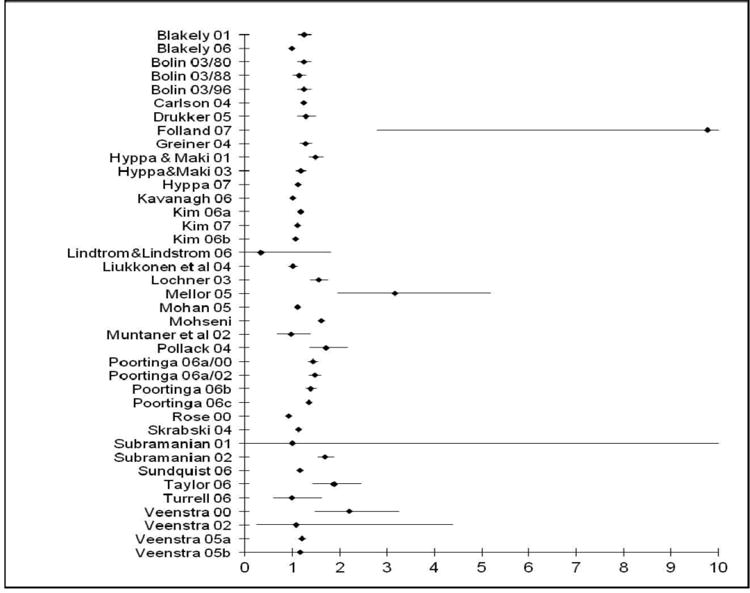
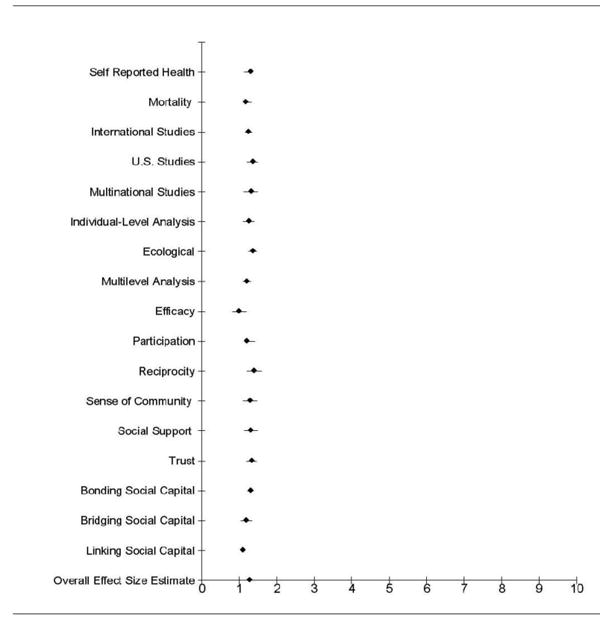
Social capital refers to various levels of social relationships formed through social networks. Measurement differences have lead to imprecise measurement. A meta-analysis of eligible studies assessing the bivariate association between social capital and self-reported health and all-cause mortality was performed. Thirty-nine studies met inclusion criteria, showing social capital increased odds of good health by 27 percent (95% confidence intervals [CI] =21%, 34%). Social capital variables, reciprocity increased odds of good health by 39 percent (95% CI = 21%, 60%) and trust by 32 percent (95% CI =19%, 46%). Future research suggests operationalizing measures by assessing differences by race/ethnicity, gender and socioeconomic status.
Keywords: health; meta-analysis; mortality; physical health; review of literature; self-rated health; social capital.
Figures
References
-
- Blakely T, Atkinson J, Ivory V, Collings S, Wilton J, Howden-Chapman P. No association of neighbourhood volunteerism with mortality in New Zealand: A national multilevel cohort study. International Journal of Epidemiology. 2006;35(4):981–989. - PubMed
-
- Bolin K, Lindgren B, Lindstrom M, Nystedt P. Investments in social capital-implications of social interactions for the production of health. Social Science & Medicine. 2003;56:2379–2390. - PubMed
-
- Boneham MA, Sixsmith JA. The voices of older women in a disadvantaged community: Issues of health and social capital. Social Science & Medicine. 2006;62:269–279. - PubMed
-
- Bourdieu P. The forms of capital. In: Richardson JG, editor. Handbook of Theory and Research for the Sociology of Education. New York: Greenwood Press; 1985.
Publication types
MeSH terms
Grants and funding
LinkOut - more resources
Full Text Sources
Other Literature Sources
Medical
Miscellaneous
