. 2013 Apr 2;13(4):4468-84.
doi: 10.3390/s130404468.

Formaldehyde gas sensors: a review

Affiliations

Formaldehyde gas sensors: a review

Po-Ren Chung et al. Sensors (Basel). .

Abstract

Many methods based on spectrophotometric, fluorometric, piezoresistive, amperometric or conductive measurements have been proposed for detecting the concentration of formaldehyde in air. However, conventional formaldehyde measurement systems are bulky and expensive and require the services of highly-trained operators. Accordingly, the emergence of sophisticated technologies in recent years has prompted the development of many microscale gaseous formaldehyde detection systems. Besides their compact size, such devices have many other advantages over their macroscale counterparts, including a real-time response, a more straightforward operation, lower power consumption, and the potential for low-cost batch production. This paper commences by providing a high level overview of the formaldehyde gas sensing field and then describes some of the more significant real-time sensors presented in the literature over the past 10 years or so.


Figures
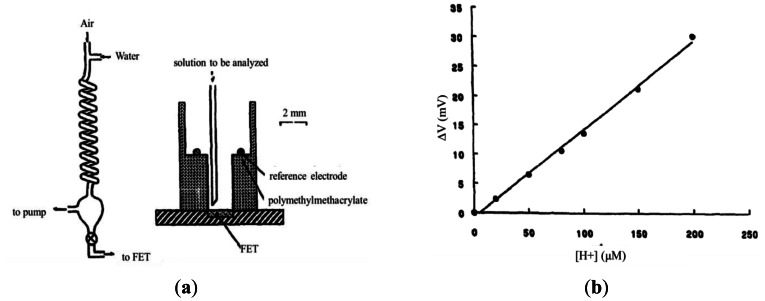
Figure 1.
Figure 1.
(a) Schematic illustration of FET-based detection of gaseous formaldehyde. Left: general arrangement of sampling system. Right: Detailed view of FET sensor. (b) Potentiometric response of FET sensor given increasing formaldehyde concentration [23].
Figure 2.
Figure 2.
(a) Schematic illustration of flow injection system coupled with collection/concentration system for formaldehyde determination. (RS, reagent solution; CS and AS, carrier and absorbing solutions, respectively; P1, double-plunger pump; P2, peristaltic pump; P3, syringe pump; V1 and V2, six-way valves; V3, three-way valve; S, sample; M, mixing joint; DG, degassing unit; RC, reaction coil; D, detector; BPC, back-pressure coil; CMC, chromatomembrane cell; BPB, biporous PTFE block; PMF, porous membrane filter. (A) Introduction of absorbing solution into FIA system; (B) air sampling); (b) Variation of peak area and peak height with air sample volume [24].
Figure 3.
Figure 3.
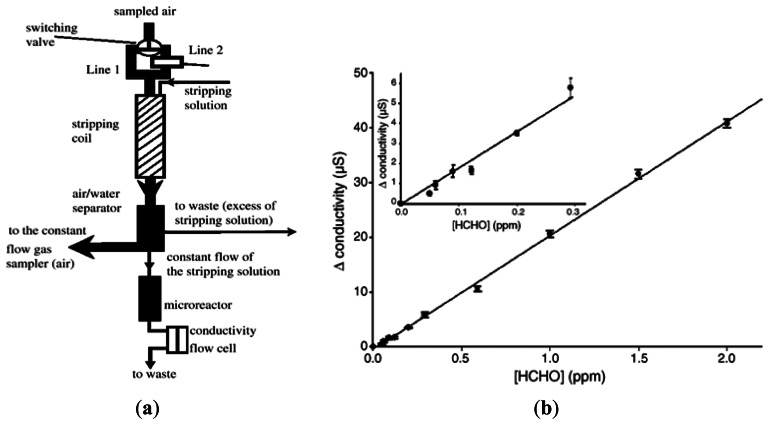
(a) Schematic illustration of biosensor setup. Atmospheric air is sampled by constant flow gas sampler and formaldehyde concentration is measured by sending air sample directly to scrubbing coil via switching valve (line 1). Note that blank signals are obtained by switching sampled air through HCHO trap containing 2,4-dinitrophenylhydrazine-loaded filter (line2). (b) Variation of conductivity with formaldehyde concentration [25].
Figure 4.
Figure 4.
(a) Chemical structures of colorimetric reagents (KD-XA01 and KD-XA02) and their transformation into lutidine derivatives after reaction with formaldehyde. (b) (A) Schematic representation of the formaldehyde monitoring instrument and (B) the optical location of the LED and photodiode to detect the reflected light from the table in [27].
Figure 5.
Figure 5.
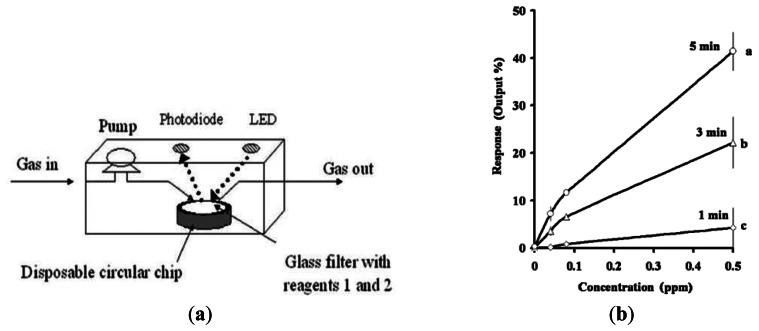
(a) Schematic illustration of formaldehyde sensor based on photometer and reagent-filled filter. (b) Variation of sensor response with formaldehyde concentration given sampling times of 1, 3 and 5 min [5].
Figure 6.
Figure 6.
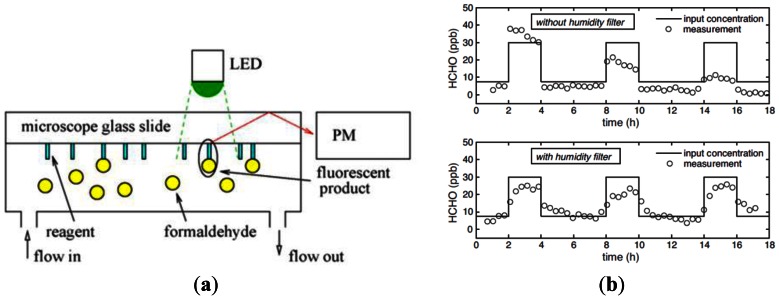
(a) Schematic illustration of formaldehyde sensor in which formaldehyde molecules react with Fluoral-P molecules to form DDL, which is then excited by LED with wavelength of 405 nm; (b) Pulse-mode detection of HCHO in atmosphere with relative humidity of 50% with and without humidity filter, respectively [28].
Figure 7.
Figure 7.
(a) Schematic illustration of formaldehyde sensor comprising piezoresistive cantilever sensor platform. (b) Variation of output voltage and surface stress over time given increasing concentration of formaldehyde vapor [29].
Figure 8.
Figure 8.
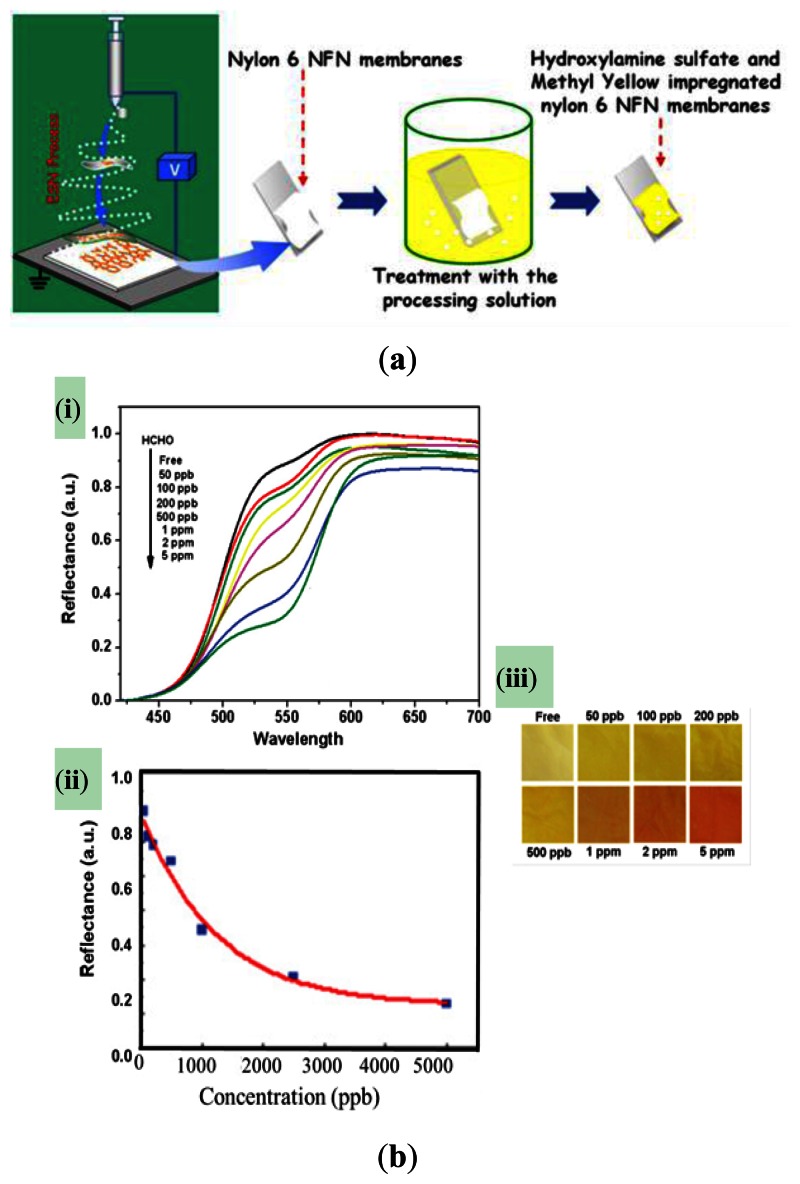
(a) Schematic illustration showing preparation of methyl yellow-impregnated Nylon 6 colorimetric NFN membranes. (b) (i) and (ii) Variation of reflectance with wavelength as function of formaldehyde concentration, and (iii) color-differentiation map comprising converted RGB colors for various formaldehyde concentrations [13].
Figure 9.
Figure 9.
Gaseous formaldehyde detection system comprising pump (1), rotameter (2), reservoir bottle (3), solution exit (4), exit and solution entrance (5), ammonium sulfate solution (6), pipe (7) and piston with hole (8) [30].
Figure 10.
Figure 10.
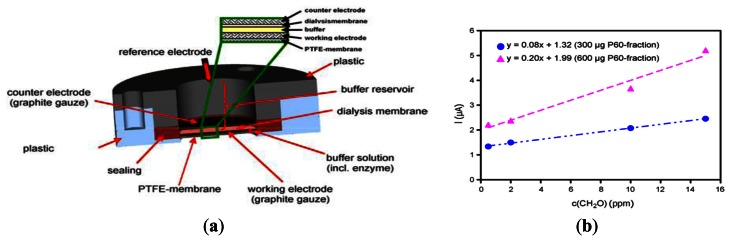
(a) Sensor for gaseous formaldehyde detection comprising multiple membranes and electrodes. (b) Characteristic response curve of sensor given different enzyme loads [31].
Figure 11.
Figure 11.
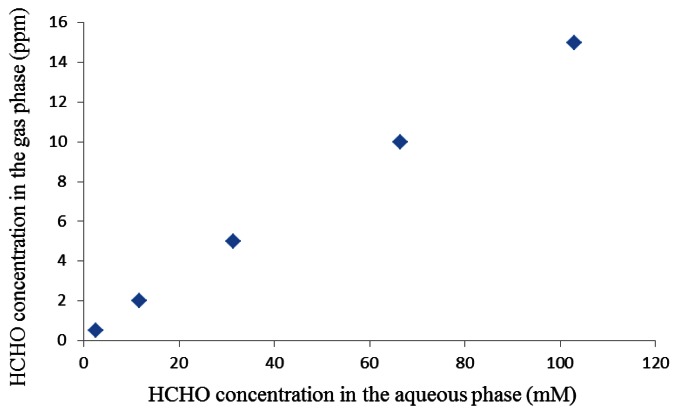
Formaldehyde concentration in the aqueous phase and the corresponding equilibrium gas phase concentrations at 20 °C according to the equation given in [32].
Figure 12.
Figure 12.
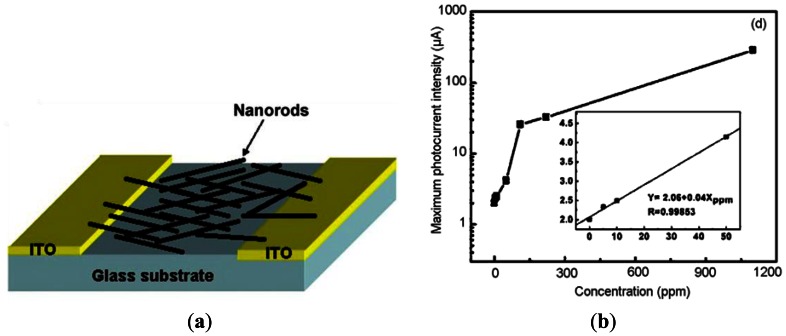
(a) Formaldehyde sensor comprising nano-rods deposited on ITO/glass substrate; (b) Variation of photocurrent intensity with formaldehyde concentration [33].
Figure 13.
Figure 13.
Schematic illustration of formaldehyde sensor comprising integrated micro-hotplate and IDEs [41].
Figure 14.
Figure 14.
(a) Schematic illustration of formaldehyde sensor comprising sensing layer deposited on micro-hotplate. (b) Variation of resistance with formaldehyde concentration [44].
Figure 15.
Figure 15.
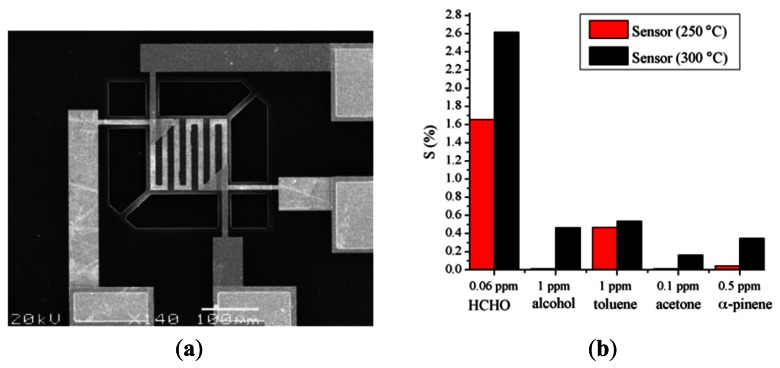
(a) SEM image of micro-hotplate within dual-sensor detection chip. (b) Output response of sensor in presence of various compounds with different concentrations [45].

References

    1. Korpan Y.I., Gonchar M.V., Sibirny A.A., Martelet C., El'skaya A.V., Gibson T.D., Soldatkin A.P. Development of highly selective and stable potentiometric sensors for formaldehyde determination. Biosens. Bioelectron. 2000;15:77–83. - PubMed
    1. Kataky R., Bryce M.R., Goldenberg L., Hayes S., Nowak A. A biosensor for monitoring formaldehyde using a new lipophilic tetrathiafulvalene- tetracyanoquinodimethane salt and a polyurethane membrane. Talanta. 2002;56:451–458. - PubMed
    1. Kim W.J., Terada N., Nomura T., Takahashi R., Lee S.D., Park J.H., Konno A. Effect on formaldehyde on the expression of adhesion molecule in nasal microvascular endothelial cells: The role of formaldehyde in the pathogenesis of sick building syndrome. Clin. Exp. Allergy. 2002;32:287–295. - PubMed
    1. Hemple A.J., Kjaergaard K.S., Molhave L., Hundnell H.K. Sensory eye irritation in humans exposed to mixture of volatile organic compounds. Arch. Environ. Health. 1999;54:416–424. - PubMed
    1. Kawamura K., Kerman K., Fujihara M., Nagatani N., Hashiba T., Tamiya E. Development of a novel hand-held formaldehyde gas sensor for the rapid detection of sick building syndrome. Sens. Actuators B Chem. 2005;105:495–501.

Publication types