


doi: 10.1007/s11515-012-1254-7.
DISC1 genetics, biology and psychiatric illness
Affiliations
- PMID: 23550053
- PMCID: PMC3580875
- DOI: 10.1007/s11515-012-1254-7
Item in Clipboard
DISC1 genetics, biology and psychiatric illness
Front Biol (Beijing).
.
Abstract
Psychiatric disorders are highly heritable, and in many individuals likely arise from the combined effects of genes and the environment. A substantial body of evidence points towards DISC1 being one of the genes that influence risk of schizophrenia, bipolar disorder and depression, and functional studies of DISC1 consequently have the potential to reveal much about the pathways that lead to major mental illness. Here, we review the evidence that DISC1 influences disease risk through effects upon multiple critical pathways in the developing and adult brain.
Keywords: DISC1; depression; genetics; neural pathways; schizophrenia.
Figures
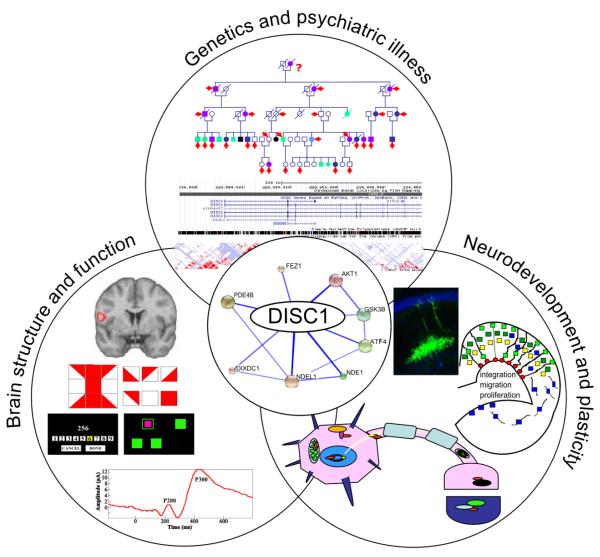
DISC1 in neurodevelopment, brain functioning and psychiatric illness. DISC1 is a scaffold protein with many functional partners associated with brain development and disease. Genetics and psychiatric illness: The DISC1 protein network was modified from String DB (http://string-db.org/ ). The t(1;11) Scottish pedigree was modified, with permission, from Blackwood et al. (Blackwood et al., 2001) . A fragment of the DISC1 gene structure, SNPs and linkage disequilibrium blocks was generated using the UCSC genome browser (http://genome.ucsc.edu/ ). Brain structure and function: Examples of neurocognitive tests in which individuals carrying variants at the DISC1 locus show altered performance; differences in brain activation by DISC1 L607F genotype as measured by functional MRI (with thanks to Andrew McIntosh); the P300 event related potential, which is elicited in decision making, and shows reduced amplitude and latency in DISC1 translocation carriers. Neurodevelopment and plasticity: DISC1 is a multi-compartmentalised protein, present at the nucleus, centrosome, mitochondria, microtubules and synapse; DISC1 has roles in neurodevelopment and plasticity, in proliferation, migration and integration of neurons; neural stem cells are a promise in research and treatment of psychiatric and neurodegenerative disorders; GFP-labelled neural stem cells transplanted into the mouse brain can give rise to cells resembling normal hippocampal neurons (Image by Yirui Sun, Wellcome Imagescc).
References
-
- Abazyan B, Nomura J, Kannan G, Ishizuka K, Tamashiro KL, Nucifora F, Pogorelov V, Ladenheim B, Yang C, Krasnova IN, Cadet JL, Pardo C, Mori S, Kamiya A, Vogel MW, Sawa A, Ross CA, Pletnikov MV. Prenatal interaction of mutant DISC1 and immune activation produces adult psychopathology. Biol Psychiatry. 2010;68:1172–1181. - PMC - PubMed
-
- Ameri K, Harris AL. Activating transcription factor 4. Int J Biochem Cell Biol. 2008;40:14–21. - PubMed
Grants and funding
LinkOut - more resources
Full Text Sources