. 2013 Jul;19(7):477-83.
doi: 10.1111/cns.12089. Epub 2013 Apr 2.

MiR-139 inhibits Mcl-1 expression and potentiates TMZ-induced apoptosis in glioma

Affiliations

MiR-139 inhibits Mcl-1 expression and potentiates TMZ-induced apoptosis in glioma

Rui-Yan Li et al. CNS Neurosci Ther. 2013 Jul.

Abstract

Aims: Mcl-1, an antiapoptotic member of the Bcl-2 family, is overexpressed in human glioblastoma, conferring a survival advantage to tumor cells. The mechanisms underlying its dysregulation have not been clarified. In this study, we explored the involvement of micro-RNAs that acted as endogenous sequence-specific suppressors of gene expression.

Methods and results: Using computational and TCGA analysis, we identified miR-139 as being downregulated in glioblastoma in comparison with human brain tissue, as well as possessing a putative target site in Mcl-1 mRNA. Overexpression of miR-139 led to a clear decrease in Mcl-1 expression in gliomas. Reporter assays revealed direct post-transcriptional regulation involving miR-139 and the 3'-untranslated region of Mcl-1. Human glioma tissues with low expression of miR-139 displayed higher expression of Mcl-1 protein than those with high expression, suggesting that low miR-139 contributes to Mcl-1 overexpression. In addition, upregulation of miR-139 suppressed the proliferation and enhanced temozolomide (TMZ)-induced apoptosis. Finally, we observed that Mcl-1 knockdown resulted in similar effects compared with miR-139 transfection.

Conclusion: Our results suggested that miR-139 negatively regulated Mcl-1 and induced apoptosis in cooperation with an anticancer drug TMZ in glioma.


Conflict of interest statement

The authors declare no conflict of interest.

Figures

Figure 1
Figure 1
Mcl‐1 inversely correlated with miR‐139 expression in glioma. (A) Diagram of seed sequence of miR‐139 matched the 3′ UTR of the Mcl‐1 gene. (B) Expression of Mcl‐1 in resected glioma specimen was assessed by IHC assay. FISH assay showed the expression of miR‐139 in the homologous specimens. (C) A statistically significant inverse correlation between miR‐139 and Mcl‐1 protein levels in clinical specimens (Spearman's correlation analysis, r = −0.79097; P < 0.001). (D) Western blot assays of Mcl‐1 in glioma cells. (E) qRT‐PCR assay of miR‐139 in glioma cells.
Figure 2
Figure 2
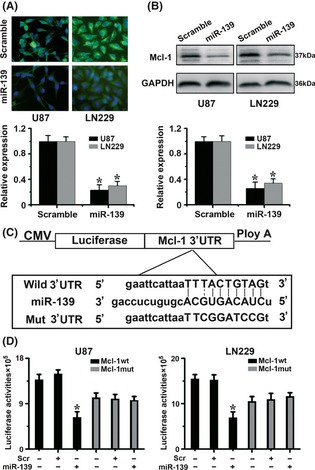
Mcl‐1 is direct target of miR‐139 in glioma cells. (A) U87 and LN229 cells were transfected with the miR‐139 mimics or with a scramble. Expression of the Mcl‐1 protein was evaluated 48 h later by immunofluorescence assay. As shown, the levels of Mcl‐1 were significantly decreased in the presence of miR‐139, but not in the presence of scramble. (B) Western blot analysis of total cell lysates of U87 and LN229 cells transfected with the indicated miRNAs. As shown, transfection with miR‐139 induced efficient Mcl‐1 decrease. (C) Diagram of seed sequence of miR‐139 matched the 3′ UTR of the Mcl‐1 gene. (D) Luciferase reporter assays in glioma cells, following cotransfection of cells with wild‐type or mutant 3′UTR Mcl‐1 and miRNA, as indicated. Data represent fold change in expression (mean ± SE) of three replicates.
Figure 3
Figure 3
miR‐139 suppresses glioma growth both in vitro and in vivo. (A) Representative cartogram showing the proliferation regulated by miR‐139‐treated cells and scramble. (B), (C) Tumor growth curves and mass for miR‐139 mimics‐treated LN229 tumors vs scramble xenograft. Scramble refers to scramble oligonucleotides and uses for negative control. (D), (F) qRT‐PCR and FISH assay for miR‐139 expression in miR‐139 mimics‐treated LN229 tumors vs. scramble xenograft. (E) Western blot assay for Mcl‐1 expression in miR‐139 mimics‐treated LN229 tumors vs. scramble xenograft. (F) IHC assay for Mcl‐1 and caspase‐3 expression in miR‐139 mimics‐treated LN229 tumors vs. scramble xenograft.
Figure 4
Figure 4
Sensitivity to apoptosis is increased after transfection of miR‐139. (A) Western blot assay showed that ectopic expression of miR‐139 promotes mitochondrion release of cytochrome c. (B) U87 and LN229 cells were transfected with miR‐139 mimics or scramble at 40 nM. After 24 h, TMZ was added in fresh media and the cells were incubated for 4 h. Cells were then analyzed by apoptosis assay. (C) In parallel, cells were transfected and treated with TMZ as in panel B, and caspase 3/7 activity was measured.
Figure 5
Figure 5
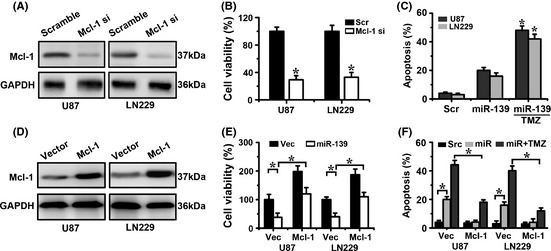
Mcl‐1 impacts proliferation, apoptosis of glioma cells. (A) Mcl‐1 expression levels in U87 and LN229 cells transfected with Mcl‐1 si were assessed by Western blot. (B–C) Representative cartogram showing cell proliferation and apoptosis regulated by Mcl‐1 si. (D) Mcl‐1 expression levels in U87 and LN229 cells transfected with Mcl‐1 were assessed by Western blot. (E–F) Representative cartogram showing proliferation and apoptosis regulated by miR‐139 or/and Mcl‐1.

References

    1. Cai Y, Yu X, Hu S, et al. A brief review on the mechanisms of miRNA regulation. Genomics Proteomics Bioinformatics 2009;7:147–154. - PMC - PubMed
    1. Calin GA, Croce CM. MicroRNA signatures in human cancers. Nat Rev Cancer 2006;6:857–866. - PubMed
    1. Chen L, Wang X, Wang H, et al. miR‐137 is frequently down‐regulated in glioblastoma is a negative regulator of Cox‐2. Eur J Cancer 2012;48:3104–3111. - PubMed
    1. Moore LM, Zhang W. Targeting miR‐21 in glioma: a small RNA with big potential. Expert Opin Ther Targets 2010;14:1247–1257. - PubMed
    1. Ren Y, Kang CS, Yuan XB, et al. Co‐delivery of as‐miR‐21 and 5‐FU by poly(amidoamine) dendrimer attenuates human glioma cell growth in vitro. J Biomater Sci Polym Ed 2010;21:303–314. - PubMed

Publication types

MeSH terms