


Neuropsychological correlates of complicated grief in older spousally bereaved adults
- PMID: 23551907
- PMCID: PMC3968854
- DOI: 10.1093/geronb/gbt025
Neuropsychological correlates of complicated grief in older spousally bereaved adults
Abstract
Objectives: Across many research domains, evidence for complicated grief as a distinct psychopathology continues to grow. Previous research from neuropsychology has shown an increased attentional bias to emotionally relevant stimuli in those suffering from complicated grief. This study furthers our understanding of the characteristics that distinguish complicated grief. We expand on previous research by (a) testing older adults, (b) excluding those with comorbid major depressive disorder, (c) using participant-chosen grief-related stimuli, and (d) using a married, nonbereaved control group.
Methods: We recruited 76 older adults in 3 groups: spousally bereaved with complicated grief, spousally bereaved with noncomplicated grief, and nonbereaved controls. Performance on the Wisconsin Card Sorting Task, Digit Span Backwards, and the emotional counting Stroop was examined.
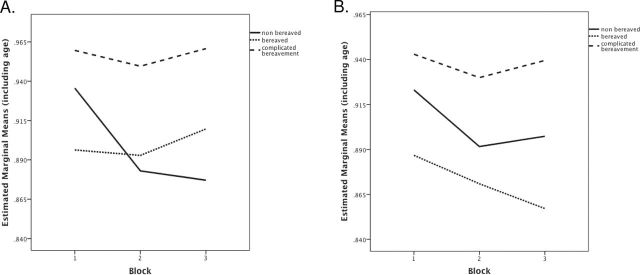
Results: Results indicate longer reaction time across 3 blocks of grief-related words in the complicated grief group but no difference across 3 blocks of the neutral words. The 3 groups performed comparably on the other neurocognitive tasks, indicating no cognitive differences in working memory or set shifting between groups. Furthermore, these effects of complicated grief generalize to older adults and appear independent of major depression.
Discussion: Complicated grief has cognitive interference as a neuropsychological component highlighting it as distinct from noncomplicated grief.
Keywords: Aging; Attention; Bereavement; Complicated grief; Stroop; Widow..
Figures
References
-
- Aartsen M. J., Van Tilburg T., Smits C. H., Comijs H. C., Knipscheer K. C. (2005). Does widowhood affect memory performance of older persons? Psychological Medicine, 35, 217–226. 10.1017/S0033291704002831 - PubMed
-
- Beck A. T., Ward C. H., Mendelson M., Mock J., Erbaugh J. (1961). An inventory for measuring depression. Archives of General Psychiatry, 4, 561–571. 10.1001/archpsyc.1961.01710120031004 - PubMed
-
- Beck A. T., Steer R. A., Ball R., Ranieri W. (1996). Comparison of Beck Depression Inventories-IA and -II in psychiatric outpatients. Journal of Personal Assessment, 67, 588–597. 10.1207/s15327752jpa6703_13 - PubMed
-
- Bernal B., Altman N. (2009). Neural networks of motor and cognitive inhibition are dissociated between brain hemispheres: An fMRI study. International Journal of Neuroscience, 119, 1848–1880. 10.1080/00207450802333029 - PubMed
-
- Bonnano G. A., Wortman C. B., Lehman D. R., Tweed R. G., Haring M., Sonnega J. … Nesse R. M. (2002). Resilience to loss and chronic grief: A prospective study from preloss to 18-months postloss. Journal of Personality & Social Psychology, 83, 1150–1164. 10.1037/0022-3514.83.5.1150 - PubMed
Publication types
MeSH terms
Grants and funding
LinkOut - more resources
Full Text Sources
Other Literature Sources
