


Effects of leucine and its metabolite β-hydroxy-β-methylbutyrate on human skeletal muscle protein metabolism
- PMID: 23551944
- PMCID: PMC3690694
- DOI: 10.1113/jphysiol.2013.253203
Effects of leucine and its metabolite β-hydroxy-β-methylbutyrate on human skeletal muscle protein metabolism
Abstract
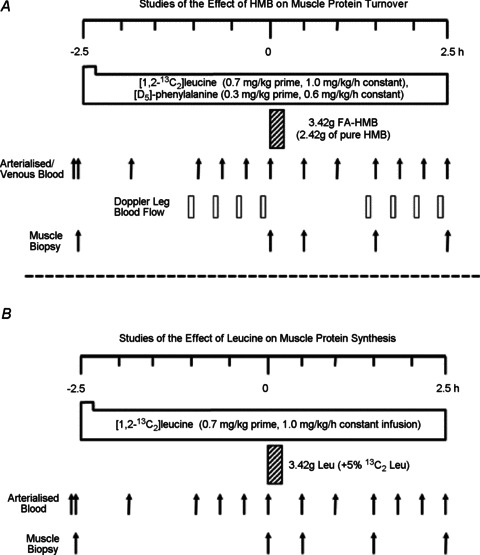
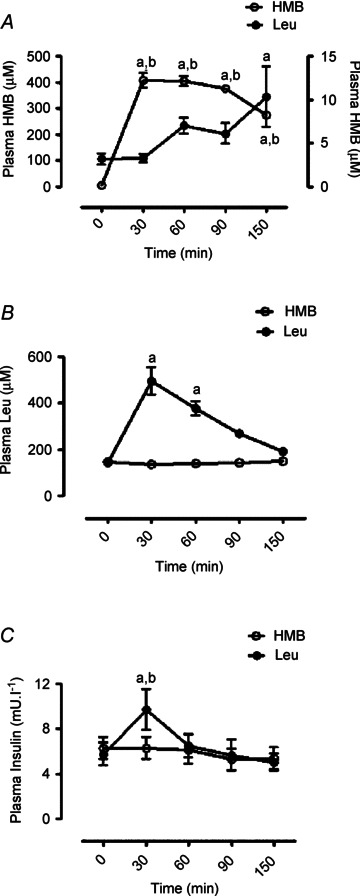
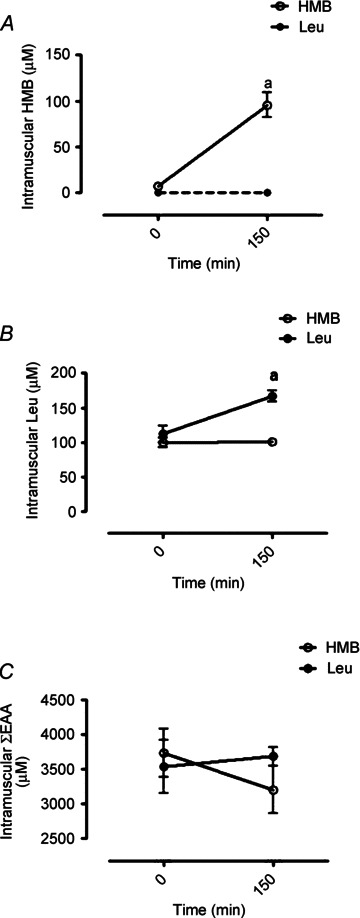
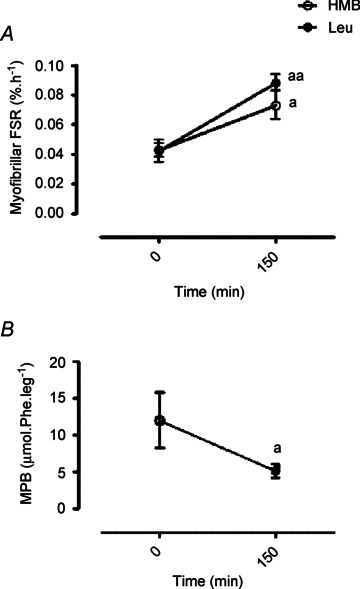
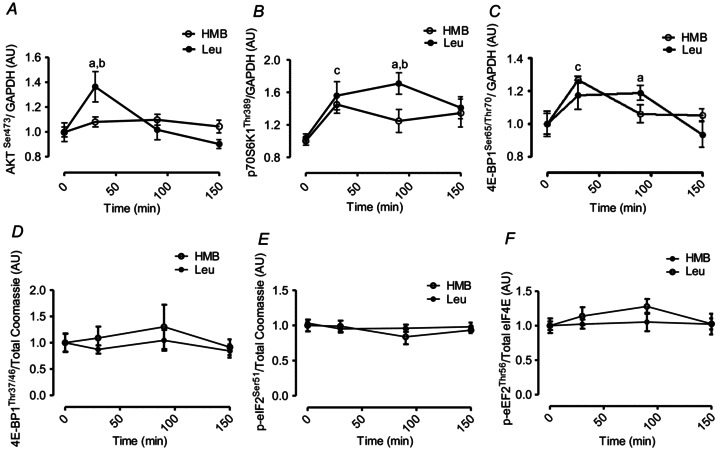
Maintenance of skeletal muscle mass is contingent upon the dynamic equilibrium (fasted losses-fed gains) in protein turnover. Of all nutrients, the single amino acid leucine (Leu) possesses the most marked anabolic characteristics in acting as a trigger element for the initiation of protein synthesis. While the mechanisms by which Leu is 'sensed' have been the subject of great scrutiny, as a branched-chain amino acid, Leu can be catabolized within muscle, thus posing the possibility that metabolites of Leu could be involved in mediating the anabolic effect(s) of Leu. Our objective was to measure muscle protein anabolism in response to Leu and its metabolite HMB. Using [1,2-(13)C2]Leu and [(2)H5]phenylalanine tracers, and GC-MS/GC-C-IRMS we studied the effect of HMB or Leu alone on MPS (by tracer incorporation into myofibrils), and for HMB we also measured muscle proteolysis (by arteriovenous (A-V) dilution). Orally consumed 3.42 g free-acid (FA-HMB) HMB (providing 2.42 g of pure HMB) exhibited rapid bioavailability in plasma and muscle and, similarly to 3.42 g Leu, stimulated muscle protein synthesis (MPS; HMB +70% vs. Leu +110%). While HMB and Leu both increased anabolic signalling (mechanistic target of rapamycin; mTOR), this was more pronounced with Leu (i.e. p70S6K1 signalling 90 min vs. 30 min for HMB). HMB consumption also attenuated muscle protein breakdown (MPB; -57%) in an insulin-independent manner. We conclude that exogenous HMB induces acute muscle anabolism (increased MPS and reduced MPB) albeit perhaps via distinct, and/or additional mechanism(s) to Leu.
Figures
References
-
- Anthony JC, Anthony TG, Kimball SR, Jefferson LS. Signaling pathways involved in translational control of protein synthesis in skeletal muscle by leucine. J Nutr. 2001;131:856S–860S. - PubMed
-
- Anthony JC, Anthony TG, Kimball SR, Vary TC, Jefferson LS. Orally administered leucine stimulates protein synthesis in skeletal muscle of postabsorptive rats in association with increased eIF4F formation. J Nutr. 2000a;130:139–145. - PubMed
-
- Anthony JC, Yoshizawa F, Anthony TG, Vary TC, Jefferson LS, Kimball SR. Leucine stimulates translation initiation in skeletal muscle of postabsorptive rats via a rapamycin-sensitive pathway. J Nutr. 2000b;130:2413–2419. - PubMed
-
- Atherton PJ, Etheridge T, Watt PW, Wilkinson D, Selby A, Rankin D, Smith K, Rennie MJ. Muscle full effect after oral protein: time-dependent concordance and discordance between human muscle protein synthesis and mTORC1 signaling. Am J Clin Nutr. 2010a;92:1080–1088. - PubMed
-
- Atherton PJ, Smith K, Etheridge T, Rankin D, Rennie MJ. Distinct anabolic signalling responses to amino acids in C2C12 skeletal muscle cells. Amino acids. 2010b;38:1533–1539. - PubMed
MeSH terms
Substances
Grants and funding
LinkOut - more resources
Full Text Sources
Other Literature Sources
Medical
Miscellaneous
