. 2013 Apr 3:13:77.
doi: 10.1186/1471-2148-13-77.

Parallel evolution of senescence in annual fishes in response to extrinsic mortality

Affiliations

Parallel evolution of senescence in annual fishes in response to extrinsic mortality

Eva Terzibasi Tozzini et al. BMC Evol Biol. .

Abstract

Background: Early evolutionary theories of aging predict that populations which experience low extrinsic mortality evolve a retarded onset of senescence. Experimental support for this theory in vertebrates is scarce, in part for the difficulty of quantifying extrinsic mortality and its condition- and density-dependent components that -when considered- can lead to predictions markedly different to those of the "classical" theories. Here, we study annual fish of the genus Nothobranchius whose maximum lifespan is dictated by the duration of the water bodies they inhabit. Different populations of annual fish do not experience different strengths of extrinsic mortality throughout their life span, but are subject to differential timing (and predictability) of a sudden habitat cessation. In this respect, our study allows testing how aging evolves in natural environments when populations vary in the prospect of survival, but condition-dependent survival has a limited effect. We use 10 Nothobranchius populations from seasonal pools that differ in their duration to test how this parameter affects longevity and aging in two independent clades of these annual fishes.

Results: We found that replicated populations from a dry region showed markedly shorter captive lifespan than populations from a humid region. Shorter lifespan correlated with accelerated accumulation of lipofuscin (an established age marker) in both clades. Analysis of wild individuals confirmed that fish from drier habitats accumulate lipofuscin faster also under natural conditions. This indicates faster physiological deterioration in shorter-lived populations.

Conclusions: Our data provide a strong quantitative example of how extrinsic mortality can shape evolution of senescence in a vertebrate clade. Nothobranchius is emerging as a genomic model species. The characterization of pairs of closely related species with different longevities should provide a powerful paradigm for the identification of genetic variations responsible for evolution of senescence in natural populations.


Figures
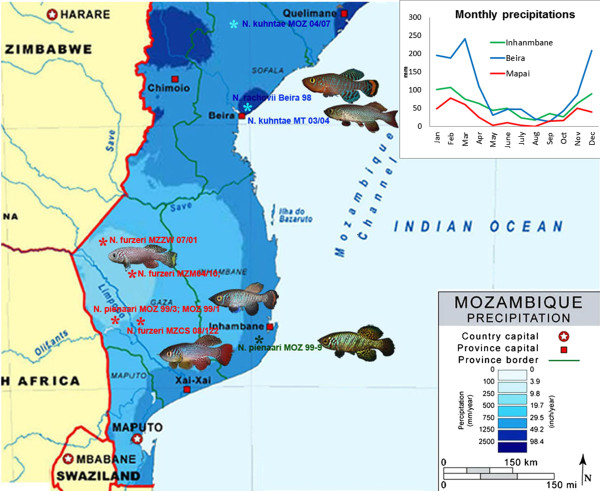
Figure 1
Figure 1
Distribution map for the Nothobranchius populations used in the present study. Physical map with annual precipitations was obtained from Stock Map Agency (http://www.stockmapagency.com). Collection points are indicated with asterisks and are color-coded: red indicates semi-arid green intermediate and blue humid habitats. Please note that the collection points of N. rachovii and two of the populations of N. kuhntae are in Beira and are collectively represented by a single asterisk. Inset shows monthly precipitations in Beira, Inhambane and Mapai as examples of humid, intermediate and semi-arid regions.
Figure 2
Figure 2
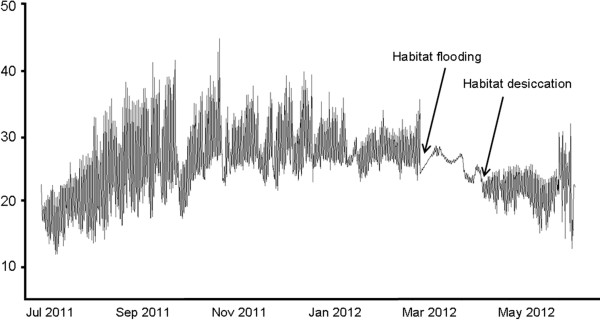
Temperature fluctuations (logging every 3 hours) at site MZCS 207 (semi-arid region) from a period between 29 June 2011 to 23 May 2012, with a single period of habitat duration. The estimated time of filling and drying of the pond are indicated.
Figure 3
Figure 3
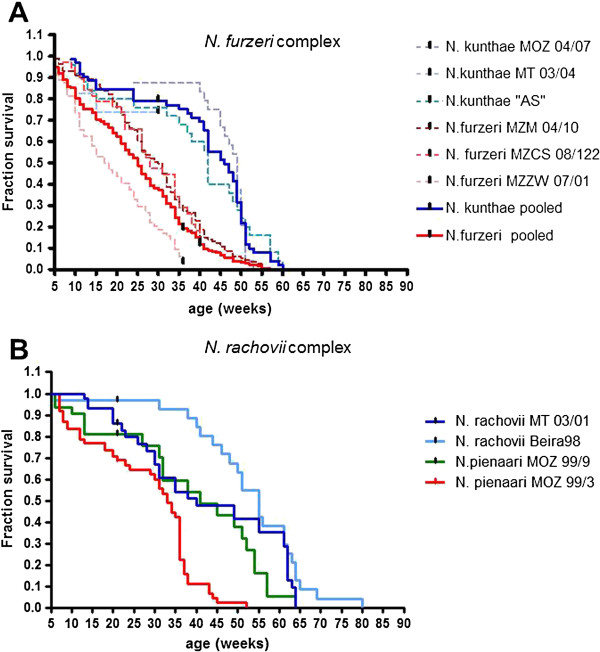
Age-dependent survival of N. furzeri species complex and N. rachovii species complex. (A) Survivorship of N. furzeri MZZW 07/01 (pink broken line n = 124), N. furzeri MZM 04/10 (red broken line, n = 113), N. furzeri MZCS 08/122 (brown broken line, n = 33), N. kuhntae MT-03/04 (light blue broken line n = 23; censored at age 33 weeks due to disease outbreak), N. kuhntae “aquarium strain” (blue broken line, n = 25) and N. kuhntae MOZ 04/07 (dark blue broken line, n = 24). Pooled survivorship of N. furzeri (n = 223) is shown in solid red and the survivorship of pooled N. kuhntae (n = 72) is shown in solid blue. The difference in the survivorship between the two pooled groups is highly significant (Log-Rank test, p < 0.0001). For descriptive statistics and pair wise comparisons see Additional file 1: Table S2, Additional file 2: Table S3 – (B) Survivorship of N. pienaari MOZ 99/3 (red line, n = 61). N. pienaari MOZ 99/9 (green line, n = 31), N. rachovii Beira 98 (light blue line, n = 34) and N. rachovii MT 03/01 (blue line, n = 43). For descriptive statistics and pair-wise comparisons see Additional file 4: Table S4, Additional file 5: Table S5.
Figure 4
Figure 4
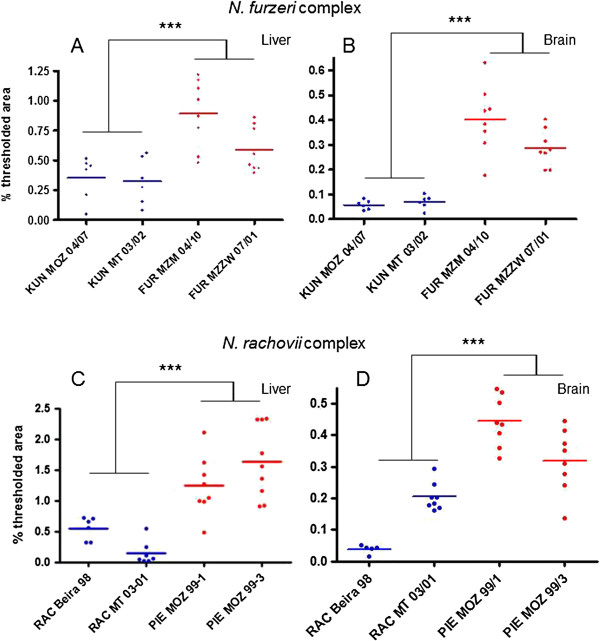
Expression of lipofuscin in captive individuals of N. furzeri species complex and N. rachovii species complex. (A) N. furzeri complex, expression of lipofuscin in the liver at age 21 weeks. (B) N. furzeri complex, expression of lipofuscin in the brain at age 21 weeks. (C) N. rachovii complex, expression of lipofuscin in the liver at age 21 weeks. (D) N. rachovii complex, expression of lipofuscin in the liver at age 21 weeks. FUR = N. furzeri, KUN = N. kuhntae, RAC = N. rachovii, PIE = N. pienaari. In all graphs, red points refer to populations from semi-arid habitats and blue point to populations from humid habitats. Lipofuscin is quantified as percentage of pixels in the image that are brighter than a fixed fluorescence threshold. *** = p < 0.001,Mann Whithney’s U-test. For pairwise comparisons see Additional file 6: Table S6, Additional file 7: Table S7, Additional file 8: Table S8 Additional file 9: Table S9.
Figure 5
Figure 5
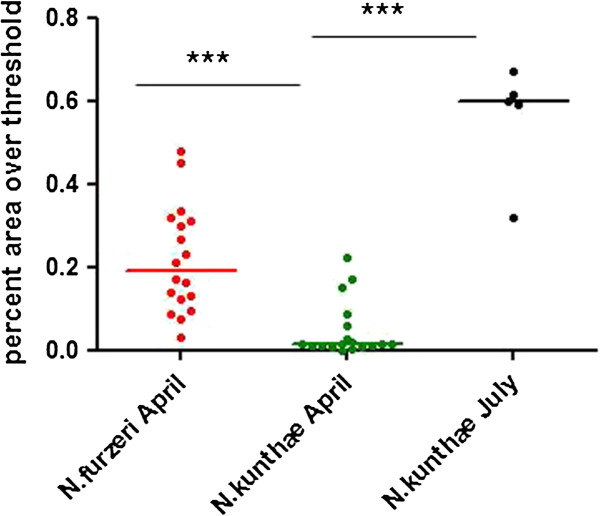
Expression of lipofuscin in wild animals. Lipofuscin measurements in the liver of wild individuals of N. furzeri and N. kuhntae. ***p = 0.001, Kruskall-Wallis non-parametric ANOVA.

References

    1. Fontana L, Partridge L, Longo VD. Extending healthy life span–from yeast to humans. Science. 2010;328(5976):321–326. doi: 10.1126/science.1172539. - DOI - PMC - PubMed
    1. Martin GM. The biology of aging: 1985-2010 and beyond. FASEB J. 2011;25(11):3756–3762. doi: 10.1096/fj.11-1102.ufm. - DOI - PMC - PubMed
    1. Barzilai N, Guarente L, Kirkwood TB, Partridge L, Rando TA, Slagboom PE. The place of genetics in ageing research. Nat Rev Genet. 2012;13(8):589–594. doi: 10.1038/nrg3290. - DOI - PubMed
    1. Austad SN. Retarded senescence in an insular population of virginia opossums (didelphis-virginiana) J Zool. 1993;229:695–708. doi: 10.1111/j.1469-7998.1993.tb02665.x. - DOI
    1. Bronikowski AM. The evolution of aging phenotypes in snakes: a review and synthesis with new data. Age (Dordr) 2008;30(2–3):169–176. - PMC - PubMed

Publication types