


Are empirically-derived subtypes of mild cognitive impairment consistent with conventional subtypes?
- PMID: 23552486
- PMCID: PMC3742806
- DOI: 10.1017/S1355617713000313
Are empirically-derived subtypes of mild cognitive impairment consistent with conventional subtypes?
Abstract
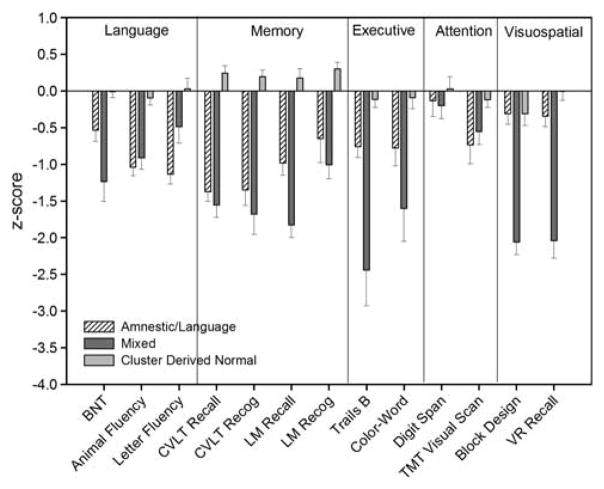
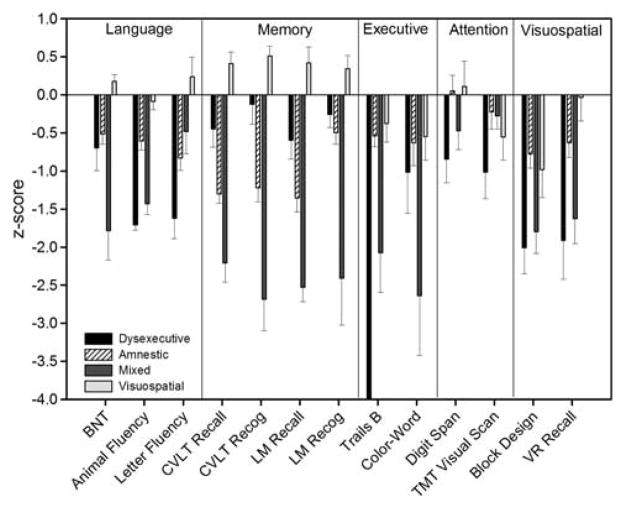
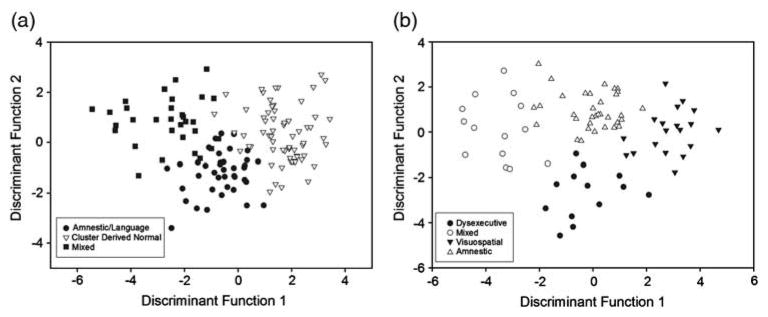
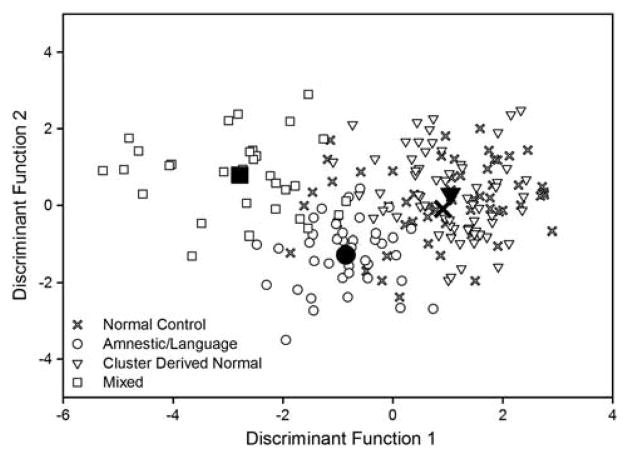
Given the importance of identifying dementia prodromes for future treatment efforts, we examined two methods of diagnosing mild cognitive impairment (MCI) and determined whether empirically-derived MCI subtypes of these diagnostic methods were consistent with one another as well as with conventional MCI subtypes (i.e., amnestic, non-amnestic, single-domain, multi-domain). Participants were diagnosed with MCI using either conventional Petersen/Winblad criteria (n = 134; >1.5 SDs below normal on one test within a cognitive domain) or comprehensive neuropsychological criteria developed by Jak et al. (2009) (n = 80; >1 SD below normal on two tests within a domain), and the resulting samples were examined via hierarchical cluster and discriminant function analyses. Results showed that neuropsychological profiles varied depending on the criteria used to define MCI. Both criteria revealed an Amnestic subtype, consistent with prodromal Alzheimer's disease (AD), and a Mixed subtype that may capture individuals in advanced stages of MCI. The comprehensive criteria uniquely yielded Dysexecutive and Visuospatial subtypes, whereas the conventional criteria produced a subtype that performed within normal limits, suggesting its susceptibility to false positive diagnostic errors. Whether these empirically-derived MCI subtypes correspond to dissociable neuropathologic substrates and represent reliable prodromes of dementia will require additional follow-up.
Figures
References
-
- Bartley M, Bokde AL, Ewers M, Faluyi YO, Tobin WO, Snow A, O’Neill D. Subjective memory complaints in community dwelling health older people: The influence of brain and psychopathology. International Journal of Geriatric Psychiatry. 2012;27:836–843. - PubMed
-
- Bickel H, Mosch E, Seigerschmidt E, Siemen M, Forstl H. Prevalence and persistence of mild cognitive impairment among elderly patients in general hospitals. Dementia and Geriatric Cognitive Disorders. 2006;21(4):242–250. - PubMed
-
- Binder LM, Iverson GL, Brooks BL. To err is human: “Abnormal” neuropsychological scores and variability are common in healthy adults. Archives of Clinical Neuropsychology. 2009;24:31–46. - PubMed
-
- Busse A, Hensel A, Guhne U, Angermeyer MC, Riedel-Heller SG. Mild cognitive impairment: Long-term course of four clinical subtypes. Neurology. 2006;67:2176–2185. - PubMed
Publication types
MeSH terms
Grants and funding
LinkOut - more resources
Full Text Sources
Other Literature Sources
Medical
