


Differential freshwater flagellate community response to bacterial food quality with a focus on Limnohabitans bacteria
- PMID: 23552621
- PMCID: PMC3721123
- DOI: 10.1038/ismej.2013.57
Differential freshwater flagellate community response to bacterial food quality with a focus on Limnohabitans bacteria
Abstract
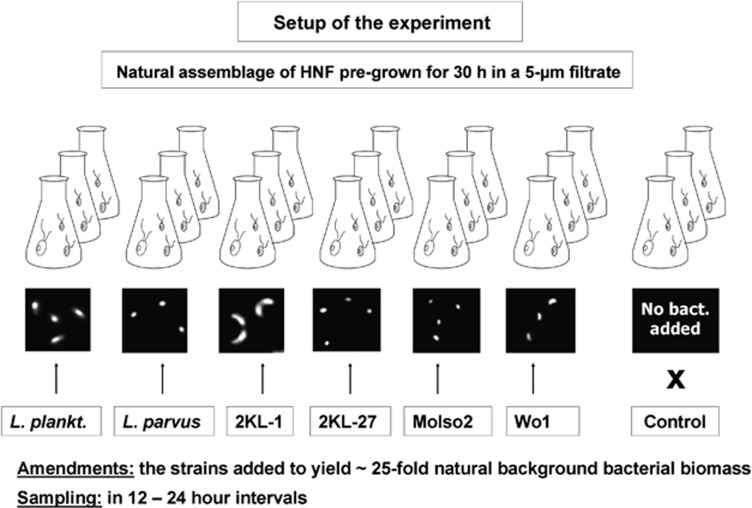
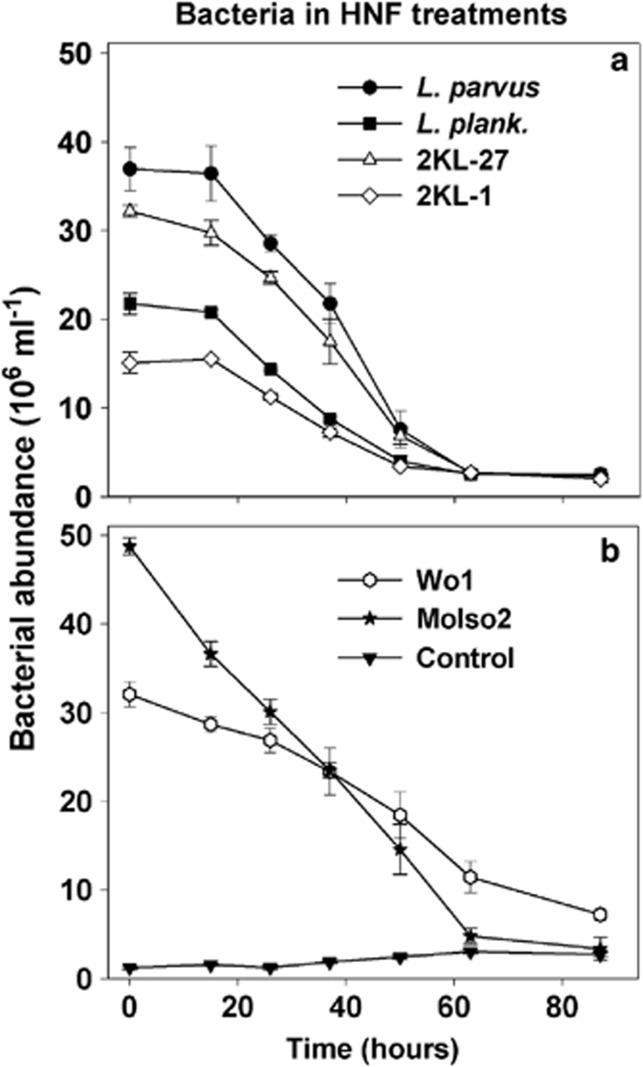
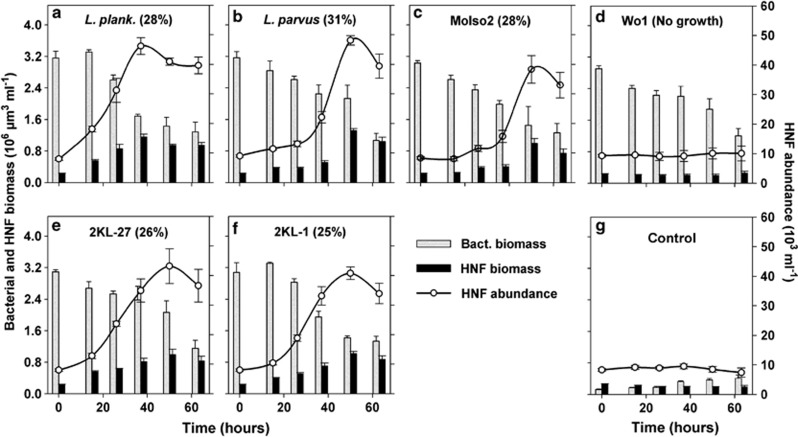
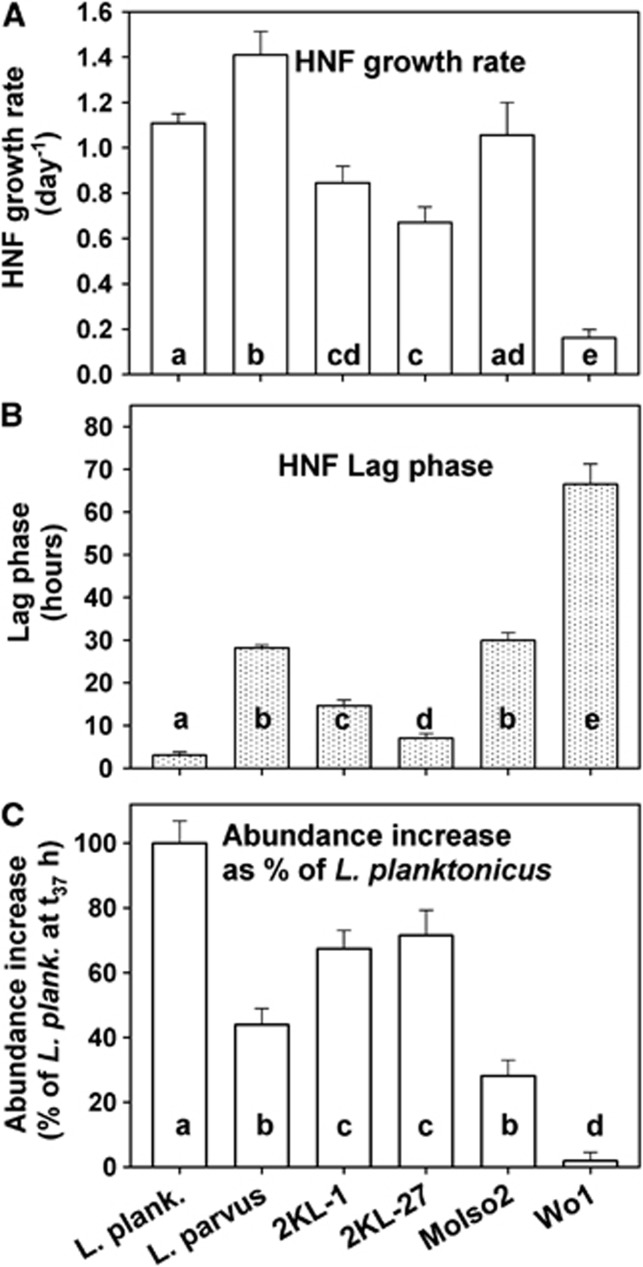
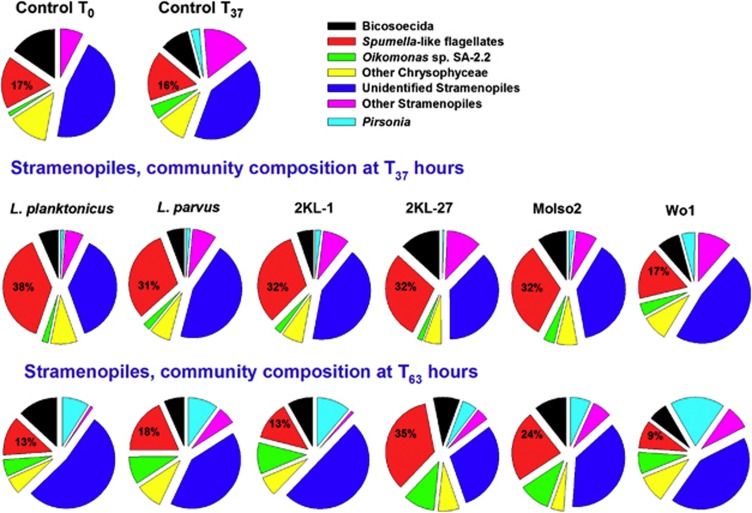
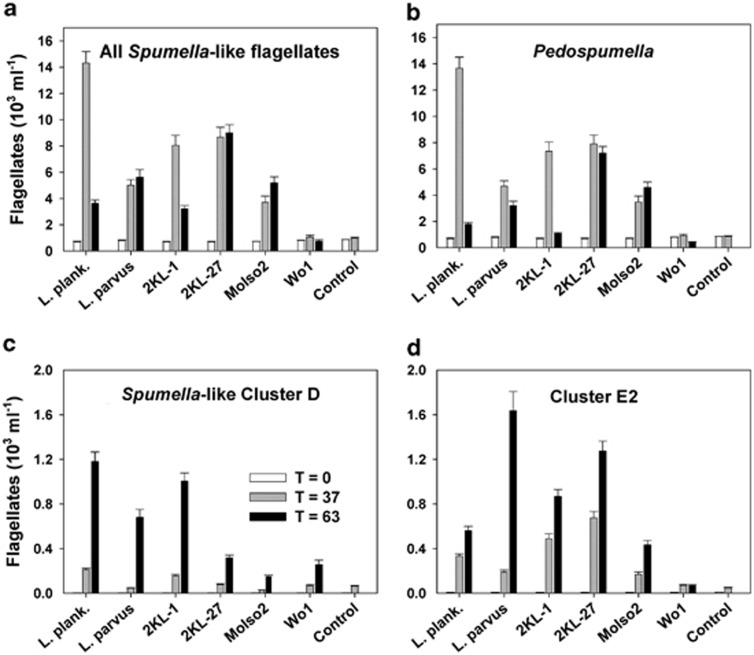
Different bacterial strains can have different value as food for heterotrophic nanoflagellates (HNF), thus modulating HNF growth and community composition. We examined the influence of prey food quality using four Limnohabitans strains, one Polynucleobacter strain and one freshwater actinobacterial strain on growth (growth rate, length of lag phase and growth efficiency) and community composition of a natural HNF community from a freshwater reservoir. Pyrosequencing of eukaryotic small subunit rRNA amplicons was used to assess time-course changes in HNF community composition. All four Limnohabitans strains and the Polynucleobacter strain yielded significant HNF community growth while the actinobacterial strain did not although it was detected in HNF food vacuoles. Notably, even within the Limnohabitans strains we found significant prey-related differences in HNF growth parameters, which could not be related only to size of the bacterial prey. Sequence data characterizing the HNF communities showed also that different bacterial prey items induced highly significant differences in community composition of flagellates. Generally, Stramenopiles dominated the communities and phylotypes closely related to Pedospumella (Chrysophyceae) were most abundant bacterivorous flagellates rapidly reacting to addition of the bacterial prey of high food quality.
Figures
Similar articles
-
Prey-Specific Growth Responses of Freshwater Flagellate Communities Induced by Morphologically Distinct Bacteria from the Genus Limnohabitans.Appl Environ Microbiol. 2015 Aug;81(15):4993-5002. doi: 10.1128/AEM.00396-15. Epub 2015 May 15. Appl Environ Microbiol. 2015. PMID: 25979896 Free PMC article.
-
Cascading effects in freshwater microbial food webs by predatory Cercozoa, Katablepharidacea and ciliates feeding on aplastidic bacterivorous cryptophytes.FEMS Microbiol Ecol. 2020 Oct 6;96(10):fiaa121. doi: 10.1093/femsec/fiaa121. FEMS Microbiol Ecol. 2020. PMID: 32556274 Free PMC article.
-
Grazer and virus-induced mortality of bacterioplankton accelerates development of Flectobacillus populations in a freshwater community.Environ Microbiol. 2007 Mar;9(3):789-800. doi: 10.1111/j.1462-2920.2006.01201.x. Environ Microbiol. 2007. PMID: 17298377
-
Bacterivory by heterotrophic flagellates: community structure and feeding strategies.Antonie Van Leeuwenhoek. 2002 Aug;81(1-4):465-80. doi: 10.1023/a:1020509305868. Antonie Van Leeuwenhoek. 2002. PMID: 12448743 Review.
-
The significance of inter- and intraspecific variation in bacterivorous and herbivorous protists.Antonie Van Leeuwenhoek. 2002 Aug;81(1-4):327-41. doi: 10.1023/a:1020547517255. Antonie Van Leeuwenhoek. 2002. PMID: 12448731 Review.
Cited by
-
Arsenic and Mercury Distribution in an Aquatic Food Chain: Importance of Femtoplankton and Picoplankton Filtration Fractions.Environ Toxicol Chem. 2023 Jan;42(1):225-241. doi: 10.1002/etc.5516. Epub 2022 Dec 9. Environ Toxicol Chem. 2023. PMID: 36349954 Free PMC article.
-
Bacterioplankton seasonality in deep high-mountain lakes.Front Microbiol. 2022 Sep 14;13:935378. doi: 10.3389/fmicb.2022.935378. eCollection 2022. Front Microbiol. 2022. PMID: 36187988 Free PMC article.
-
Trophic flexibility of marine diplonemids - switching from osmotrophy to bacterivory.ISME J. 2022 May;16(5):1409-1419. doi: 10.1038/s41396-022-01192-0. Epub 2022 Jan 18. ISME J. 2022. PMID: 35042972 Free PMC article.
-
Synchrony of Eukaryotic and Prokaryotic Planktonic Communities in Three Seasonally Sampled Austrian Lakes.Front Microbiol. 2018 Jun 15;9:1290. doi: 10.3389/fmicb.2018.01290. eCollection 2018. Front Microbiol. 2018. PMID: 29963032 Free PMC article.
-
Cryptophyta as major bacterivores in freshwater summer plankton.ISME J. 2018 Jun;12(7):1668-1681. doi: 10.1038/s41396-018-0057-5. Epub 2018 Feb 20. ISME J. 2018. PMID: 29463895 Free PMC article.
References
-
- Altschul SF, Gish W, Miller W, Myers EW, Lipman DJ. Basic local alignment search tool. J Mol Biol. 1990;215:403–410. - PubMed
-
- Boenigk J, Arndt H. Bacterivory by heterotrophic flagellates: community structure and feeding strategies. Anton Leeuw Int J G. 2002;81:465–480. - PubMed
-
- Boenigk J, Jost S, Stoeck T, Garstecki T. Differential thermal adaptation of clonal strains of a protist morphospecies originating from different climatic zones. Environ Microbiol. 2007;9:593–602. - PubMed
-
- Boenigk J, Pfandl K, Stadler P, Chatzinotas A. High diversity of the ‘Spumella-like' flagellates: an investigation based on the SSU rRNA gene sequences of isolates from habitats located in six different geographic regions. Environ Microbiol. 2005;7:685–697. - PubMed
Publication types
MeSH terms
LinkOut - more resources
Full Text Sources
Other Literature Sources
