. 2013 Apr 11;496(7444):187-92.
doi: 10.1038/nature12062. Epub 2013 Apr 3.

The architecture of Tetrahymena telomerase holoenzyme

Affiliations

The architecture of Tetrahymena telomerase holoenzyme

Jiansen Jiang et al. Nature. .

Abstract

Telomerase adds telomeric repeats to chromosome ends using an internal RNA template and a specialized telomerase reverse transcriptase (TERT), thereby maintaining genome integrity. Little is known about the physical relationships among protein and RNA subunits within a biologically functional holoenzyme. Here we describe the architecture of Tetrahymena thermophila telomerase holoenzyme determined by electron microscopy. Six of the seven proteins and the TERT-binding regions of telomerase RNA (TER) have been localized by affinity labelling. Fitting with high-resolution structures reveals the organization of TERT, TER and p65 in the ribonucleoprotein (RNP) catalytic core. p50 has an unanticipated role as a hub between the RNP catalytic core, p75-p19-p45 subcomplex, and the DNA-binding Teb1. A complete in vitro holoenzyme reconstitution assigns function to these interactions in processive telomeric repeat synthesis. These studies provide the first view of the extensive network of subunit associations necessary for telomerase holoenzyme assembly and physiological function.


Figures
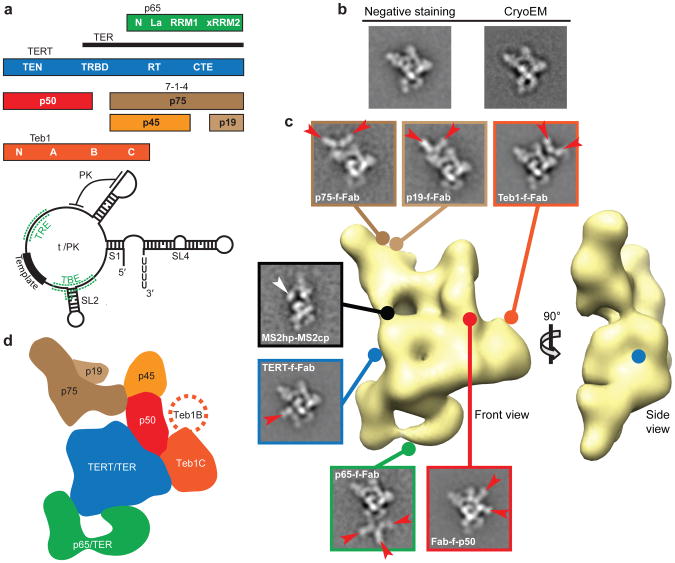
Figure 1
Figure 1. EM reconstruction of Tetrahymena telomerase holoenzyme and subunit localization
a, Holoenzyme subunits and domains (top) and TER secondary structure (below). b, Representative class averages of negative staining EM and cryoEM images of TERT-f telomerase. c, 3D reconstruction of Teb1-f telomerase (front and side views) and class averages of affinity labeled telomerase particles. Lines with circle heads indicate attachment point of Fab (red arrows) and MS2cp (white arrow). Side-lengths of class averages in this and subsequent figures are 350 Å. d, Subunit schematic (front view).
Figure 2
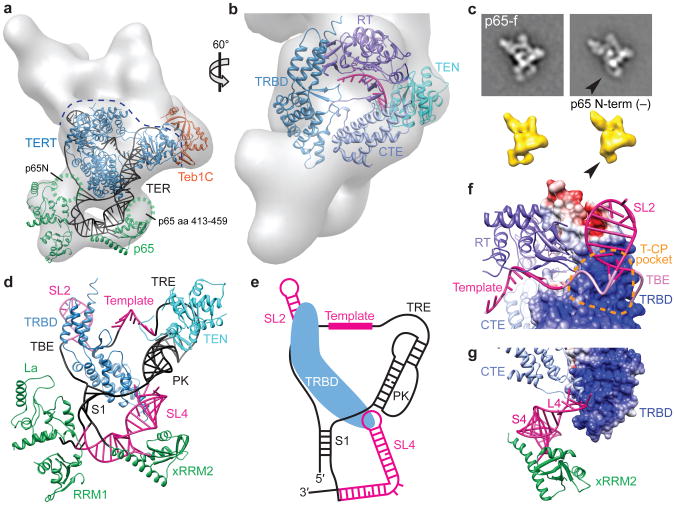
Figure 2. Structure of the RNP catalytic core
a, 3D reconstruction of Teb1-f telomerase with TERT, p65, and TER (black), plus Teb1C modeled into the EM density. The dashed line indicates the top boundary of TERT/TER. b, Zoomed and rotated view of (a) showing TERT domains TEN, CTE, TRBD, and RT, with TER template and essential Mg2+ at the active site in magenta. c, Class averages of p65-f telomerase (top) and 3D reconstructions (bottom) of TERT-f telomerase with p65 (left) and p65 missing N-terminal density (right, black arrows). d, TER model structure (well determined, magenta; remaining, black) and interactions with TERT TRBD and TEN and p65 La, RRM1, and xRRM2 domains. e, Secondary structure schematic of TER with TRBD. f, Modeled interaction between TBE (pink) and TRBD T-CP pocket. g, Modeled interactions of distal SL4 with CTE and bottom of TRBD. In f,g TRBD is shown as GRASP surface.
Figure 3
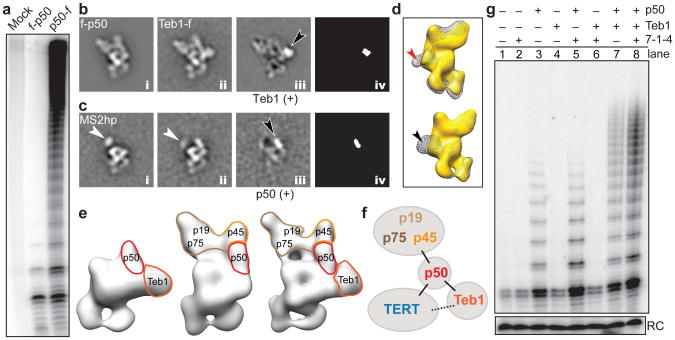
Figure 3. p50 anchors TERT, 7-1-4, and Teb1
a, Primer extension assay of FLAG antibody purifications from cell extracts lacking a tagged subunit (mock) or with f-p50 or p50-f. b, Class averages of f-p50 telomerase (i), Teb1-f telomerase (ii), difference map by subtracting i from ii (iii), and map of statistically significant (>4 σ) regions in the difference map (iv). Black arrow points to Teb1 density. c, MS2hp telomerase class averages containing MS2cp without p50 (i), with p50 (ii), difference map (iii), and statistically significant regions (iv) as in (b). White and black arrows point to MS2cp and p50 densities, respectively. 7-1-4 is not seen in these class averages. d, Back view of 3D reconstructions of TERT-f telomerase lacking Teb1 (gold) overlaid with (top) Fab-f-p50 (gray mesh) and (bottom) Teb1-f telomerase (gray mesh) showing that Fab (red arrow) occupies the same site as Teb1 (black arrow). e, 3D reconstructions of TERT-f telomerase lacking 7-1-4 (left), lacking Teb1 (middle), and holoenzyme (right). f, Schematic of subunit interactions. g, Primer extension assay of the RNP catalytic core (TERT-TER-p65) reconstituted with additional combinations of 7-1-4, p50, and/or Teb1BC. Reactions were for 5 min. RC is a radiolabeled oligonucleotide added to telomerase products as a precipitation recovery control.
Figure 4
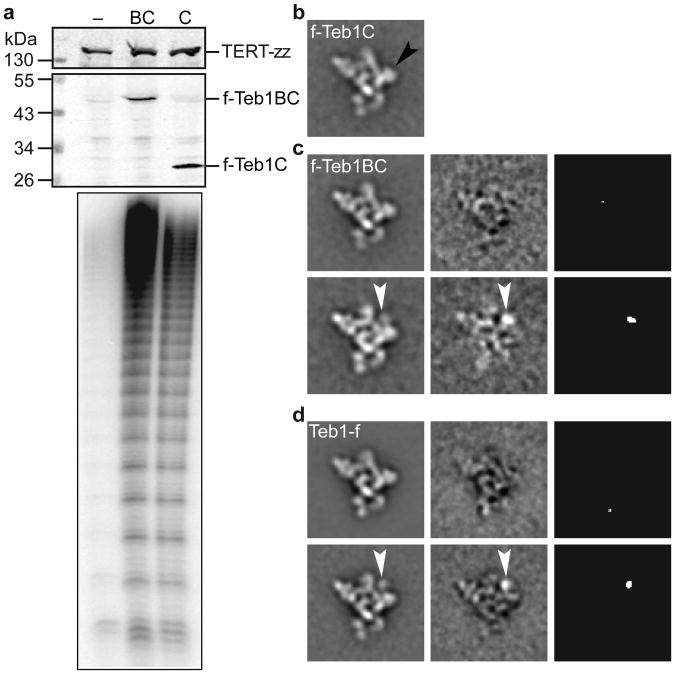
Figure 4. Contribution of Teb1 domains to holoenzyme structure and activity
a, Cell extract western blots and two-step purified enzyme primer extension assays of f-Teb1BC (BC, lane 2) and f-Teb1C (C, lane 3) telomerase. Cell extract with TERT-zz alone (–, lane 1) is a negative control for specificity of f-Teb1BC and f-Teb1C binding to FLAG antibody. b-d, Comparison of class averages (left column) of f-Teb1C (b), f-Teb1BC (c), and Teb1-f (d) telomerases. Density assigned to Teb1B (white arrows) was seen in <5% of particles, while density for Teb1C (black arrow in b) occupies a fixed position in all particles. Class averages without and with Teb1B density are represented by the upper and lower rows of c and d, respectively. Difference maps (middle column) by subtracting b from the respective class averages and maps of statistically significant (>4 σ) regions in the difference maps (right column) in c and d show Teb1B density (white arrows).
Figure 5
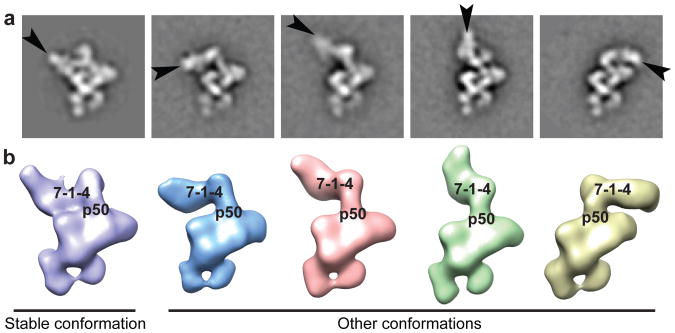
Figure 5. Positional dynamics of 7-1-4
a, Teb1-f telomerase class averages with p75 indicated (black arrows). b, 3D reconstructions of Teb1-f telomerase showing different positions of 7-1-4.

Comment in

References

    1. Artandi SE, DePinho RA. Telomeres and telomerase in cancer. Carcinogenesis. 2010;31:9–18. - PMC - PubMed
    1. Armanios M, Blackburn EH. The telomere syndromes. Nat Rev Genet. 2012;13:693–704. - PMC - PubMed
    1. Blackburn EH, Greider CW, Szostak JW. Telomeres and telomerase: The path from maize, Tetrahymena and yeast to human cancer and aging. Nat Med. 2006;12:1133–1138. - PubMed
    1. Egan ED, Collins K. Biogenesis of telomerase ribonucleoproteins. RNA. 2012;18:1747–1759. - PMC - PubMed
    1. Podlevsky JD, Chen JJL. It all comes together at the ends: Telomerase structure, function, and biogenesis. Mutat Res Fundam Mol Mech Mugag. 2012;730:3–11. - PMC - PubMed

Publication types

MeSH terms