Review
. 2013 Jun;8(3):594-607.
doi: 10.1007/s11481-013-9442-z. Epub 2013 Apr 4.

Targeting the glutamatergic system for the treatment of HIV-associated neurocognitive disorders

Affiliations
Review

Targeting the glutamatergic system for the treatment of HIV-associated neurocognitive disorders

Michelle C Potter et al. J Neuroimmune Pharmacol. 2013 Jun.

Abstract

The accumulation of excess glutamate in the extracellular space as a consequence of CNS trauma, neurodegenerative diseases, infection, or deregulation of glutamate clearance results in neuronal damage by excessive excitatory neurotransmission. Glutamate excitotoxicity is thought to be one of several mechanisms by which HIV exerts neurotoxicity that culminates in HIV-associated neurocognitive disorders (HAND). Excess glutamate is released upon HIV infection of macrophage/microglial cells and has been associated with neurotoxicity mediated by gp120, transactivator of transcription (Tat) and other HIV proteins. Several strategies have been used over the years to try to prevent glutamate excitotoxicity. Since the main toxic effects of excess glutamate are thought to be due to excitotoxicity from over activation of glutamate receptors, antagonists of these receptors have been popular therapeutic targets. Early work to ameliorate the effects of excess extracellular glutamate focused on NMDA receptor antagonism, but unfortunately, potent blockade of this receptor has been fraught with side effects. One alternative to direct receptor blockade has been the inhibition of enzymes responsible for the production of glutamate such as glutaminase and glutamate carboxypeptidase II. Another approach has been to regulate the transporters responsible for modulation of extracellular glutamate such as excitatory amino acid transporters and the glutamate-cystine antiporter. There is preliminary experimental evidence that these approaches have potential therapeutic utility for the treatment of HAND. These efforts however, are at an early stage where the next steps are dependent on the identification of drug-like inhibitors as well as the development of predictive neuroAIDS animal models.


Figures
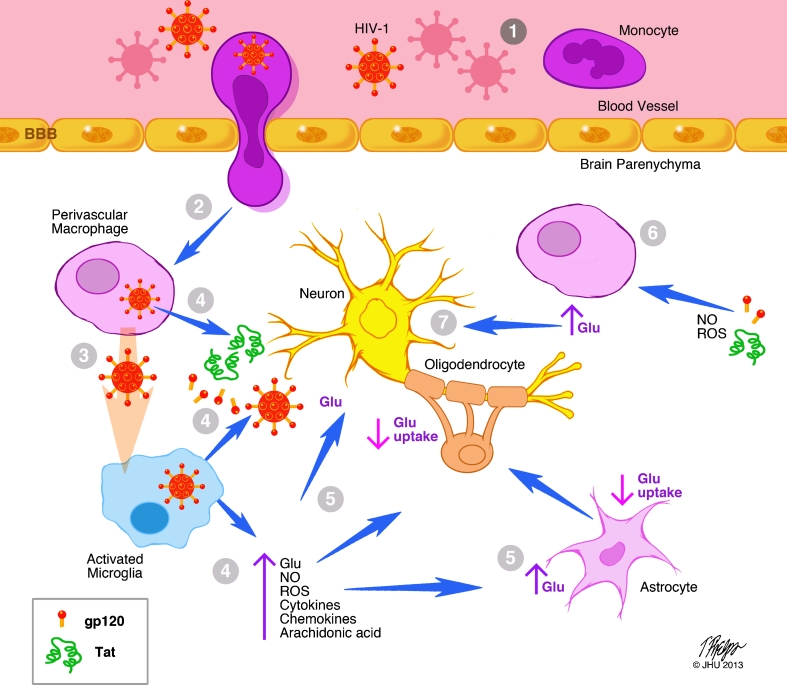
Fig. 1
Fig. 1
Mechanisms of glutamate excitoxicity during HIV-1 infection (1) Infection of circulating monocytes with HIV-1. (2) HIV-1 infected macrophages cross the BBB and become perivascular macrophages. (3) HIV-1 infected perivascular macrophages in the brain parenchyma release viral particles that infect other brain macrophages and microglial cells. (4) Activated macrophages and microglial cells release viral proteins gp120 and Tat, glutamate and other factors such as NO, ROS, cytokines, chemokines and arachidonic acid that can either directly or indirectly affect glutamate metabolism and/or transport. (5) Decrease in glutamate uptake by oligodendrocytes and astrocytes due to increased levels of these toxins released by HIV-1 infected macrophages and microglial cells. These factors also cause an increase in vesicular glutamate release by astrocytes. (6) Viral proteins Tat and gp120 and oxidative stress induced by ROS and NO cause an increase in the activity of xCT in uninfected perivascular macrophages and microglia and as a consequence extracellular levels of glutamate increase. (7) Excessive extracellular glutamate triggers activation of glutamate receptors on neurons causing an increase in the intracellular calcium levels, cell death and neuronal degeneration
Fig. 2
Fig. 2
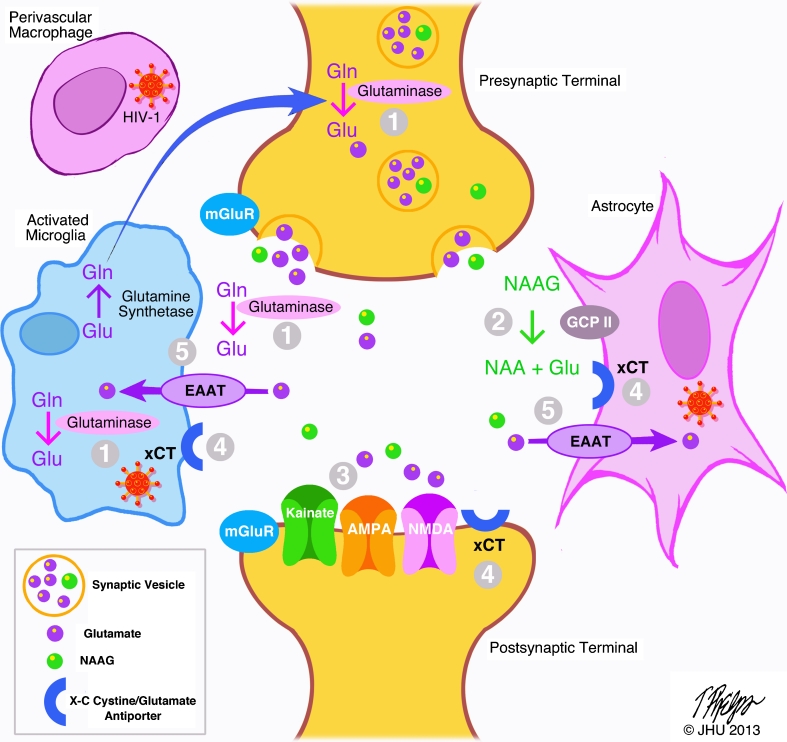
Potential ways to regulate glutamate excitotoxicity for the treatment of HAND (1) Inhibition of glutaminase - glutaminase is a neuronal enzyme that produces glutamate by the deamination of glutamine. During HIV-1 infection, it is increased in glial cells and the synaptic cleft. (2) Inhibition of GCPII - GCPII is an astrocytic enzyme that catalyzes the hydrolysis of NAAG to N-acetyl aspartate (NAA) and glutamate. (3) Blockade of glutamate receptors- glutamate receptors such as NMDA, AMPA, kainate and mGluR are targets for inhibition of glutamate excitotoxicity in HAND. (4) Inhibition of xCT - xCT transports extracellular cys2 into cells and intracellular glutamate into the extracellular space. (5) Activation of glutamate transporters (e.g. EAAT1) – glutamate transporters mobilize glutamate away from the synaptic cleft. Glutamate and NAAG are released through intracellular vesicles at the presynaptic terminal during neurotransmission. The illustration shows NAAG and glutamate in the same vesicles but it is not known if they are in the same or different vesicles

References

    1. Anderson ER, Gendelman HE, Xiong H. Memantine protects hippocampal neuronal function in murine human immunodeficiency virus type 1 encephalitis. J Neurosci. 2004;24:7194–7198. doi: 10.1523/JNEUROSCI.1933-04.2004. - DOI - PMC - PubMed
    1. Angelini G, Gardella S, Ardy M, Ciriolo MR, Filomeni G, Di Trapani G, Clarke F, Sitia R, Rubartelli A. Antigen-presenting dendritic cells provide the reducing extracellular microenvironment required for T lymphocyte activation. Proc Natl Acad Sci U S A. 2002;99:1491–1496. doi: 10.1073/pnas.022630299. - DOI - PMC - PubMed
    1. Avgeropoulos N, Kelley B, Middaugh L, Arrigo S, Persidsky Y, Gendelman HE, Tyor WR. SCID mice with HIV encephalitis develop behavioral abnormalities. J Acquir Immune Defic Syndr Hum Retrovirol. 1998;18:13–20. doi: 10.1097/00042560-199805010-00003. - DOI - PubMed
    1. Bagetta G, Finazzi-Agro A, Palma E, Nistico G. Intracerebral injection of human immunodeficiency virus type 1 coat glycoprotein GP120 does not produce neurodegeneration in rats. Neurosci Lett. 1994;176:97–100. doi: 10.1016/0304-3940(94)90880-X. - DOI - PubMed
    1. Bajetto A, Bonavia R, Barbero S, Schettini G. Characterization of chemokines and their receptors in the central nervous system: physiopathological implications. J Neurochem. 2002;82:1311–1329. doi: 10.1046/j.1471-4159.2002.01091.x. - DOI - PubMed

Publication types

MeSH terms

Substances