


Prospective trial comparing full-field digital mammography (FFDM) versus combined FFDM and tomosynthesis in a population-based screening programme using independent double reading with arbitration
- PMID: 23553585
- PMCID: PMC3701792
- DOI: 10.1007/s00330-013-2820-3
Prospective trial comparing full-field digital mammography (FFDM) versus combined FFDM and tomosynthesis in a population-based screening programme using independent double reading with arbitration
Abstract
Objectives: To compare double readings when interpreting full field digital mammography (2D) and tomosynthesis (3D) during mammographic screening.
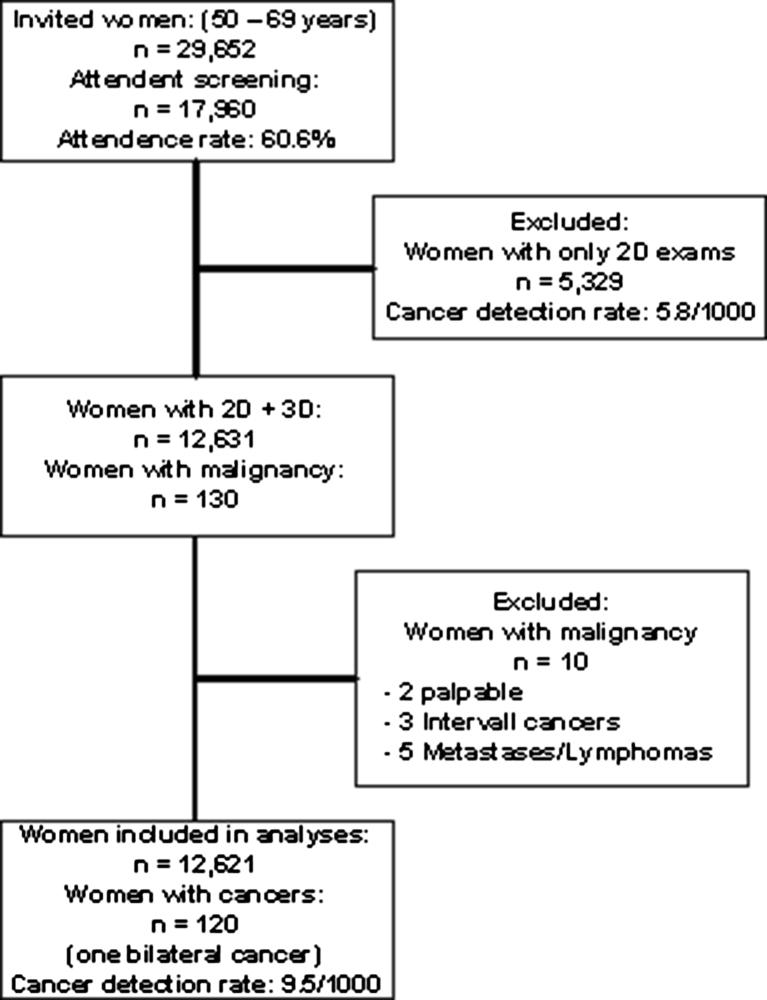
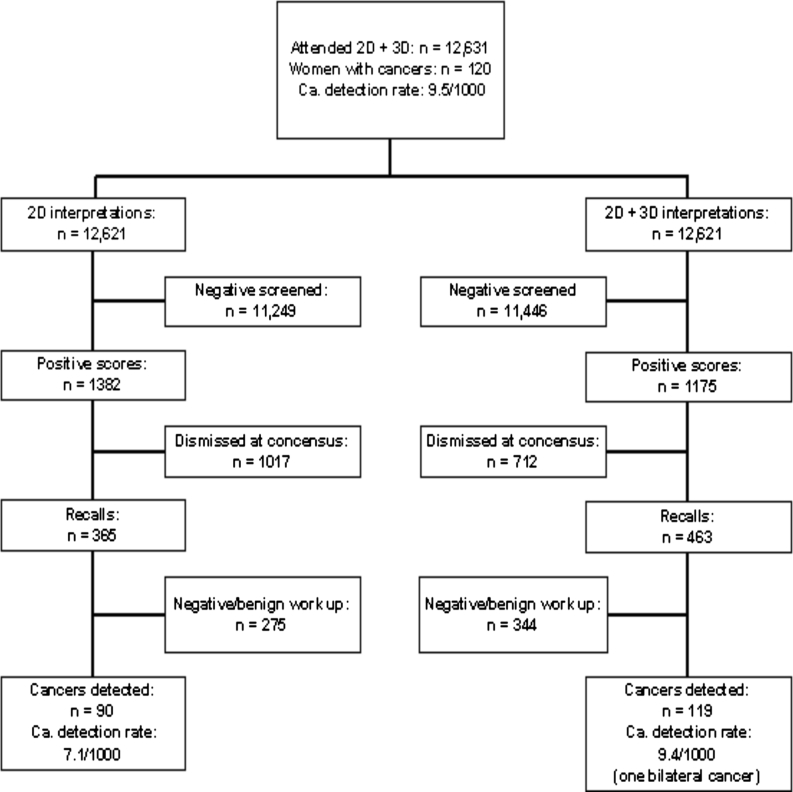
Methods: A prospective, Ethical Committee approved screening study is underway. During the first year 12,621 consenting women underwent both 2D and 3D imaging. Each examination was independently interpreted by four radiologists under four reading modes: Arm A-2D; Arm B-2D + CAD; Arm C-2D + 3D; Arm D-synthesised 2D + 3D. Examinations with a positive score by at least one reader were discussed at an arbitration meeting before a final management decision. Paired double reading of 2D (Arm A + B) and 2D + 3D (Arm C + D) were analysed. Performance measures were compared using generalised linear mixed models, accounting for inter-reader performance heterogeneity (P < 0.05).
Results: Pre-arbitration false-positive scores were 10.3 % (1,286/12,501) and 8.5 % (1,057/12,501) for 2D and 2D + 3D, respectively (P < 0.001). Recall rates were 2.9 % (365/12,621) and 3.7 % (463/12,621), respectively (P = 0.005). Cancer detection was 7.1 (90/12,621) and 9.4 (119/12,621) per 1,000 examinations, respectively (30 % increase, P < 0.001); positive predictive values (detected cancer patients per 100 recalls) were 24.7 % and 25.5 %, respectively (P = 0.97). Using 2D + 3D, double-reading radiologists detected 27 additional invasive cancers (P < 0.001).
Conclusion: Double reading of 2D + 3D significantly improves the cancer detection rate in mammography screening.
Key points: • Tomosynthesis-based screening was successfully implemented in a large prospective screening trial. • Double reading of tomosynthesis-based examinations significantly reduced false-positive interpretations. • Double reading of tomosynthesis significantly increased the detection of invasive cancers.
Figures
References
-
- EUROSCREEN Working Group Summary of the evidence of breast cancer service screening outcomes in Europe and first estimate of the benefit and harm balance sheet. J Med Screen. 2012;19(Suppl 1):5–13. - PubMed
Publication types
MeSH terms
LinkOut - more resources
Full Text Sources
Other Literature Sources
Medical
Miscellaneous
