. 2013 Apr 16;110(16):6530-5.
doi: 10.1073/pnas.1304321110. Epub 2013 Apr 3.

Epoxy metabolites of docosahexaenoic acid (DHA) inhibit angiogenesis, tumor growth, and metastasis

Affiliations

Epoxy metabolites of docosahexaenoic acid (DHA) inhibit angiogenesis, tumor growth, and metastasis

Guodong Zhang et al. Proc Natl Acad Sci U S A. .

Abstract

Epidemiological and preclinical evidence supports that omega-3 dietary fatty acids (fish oil) reduce the risks of macular degeneration and cancers, but the mechanisms by which these omega-3 lipids inhibit angiogenesis and tumorigenesis are poorly understood. Here we show that epoxydocosapentaenoic acids (EDPs), which are lipid mediators produced by cytochrome P450 epoxygenases from omega-3 fatty acid docosahexaenoic acid, inhibit VEGF- and fibroblast growth factor 2-induced angiogenesis in vivo, and suppress endothelial cell migration and protease production in vitro via a VEGF receptor 2-dependent mechanism. When EDPs (0.05 mg · kg(-1) · d(-1)) are coadministered with a low-dose soluble epoxide hydrolase inhibitor, EDPs are stabilized in circulation, causing ~70% inhibition of primary tumor growth and metastasis. Contrary to the effects of EDPs, the corresponding metabolites derived from omega-6 arachidonic acid, epoxyeicosatrienoic acids, increase angiogenesis and tumor progression. These results designate epoxyeicosatrienoic acids and EDPs as unique endogenous mediators of an angiogenic switch to regulate tumorigenesis and implicate a unique mechanistic linkage between omega-3 and omega-6 fatty acids and cancers.


Conflict of interest statement

Conflict of interest statement: University of California holds patents from the laboratory of B.D.H. on sEHI for the treatment of inflammation, hypertension, pain and other indications.

Figures
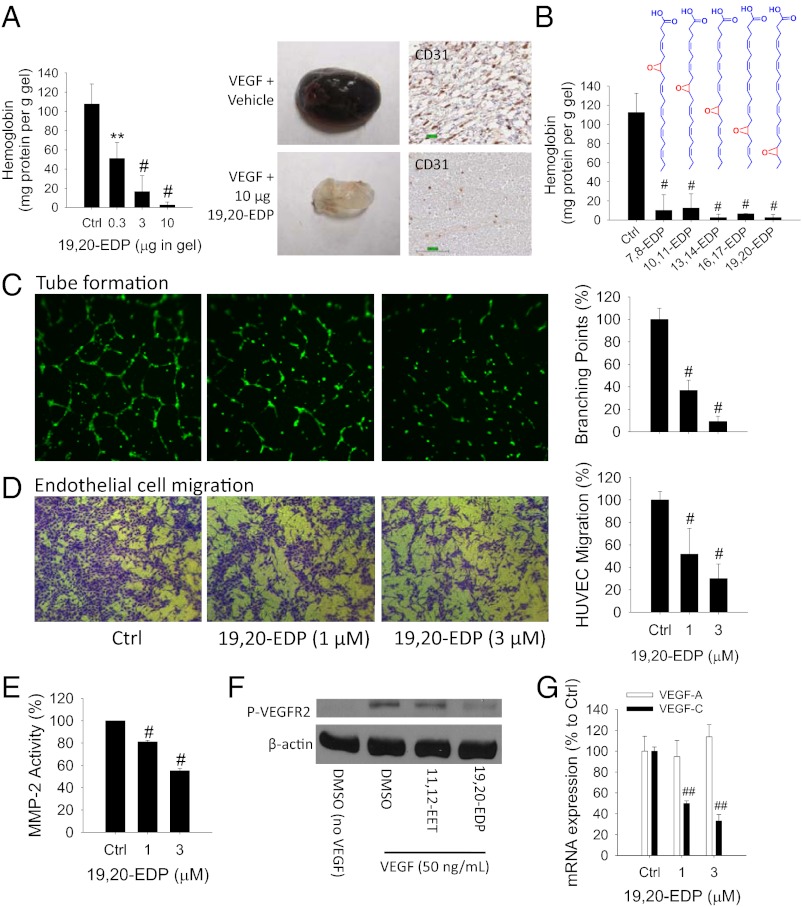
Fig. 1.
Fig. 1.
EDPs inhibit angiogenesis. (A) The 19,20-EDP inhibited VEGF-induced angiogenesis in a Matrigel plug assay in C57BL/6 mice in a dose-dependent manner (n = 4–6 mice per group). Dose of VEGF is 100 ng per gel. (Left) Quantification of angiogenesis using hemoglobin assay. (Right) Image of representative gels and immunohistochemistry for CD31. (B) All EDP regioisomers inhibited VEGF-induced angiogenesis in mice (n = 6–10 mice per group). Dose of EDP regioisomer was 10 µg per gel. (C) The 19,20-EDP inhibited endothelial tube formation after 6-h treatment in HUVECs. (Left) Calcein AM-stained HUVEC microscopy. (Right) Quantification of tube formation. (D) The 19,20-EDP inhibited VEGF-induced cell migration of HUVECs on extracellular matrix protein fibronectin after 18-h treatment in HUVECs. (Left) Crystal violet-stained HUVEC microscopy. (Right) Quantification of migrated cells. (E) The 19,20-EDP inhibited MMP activity after 4-h treatment in HUVECs. (F) At a dose of 1 µM, 19,20-EDP not 14,15-EET, inhibited VEGF-induced VEGFR2 phosphorylation after 10-min treatment in HUVECs. (G) The 19,20-EDP inhibited VEGF-C mRNA expression after 6-h treatment in HUVECs. Results are presented as means ± SD. *P < 0.05; **P < 0.01; #P < 0.001; ##P < 0.00001.
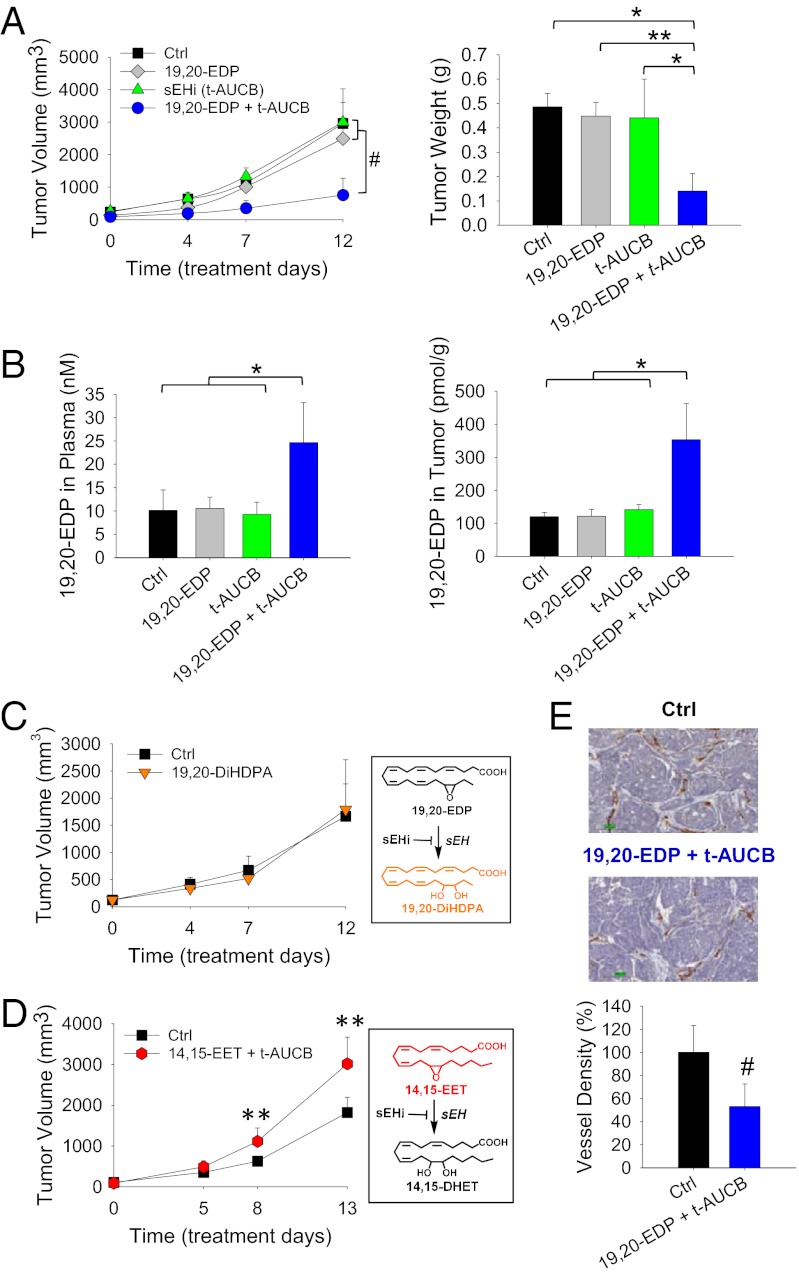
Fig. 2.
Fig. 2.
EDPs inhibit primary tumor growth. (A) Coadministration of 19,20-EDP (0.05 mg⋅kg−1⋅d−1) and sEHi t-AUCB (1 mg⋅kg−1⋅d−1) suppressed Met-1 breast tumor growth (Ctrl: n = 9 mice per group; 19,20-EDP: n = 8; t-AUCB: n = 5; 19,20-EDP + t-AUCB: n = 11). (Left) Quantification of tumor volume. (Right) Quantification of tumor weight on day 12 of treatment. (B) Analysis of 19,20-EDP in the plasma and tumors of treated mice, coadministration of t-AUCB stabilized 19,20-EDP in vivo. (C) The sEH-metabolite of 19,20-EDP, 19,20-DiHDPA, had no effect on Met-1 tumor growth in mice (n = 4 mice per group). (Right) sEH-dependent metabolic pathway of 19,20-EDP to 19,20-DiHDPA. (D) Contrary to the effect of 19,20-EDP, coadministration of 14,15-EET (0.05 mg⋅kg−1⋅d−1) and sEHi t-AUCB (1 mg⋅kg−1⋅d−1) increased Met-1 tumor growth (n = 6–7 mice per group). (Right) sEH-dependent metabolic pathway of 14,15-EET to 14,15-DHET. (E) Coadministration of 19,20-EDP and t-AUCB reduced tumor vessel density, as defined by the number of CD31-positive blood vessels. (Upper) Image of representative immunohistochemistry for CD31; (Lower) Quantification of tumor vessel density (n = 4 mice per group). Results are presented as means ± SD. *P < 0.05; **P < 0.01; #P < 0.001.
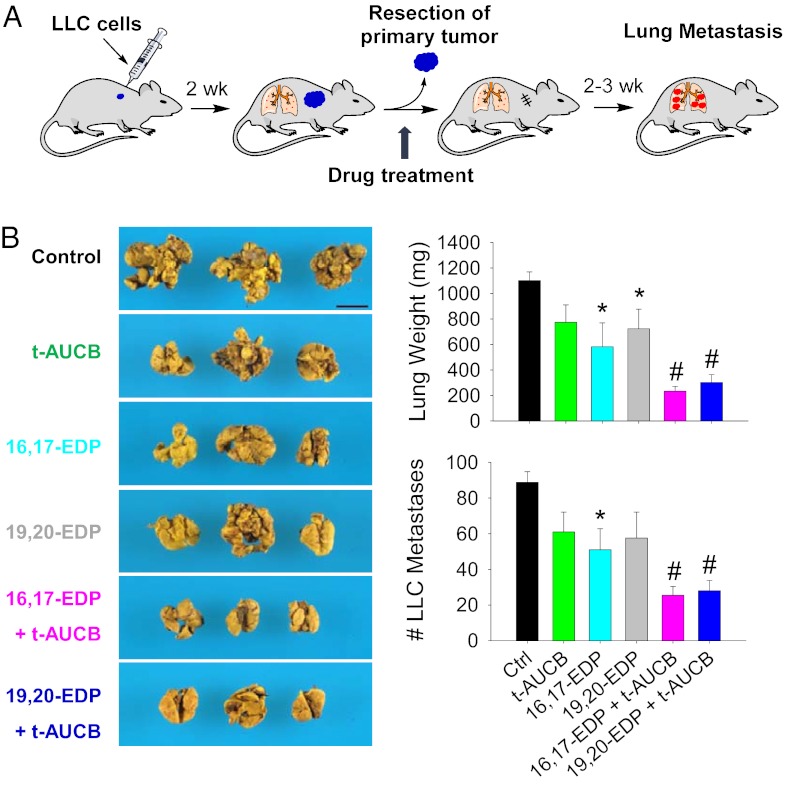
Fig. 3.
Fig. 3.
EDPs inhibit tumor metastasis. (A) Lewis lung carcinoma (LLC) metastasis model in C57BL/6 mice. (B) Spontaneous LLC metastasis was decreased in EDP- and t-AUCB–treated mice relative to vehicle treatment 17 d after primary tumor removal (LLC resection). Images show representative lung metastasis in treated and control mice. (Scale bar, 1 cm.) n = 4–5 mice per group. Results are presented as means ± SEM. *P < 0.05; #P < 0.001.

References

    1. Cho E, et al. Prospective study of dietary fat and the risk of age-related macular degeneration. Am J Clin Nutr. 2001;73(2):209–218. - PubMed
    1. Seddon JM, George S, Rosner B. Cigarette smoking, fish consumption, omega-3 fatty acid intake, and associations with age-related macular degeneration: The US Twin Study of Age-Related Macular Degeneration. Arch Ophthalmol. 2006;124(7):995–1001. - PubMed
    1. SanGiovanni JP, et al. Age-Related Eye Disease Study Research Group The relationship of dietary lipid intake and age-related macular degeneration in a case-control study: AREDS Report No. 20. Arch Ophthalmol. 2007;125(5):671–679. - PubMed
    1. Connor KM, et al. Increased dietary intake of omega-3-polyunsaturated fatty acids reduces pathological retinal angiogenesis. Nat Med. 2007;13(7):868–873. - PMC - PubMed
    1. Wolk A, Larsson SC, Johansson JE, Ekman P. Long-term fatty fish consumption and renal cell carcinoma incidence in women. JAMA. 2006;296(11):1371–1376. - PubMed

Publication types

MeSH terms