. 2013 Apr 1:4:33.
doi: 10.3389/fphar.2013.00033. eCollection 2013.

Integrin activation States and eosinophil recruitment in asthma

Affiliations

Integrin activation States and eosinophil recruitment in asthma

Mats W Johansson et al. Front Pharmacol. .

Abstract

Eosinophil arrest and recruitment to the airway in asthma are mediated, at least in part, by integrins. Eosinophils express α4β1, α6β1, αLβ2, αMβ2, αXβ2, αDβ2, and α4β7 integrins, which interact with counter-receptors on other cells or ligands in the extracellular matrix. Whether a given integrin-ligand pair mediates cell adhesion and migration depends on the activation state of the integrin. Integrins exist in an inactive bent, an intermediate-activity extended closed, and a high-activity extended open conformation. Integrin activation states can be monitored by conformation-specific monoclonal antibodies (mAbs). Studies in mice indicate that both β1 and β2 integrins mediate eosinophil recruitment to the lung. In vitro studies indicate that α4β1 and αMβ2 are the principal integrins mediating eosinophil adhesion, including to vascular cell adhesion molecule-1 and the novel αMβ2 ligand periostin. In vivo, blood eosinophils have intermediate-activity β1 integrins, as judged by mAb N29, apparently resulting from eosinophil binding of P-selectin on the surface of activated platelets, and have a proportion of their β2 integrins in the intermediate conformation, as judged by mAb KIM-127, apparently due to exposure to low concentrations of interleukin-5 (IL-5). Airway eosinophils recovered by bronchoalveolar lavage (BAL) after segmental antigen challenge have high-activity β1 integrins and high-activity αMβ2 that does not require IL-5. Here we review information on how the activation states of eosinophil β1 and β2 integrins correlate with measurements of eosinophil recruitment and pulmonary function in asthma. Blood eosinophil N29 reactivity is associated with decreased lung function under various circumstances in non-severe asthma and KIM-127 with BAL eosinophil numbers, indicating that intermediate-activity α4β1 and αMβ2 of blood eosinophils are important for eosinophil arrest and consequently for recruitment and aspects of asthma.

Keywords: adhesion; asthma; eosinophils; inflammation; integrins.


Figures
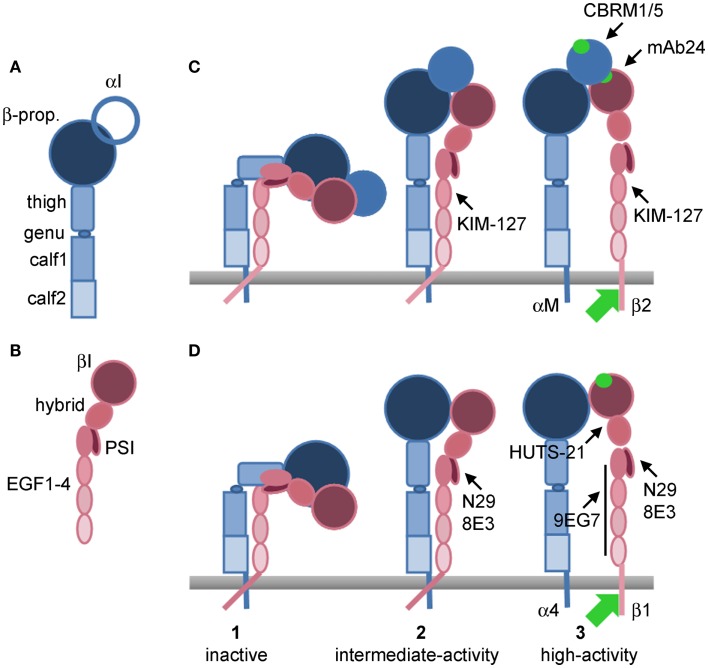
Figure 1
Figure 1
Models of integrin conformations with epitopes for activation-sensitive mAbs. (A) Domains of an integrin α subunit. (B) Domains of an integrin β subunit. (C) Conformational changes during activation of αMβ2 that uncover epitopes for anti-β2 KIM-127 and mAb24, and anti-αM CBRM1/5. (D) Conformational changes during activation of α4β1 that uncover epitopes for anti-β1 N29, 8E3, HUTS-21, and 9EG7. (1) Inactive, bent conformations; (2) intermediate-activity, extended, closed conformations; (3) high-activity, extended, open conformations. In (C) conformation 1 of αMβ2 is presumably KIM-127−/mAb24−/CBRM1/5−, conformation 2 KIM-127+/mAb24−/CBRM1/5−, and conformation 3 KIM-127+/mAb24+/CBRM1/5+. In (D) conformation 1 of α4β1 is presumably N29−/8E3−/HUTS-21−/9EG7−, conformation 2 N29+/8E3+/HUTS-21−/9EG7−, and conformation 3 N29+/8E3+/HUTS-21+/9EG7+. Green circle, ligand-binding site in αI domain in (C) or βI domain in (D), or binding site in βI domain for activated αI domain in (C). Green arrow, cytoplasmic proteins, including talin and kindlins, that bind the β integrin subunit tail and mediate activation. β-prop., β-propeller domain; EGF, integrin epidermal growth factor-like domain; PSI, plexin-semaphorin-integrin domain. Based on (Luo and Springer, ; Luo et al., ; Barthel et al., ; Evans et al., ; Hogg et al., 2011).

References

    1. Agache I., Akdis C., Jutel M., Virchow J. C. (2012). Untangling asthma phenotypes and endotypes. Allergy 67, 835–846 10.1111/j.1398-9995.2012.02832.x - DOI - PubMed
    1. Alon R., Dustin M. L. (2007). Force as a facilitator of integrin conformational changes during leukocyte arrest on blood vessels and antigen-presenting cells. Immunity 26, 17–27 10.1016/j.immuni.2007.01.002 - DOI - PubMed
    1. Anderson G. P. (2008). Endotyping asthma: new insights into key pathogenic mechanisms in a complex, heterogeneous disease. Lancet 372, 1107–1119 10.1016/S0140-6736(08)61018-1 - DOI - PubMed
    1. Askari J. A., Buckley P. A., Mould A. P., Humphries M. J. (2009). Linking integrin conformation to function. J. Cell Sci. 122, 165–170 10.1242/jcs.018556 - DOI - PMC - PubMed
    1. Banerjee E. R., Jiang Y., Henderson W. R., Jr., Latchman Y., Papayannopoulou T. (2009). Absence of alpha 4 but not beta 2 integrins restrains development of chronic allergic asthma using mouse genetic models. Exp. Hematol. 37, 715–727 10.1016/j.exphem.2009.03.010 - DOI - PMC - PubMed

LinkOut - more resources
