


Identification of distant co-evolving residues in antigen 85C from Mycobacterium tuberculosis using statistical coupling analysis of the esterase family proteins
- PMID: 23554685
- PMCID: PMC3597060
- DOI: 10.1016/S1674-8301(11)60021-3
Identification of distant co-evolving residues in antigen 85C from Mycobacterium tuberculosis using statistical coupling analysis of the esterase family proteins
Abstract
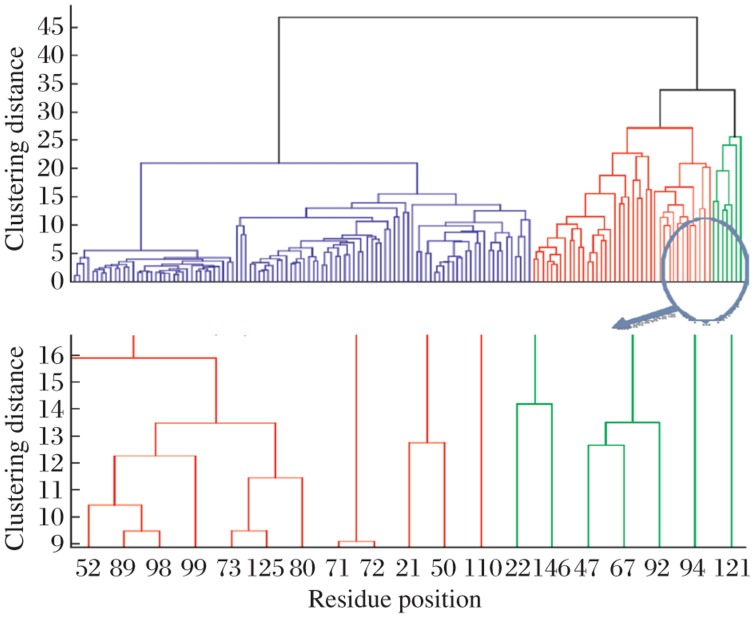
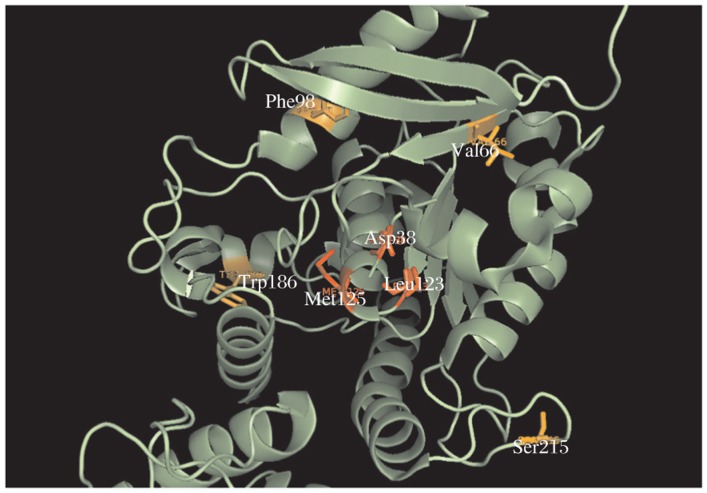
A fundamental goal in cellular signaling is to understand allosteric communication, the process by which signals originating at one site in a protein propagate reliably to affect distant functional sites. The general principles of protein structure that underlie this process remain unknown. Statistical coupling analysis (SCA) is a statistical technique that uses evolutionary data of a protein family to measure correlation between distant functional sites and suggests allosteric communication. In proteins, very distant and small interactions between collections of amino acids provide the communication which can be important for signaling process. In this paper, we present the SCA of protein alignment of the esterase family (pfam ID: PF00756) containing the sequence of antigen 85C secreted by Mycobacterium tuberculosis to identify a subset of interacting residues. Clustering analysis of the pairwise correlation highlighted seven important residue positions in the esterase family alignments. These residues were then mapped on the crystal structure of antigen 85C (PDB ID: 1DQZ). The mapping revealed correlation between 3 distant residues (Asp38, Leu123 and Met125) and suggests allosteric communication between them. This information can be used for a new drug against this fatal disease.
Keywords: Mycobacterium tuberculosis; Protein Data Bank.; antigen 85C; clustering analysis; covariance; esterase family; multiple sequence alignments; pfam; statistical coupling analysis.
Conflict of interest statement
The authors reported no conflict of interest.
Figures
References
-
- Gether U. Uncovering molecular mechanisms involved in activation of G protein coupled receptors. Endocr Rev. 2000;21:90–113. - PubMed
-
- Menon ST, Han M, Sakmar TP. Rhodospin: structural basis of molecular physiology. Physiol Rev. 2001;81:1659–88. - PubMed
-
- Hedstrom L, Szilagyi L, Rutter WJ. Converting trypsin to chymotrypsin: the role of surface loops. Science. 1993;255:1249–53. - PubMed
-
- Hedstrom L. Trypsin: a case study in the structural determinants of enzyme specificity. Biol Chem. 1996;377:465–70. - PubMed
-
- Patten PA, Gray NS, Yang PL, Marks CB, Wedemayer GY, Jay Boniface J. The immunological evolution of catalysis. Science. 1996;271:1086–91. - PubMed
LinkOut - more resources
Full Text Sources
