. 2013;7(3):e2152.
doi: 10.1371/journal.pntd.0002152. Epub 2013 Mar 28.

A Wolbachia wMel transinfection in Aedes albopictus is not detrimental to host fitness and inhibits Chikungunya virus

Affiliations

A Wolbachia wMel transinfection in Aedes albopictus is not detrimental to host fitness and inhibits Chikungunya virus

Marcus S C Blagrove et al. PLoS Negl Trop Dis. 2013.

Abstract

Background: Wolbachia inherited intracellular bacteria can manipulate the reproduction of their insect hosts through cytoplasmic incompatibility (CI), and certain strains have also been shown to inhibit the replication or dissemination of viruses. Wolbachia strains also vary in their relative fitness effects on their hosts and this is a particularly important consideration with respect to the potential of newly created transinfections for use in disease control.

Methodology/principal findings: In Aedes albopictus mosquitoes transinfected with the wMel strain from Drosophila melanogaster, which we previously reported to be unable to transmit dengue in lab challenges, no significant detrimental effects were observed on egg hatch rate, fecundity, adult longevity or male mating competitiveness. All these parameters influence the population dynamics of Wolbachia, and the data presented are favourable with respect to the aim of taking wMel to high population frequency. Challenge with the chikungunya (CHIKV) virus, for which Ae. albopictus is an important vector, was conducted and the presence of wMel abolished CHIKV dissemination to the saliva.

Conclusions/significance: Taken together, these data suggest that introducing wMel into natural Ae. albopictus populations using bidirectional CI could be an efficient strategy for preventing or reducing the transmission of arboviruses by this species.


Conflict of interest statement

The authors have declared that no competing interests exist.

Figures
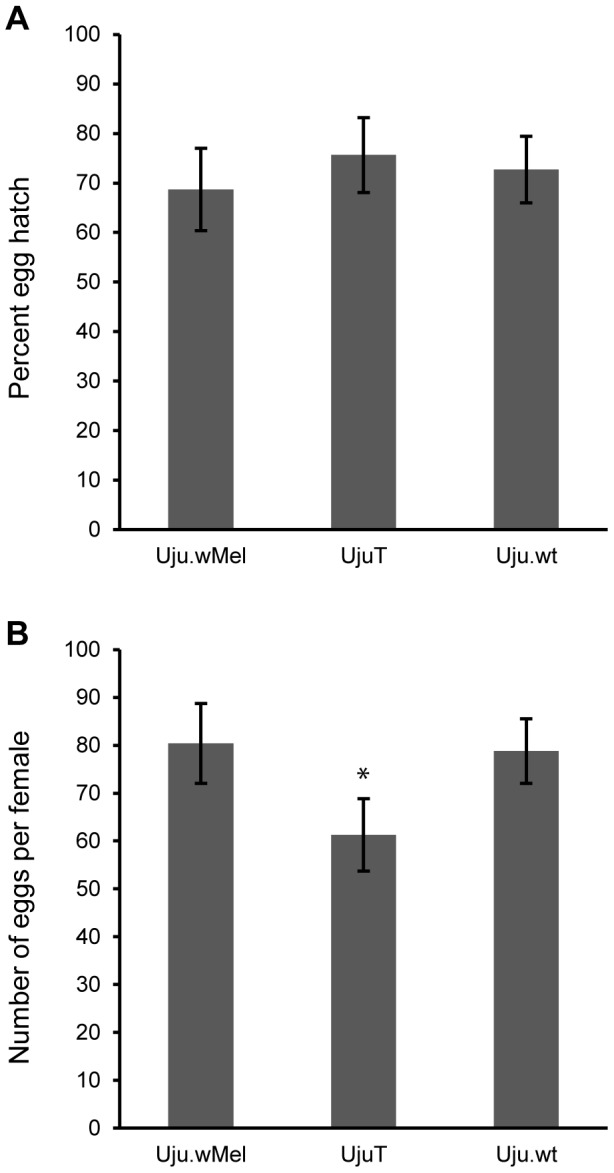
Figure 1
Figure 1. Hatch rate and fecundity of Uju.wMel.
Egg hatch (A) and fecundity or mean number of eggs produced per female per gonotrophic cycle (B) of Uju.wMel was assessed at generation sixteen. Females were blood fed at six days post eclosion, individualized for laying, and eggs hatched after five days. Second instar larvae were counted to calculate percent hatch (A) and eggs per batch per female counted to give fecundity (B). A: Uju.wMel n = 452, UjuT n = 858, Uju.wt n = 508. B: Uju.wMel n = 16, UjuT n = 14, Uju.wt n = 20. Error bars represent the SEM.
Figure 2
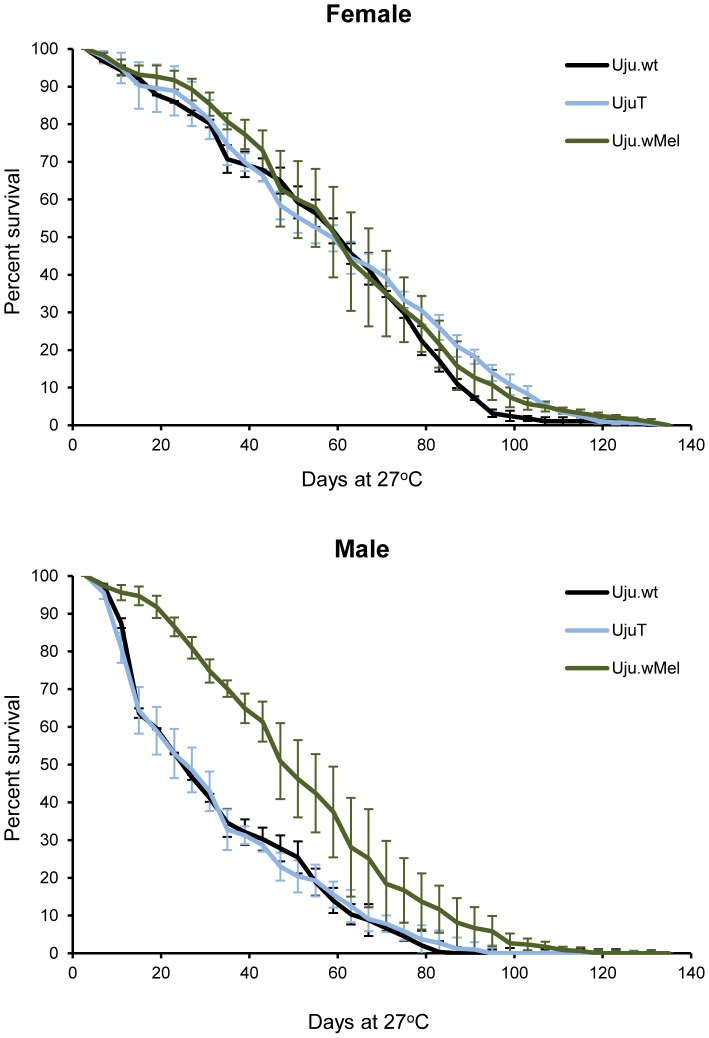
Figure 2. Longevity of Uju.wMel.
The survival over time of three Ae. albopictus lines was assessed in two or three independent replicates of cages containing approximately 100 male and 100 female mosquitoes (total of 1600 mosquitoes in eight cages). A blood meal was provided at seven days, and again every 14 days. Dead mosquitoes were counted and removed every four days. Error bars show the SEM. Male Uju.wMel longevity was significantly increased compared to UjuT and Uju.wt.
Figure 3
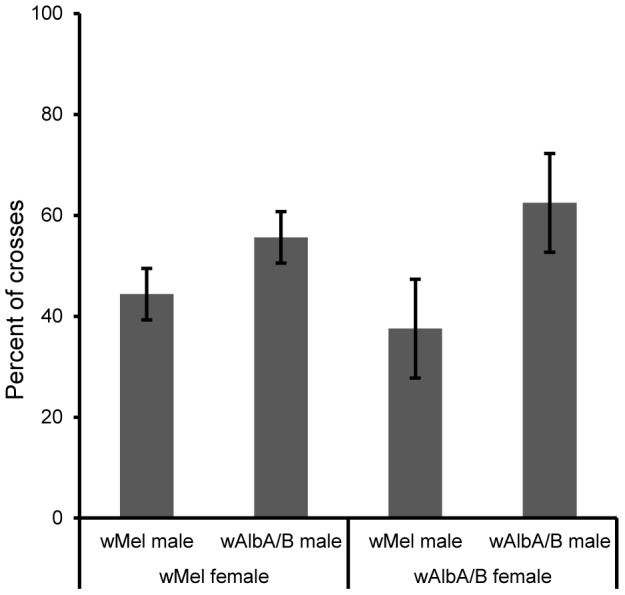
Figure 3. Mating competitiveness of Uju.wMel males.
Competitiveness of Uju.wMel males was assessed using three independent replicates of 50 male Uju.wMel : 50 male Uju.wt (wAlbA/B) : 50 females of either Uju.wMel or Uju.wt (total of 300 females in six cages). Hatching embryos indicated a compatible cross where both male and female parents were infected with the same Wolbachia. Error bars show the SEM. No significant differences in male mating competitiveness were found between the two lines with Chi-squared analysis using a likelihood framework.
Figure 4
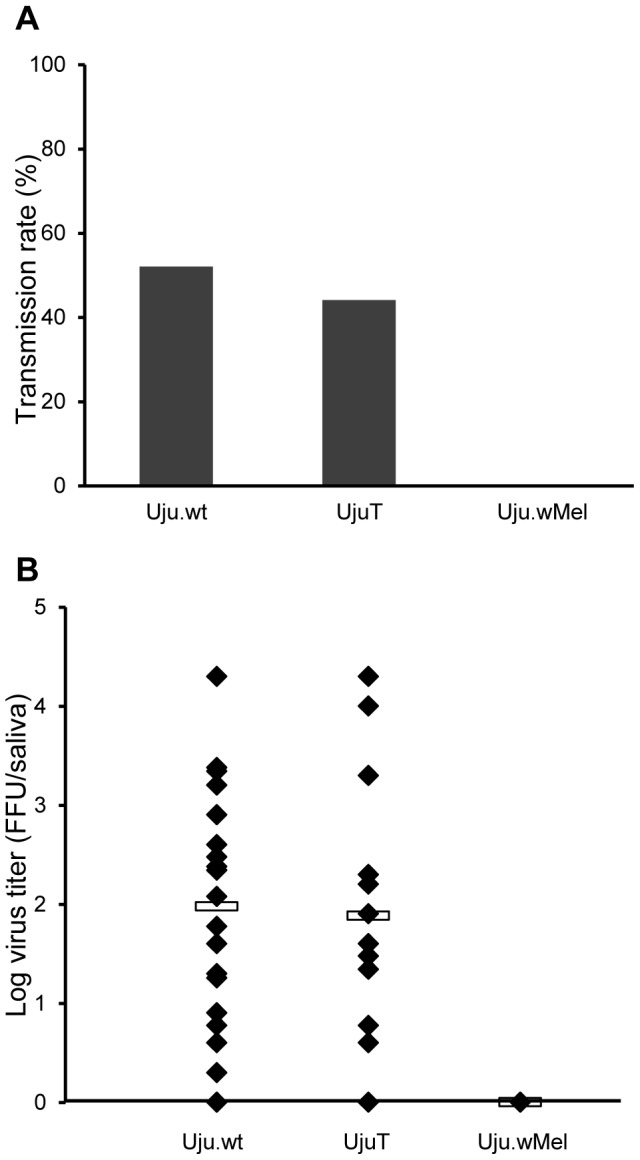
Figure 4. CHIKV challenge.
Mosquitoes were allowed to feed on artificial blood meals containing virus suspension and 7 days post infection 35–50 females were used for forced salivation. Samples were titrated by focus fluorescent assay on Ae. albopictus C6/36 cells. The transmission rate was estimated as the percentage of mosquitoes with infectious saliva among tested mosquitoes (A). Saliva samples were titrated by focus fluorescent assay on C6/36 Ae. albopictus cell culture. The total number of plaques was counted and the titer was calculated as FFU/saliva (B). No significant difference was found between Uju.wt and UjuT viral titers using a Wilcoxon rank sum test.

References

    1. Gratz NG (2004) Critical review of the vector status of Aedes albopictus . Med Vet Entomol 18: 215–227. - PubMed
    1. Sinkins SP, Braig HR, O'Neill SL (1995) Wolbachia superinfections and the expression of cytoplasmic incompatibility. Proc Biol Sci 261: 325–330. - PubMed
    1. Kittayapong P, Baimai V, O'Neill SL (2002) Field prevalence of Wolbachia in the mosquito vector Aedes albopictus . Am J Trop Med Hyg 66: 108–11. - PubMed
    1. Blagrove MSC, Arias-Goeta CA, Failloux A, Sinkins SP (2012) The Wolbachia strain wMel induces cytoplasmic incompatibility in and blocks dengue transmission by Aedes albopictus . Proc Natl Acad Sci U S A 109: 255–260. - PMC - PubMed
    1. Sun LV, Riegler M, O'Neill SL (2003) Development of a physical and genetic map of the virulent Wolbachia strain wMelPop. J Bacteriol 185: 7077–7084. - PMC - PubMed

Publication types