Review
. 2013 Nov;1833(11):2447-57.
doi: 10.1016/j.bbamcr.2013.03.018. Epub 2013 Apr 2.

How early studies on secreted and membrane protein quality control gave rise to the ER associated degradation (ERAD) pathway: the early history of ERAD

Affiliations
Review

How early studies on secreted and membrane protein quality control gave rise to the ER associated degradation (ERAD) pathway: the early history of ERAD

Patrick G Needham et al. Biochim Biophys Acta. 2013 Nov.

Abstract

All newly synthesized proteins are subject to quality control check-points, which prevent aberrant polypeptides from harming the cell. For proteins that ultimately reside in the cytoplasm, components that also reside in the cytoplasm were known for many years to mediate quality control. Early biochemical and genetic data indicated that misfolded proteins were selected by molecular chaperones and then targeted to the proteasome (in eukaryotes) or to proteasome-like particles (in bacteria) for degradation. What was less clear was how secreted and integral membrane proteins, which in eukaryotes enter the endoplasmic reticulum (ER), were subject to quality control decisions. In this review, we highlight early studies that ultimately led to the discovery that secreted and integral membrane proteins also utilize several components that constitute the cytoplasmic quality control machinery. This component of the cellular quality control pathway is known as ER associated degradation, or ERAD. This article is part of a Special Issue entitled: Functional and structural diversity of endoplasmic reticulum.

Keywords: ERAD; Endoplasmic reticulum; Lysosome; Molecular chaperone; Proteasome; Ubiquitin.


Figures

Figure 1
Figure 1
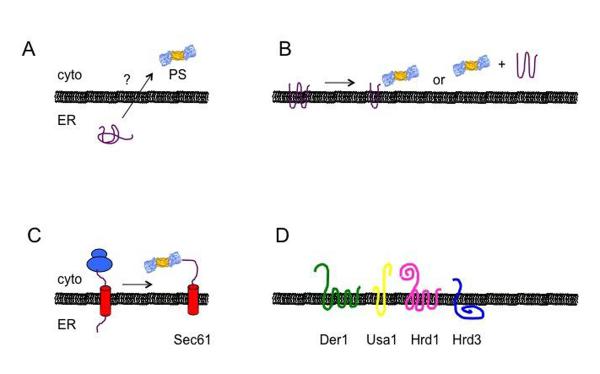
A. Soluble ERAD substrates must retrotranslocate across the ER bilayer in order to access the cytoplasmic proteasome (PS). B. Integral membrane proteins present domains that can directly access the proteasome, but membrane spanning segments must still be threaded from the lipid bilayer, regardless of whether degradation occurs at the membrane or in solution. C. The Sec61 translocation channel might be used for both protein translocation (left) and retrotranslocation (right). D. The components of the Hrd1 complex in yeast include Der1, Usa1 (which scaffolds and regulates Hrd1 oligomerization and function) and Hrd3, which serves as a dock for lectins and chaperones. The mammalian homolog of Hrd3 is SEL1, and Usa1 and Herp may function analogously. The Hrd1 complex also associates with Cdc48 (not shown), which extracts ERAD substrates. Also not shown is Ubx2, which associates with Hrd1 complex and helps anchor Cdc48 to the ER. In parts A–C, ERAD substrates are shown in purple. (See text for additional details and [, , –182]).

References

    1. Braakman I, Bulleid NJ. Protein folding and modification in the mammalian endoplasmic reticulum. Annu Rev Biochem. 2011;80:71–99. - PubMed
    1. Brodsky JL, Skach R. Protein folding and quality control in the endoplasmic reticulum: Recent lessons from yeast and mammalian cell systems. Curr Opin Cell Biol. 2011;23:464–475. - PMC - PubMed
    1. Hartl FU, Bracher A, Hayer-Hartl M. Molecular chaperones in protein folding and proteostasis. Nature. 2011;475:324–332. - PubMed
    1. Kampinga HH, Craig A. The HSP70 chaperone machinery: J proteins as drivers of functional specificity. Nat Rev Mol Cell Biol. 2010;11:579–592. - PMC - PubMed
    1. Okiyoneda T, Lukacs GL. Fixing cystic fibrosis by correcting CFTR domain assembly. J Cell Biol. 2012;199:199–204. - PMC - PubMed

Publication types

Substances

LinkOut - more resources