Review
. 2013 Aug-Sep;1827(8-9):938-48.
doi: 10.1016/j.bbabio.2013.03.010. Epub 2013 Apr 2.

Multi-heme proteins: nature's electronic multi-purpose tool

Affiliations
Review

Multi-heme proteins: nature's electronic multi-purpose tool

Kathryn D Bewley et al. Biochim Biophys Acta. 2013 Aug-Sep.

Abstract

While iron is often a limiting nutrient to Biology, when the element is found in the form of heme cofactors (iron protoporphyrin IX), living systems have excelled at modifying and tailoring the chemistry of the metal. In the context of proteins and enzymes, heme cofactors are increasingly found in stoichiometries greater than one, where a single protein macromolecule contains more than one heme unit. When paired or coupled together, these protein associated heme groups perform a wide variety of tasks, such as redox communication, long range electron transfer and storage of reducing/oxidizing equivalents. Here, we review recent advances in the field of multi-heme proteins, focusing on emergent properties of these complex redox proteins, and strategies found in Nature where such proteins appear to be modular and essential components of larger biochemical pathways. This article is part of a Special Issue entitled: Metals in Bioenergetics and Biomimetics Systems.

Keywords: Cytochrome c; Cytochrome c peroxidase; Dissimilatory metal reduction; Electron transfer.


Figures

Fig. 1
Fig. 1
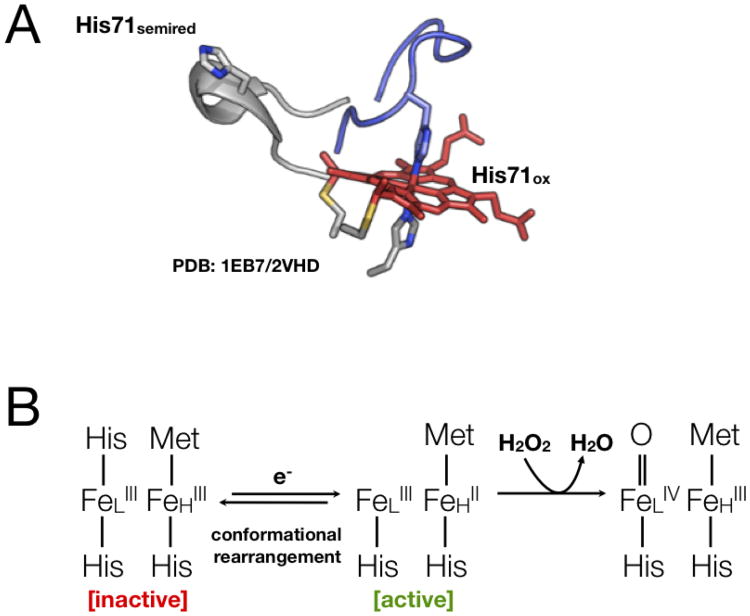
A. The conformational switch found in the majority of known bCcP enzymes involves the reorganization of the distal face of the peroxidatic heme, as a function of the redox state of a high-potential heme, some 12 Å away. B. The mechanistic impact of reductive activation suggests that by “banking” an electron in the high potential center, the first kinetic intermediate need to involve the build-up of a radical species.
Fig. 2
Fig. 2
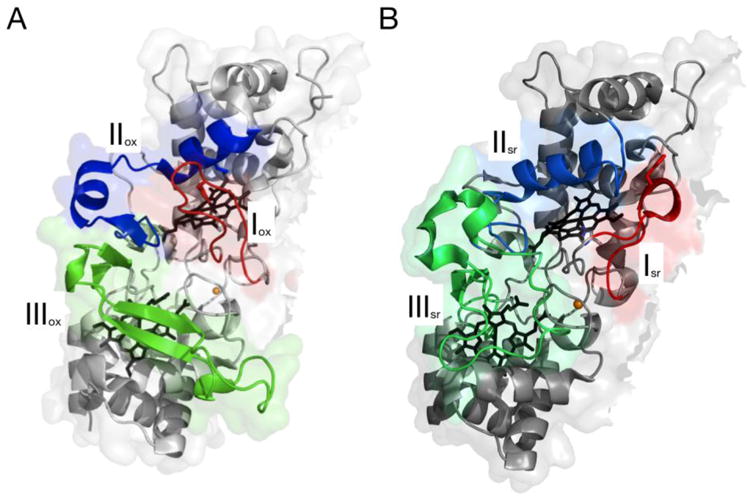
The conformational differences observed in (A) the fully oxidized form of Pa bCcP, and (B) the subsequent reorganization of three loop regions upon chemical preparation of the FeLIIIFeHII redox state. (Figure composed using Pymol, with Protein Data Bank files, 1EB7.pdb and 2VHD.pdb (panel B)).
Fig. 3
Fig. 3
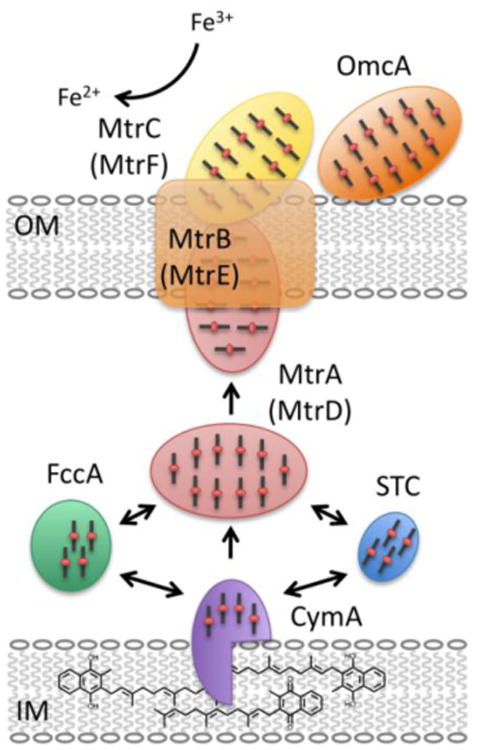
The dissimilatory metal reduction (DMR) pathway in Shewanella oneidensis. A network of multi-heme cytochromes is responsible for the long-range electron transfer from the quinol pool through the tetraheme cytochrome, CymA, across the periplasm via MtrA, and finally to MtrC through the porin protein, MtrB. Arrows indicate substantiated redox reactions through electrochemical and spectroscopic studies (see main text).
Fig. 4
Fig. 4
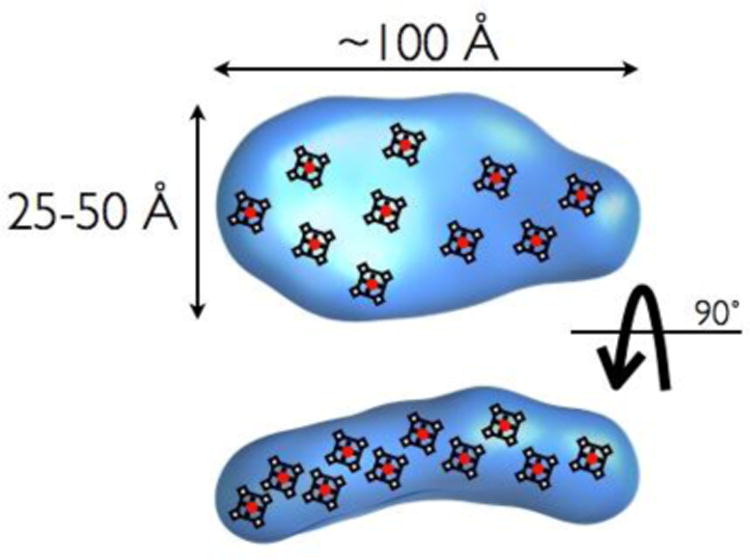
Depiction of MtrA structure, as described by SAXS, by Firer-Sherwood and co-workers [90], with schematized placement of potential porphyrin structures.
Fig. 5
Fig. 5
Ammonia oxidation pathway in Nitrosomonas europaea. Hydroxylamine (which is produced from the oxidation of ammonia from ammonia monooxygenase) is oxidized by hydroxylamine oxidoreductase (HAO). Electrons are then transferred through cytochromes c554, c552, and finally to cytochrome c oxidase.
Fig. 6
Fig. 6
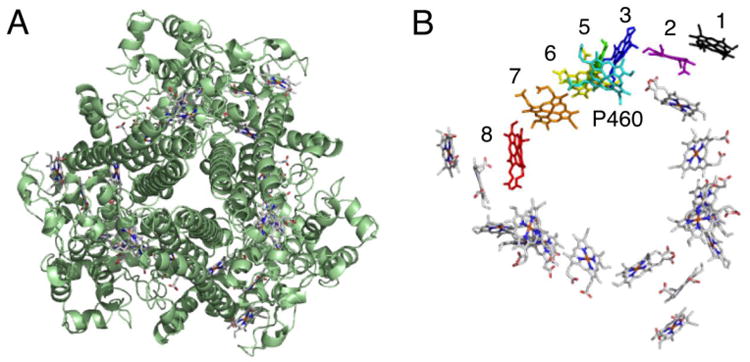
Hydroxylamine oxidoreductase (HAO) is a homotrimer containing 24 heme groups (A). Each monomer contains 8 heme groups with a unique P460 heme (shown in cyan, B). Figure constructed from Protein Data Bank file 1FGJ.pdb.
Fig. 7
Fig. 7
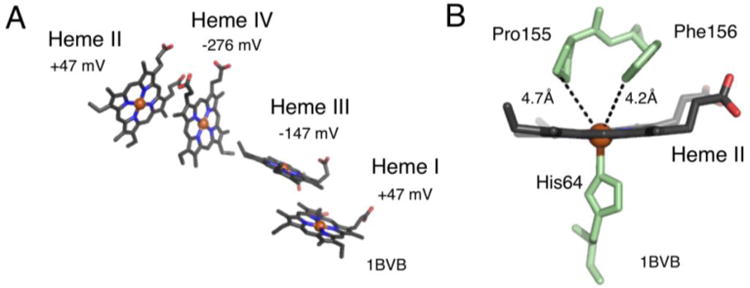
Heme configuration of c554 shows two sets of parallel heme groups (A). The high potential heme groups (Hemes I and II) are the furthest apart, spatially (28.1 Å, Fe-Fe). The heme groups are bis-His ligated, except for Heme II. Heme II is penta-coordinate with one ligated histidine (B). (Protein Data Bank entry 1BVB.pdb).
Fig. 8
Fig. 8
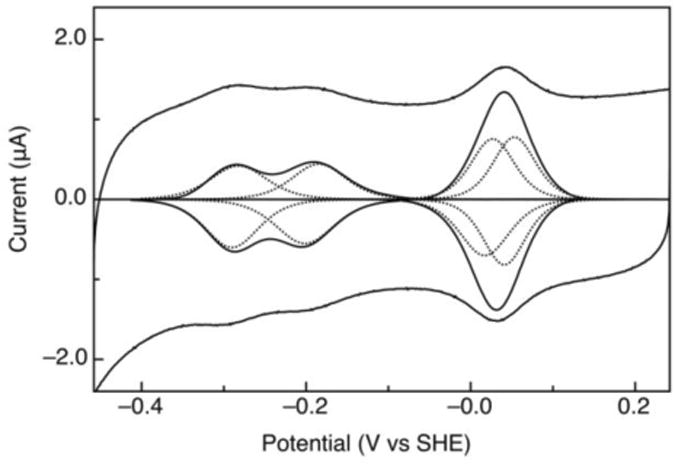
A cyclic voltammogram of c554 on 4-mercaptobenzoic acid modified gold (scan rate of 1V, 4°C, pH 7); both raw and baseline subtracted data. The four heme groups are modeled in with dashed lines.

References

    1. Banci L, Bertini I, Luchinat C, Turano P. Special Cofactors and Metal Clusters. In: Bertini I, Gray H, Stiefel E, Valentine J, editors. Biological Inorganic Chemistry: structure and reactivity. University Science Books; Sausalito, California: 2007. pp. 43–56.
    1. Messerschmidt A, Huber R, Poulos T, Wieghardt K. Handbook of Metalloproteins. John Wiley & Sons, Ltd; New York, NY: 2001.
    1. Sanders C, Turkarslan S, Lee DW, Daldal F. Cytochrome c biogenesis: the Ccm system. Trends Microbiol. 2010;18:266–274. - PMC - PubMed
    1. Hartshorne S, Richardson DJ, Simon J. Multiple haem lyase genes indicate substrate specificity in cytochrome c biogenesis. Biochem Soc Trans. 2006;34:146–149. - PubMed
    1. Herbaud ML, Aubert C, Durand MC, Guerlesquin F, Thony-Meyer L, Dolla A. Escherichia coli is able to produce heterologous tetraheme cytochrome c(3) when the ccm genes are co-expressed. Biochim Biophys Acta. 2000;1481:18–24. - PubMed

Publication types

LinkOut - more resources