


How might circadian rhythms control mood? Let me count the ways.
- PMID: 23558300
- PMCID: PMC3725187
- DOI: 10.1016/j.biopsych.2013.02.019
How might circadian rhythms control mood? Let me count the ways.
Abstract
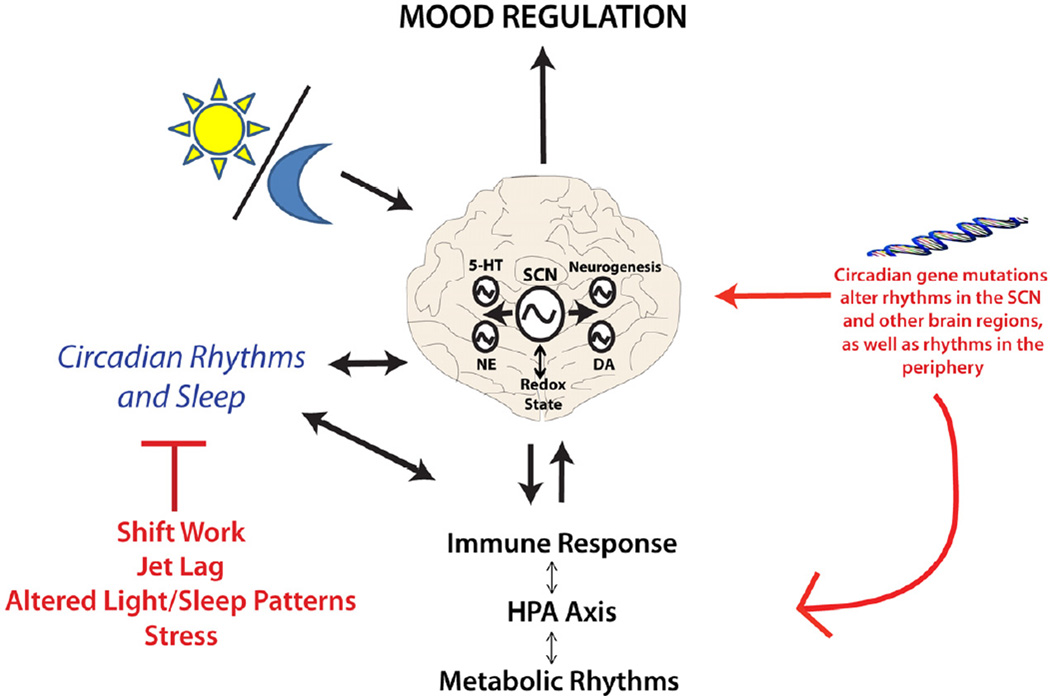
Mood disorders are serious diseases that affect a large portion of the population. There have been many hypotheses put forth over the years to explain the development of major depression, bipolar disorder, and other mood disorders. These hypotheses include disruptions in monoamine transmission, hypothalamus-pituitary-adrenal axis function, immune function, neurogenesis, mitochondrial dysfunction, and neuropeptide signaling (to name a few). Nearly all people suffering from mood disorders have significant disruptions in circadian rhythms and the sleep/wake cycle. In fact, altered sleep patterns are one of the major diagnostic criteria for these disorders. Moreover, environmental disruptions to circadian rhythms, including shift work, travel across time zones, and irregular social schedules, tend to precipitate or exacerbate mood-related episodes. Recent studies have found that molecular clocks are found throughout the brain and body where they participate in the regulation of most physiological processes, including those thought to be involved in mood regulation. This review will summarize recent data that implicate the circadian system as a vital regulator of a variety of systems that are thought to play a role in the development of mood disorders.
Keywords: Bipolar disorder; circadian rhythms; depression; immune system; metabolism; neurogenesis.
Copyright © 2013 Society of Biological Psychiatry. Published by Elsevier Inc. All rights reserved.
Conflict of interest statement
The author declares no conflicts of interest with this manuscript.
Figures
Comment in
-
Much ado about…a moody clock.Biol Psychiatry. 2013 Aug 15;74(4):236-7. doi: 10.1016/j.biopsych.2013.05.037. Biol Psychiatry. 2013. PMID: 23885751 No abstract available.
Similar articles
-
Mood-related central and peripheral clocks.Eur J Neurosci. 2020 Jan;51(1):326-345. doi: 10.1111/ejn.14253. Epub 2018 Nov 29. Eur J Neurosci. 2020. PMID: 30402924 Free PMC article. Review.
-
Circadian rhythms and mood disorders: Time to see the light.Neuron. 2024 Jan 3;112(1):25-40. doi: 10.1016/j.neuron.2023.09.023. Epub 2023 Oct 18. Neuron. 2024. PMID: 37858331 Free PMC article. Review.
-
Circadian genes, rhythms and the biology of mood disorders.Pharmacol Ther. 2007 May;114(2):222-32. doi: 10.1016/j.pharmthera.2007.02.003. Epub 2007 Feb 28. Pharmacol Ther. 2007. PMID: 17395264 Free PMC article. Review.
-
Circadian Rhythms in Mood Disorders.Adv Exp Med Biol. 2021;1344:153-168. doi: 10.1007/978-3-030-81147-1_9. Adv Exp Med Biol. 2021. PMID: 34773231
-
Mood variation under dual regulation of circadian clock and light.Chronobiol Int. 2025 Feb;42(2):162-184. doi: 10.1080/07420528.2025.2455144. Epub 2025 Jan 22. Chronobiol Int. 2025. PMID: 39840618 Review.
Cited by
-
Circadian modulation of dopamine levels and dopaminergic neuron development contributes to attention deficiency and hyperactive behavior.J Neurosci. 2015 Feb 11;35(6):2572-87. doi: 10.1523/JNEUROSCI.2551-14.2015. J Neurosci. 2015. PMID: 25673850 Free PMC article.
-
How Does Light Regulate Mood and Behavioral State?Clocks Sleep. 2019 Jul 12;1(3):319-331. doi: 10.3390/clockssleep1030027. eCollection 2019 Sep. Clocks Sleep. 2019. PMID: 33089172 Free PMC article. Review.
-
Diurnal oscillations of MRI metrics in the brains of male participants.Nat Commun. 2023 Nov 3;14(1):7044. doi: 10.1038/s41467-023-42588-6. Nat Commun. 2023. PMID: 37923728 Free PMC article.
-
A novel murine model of mania.Mol Psychiatry. 2023 Jul;28(7):3044-3054. doi: 10.1038/s41380-023-02037-8. Epub 2023 Mar 29. Mol Psychiatry. 2023. PMID: 36991130 Free PMC article.
-
Circadian Clock Model Supports Molecular Link Between PER3 and Human Anxiety.Sci Rep. 2017 Aug 31;7(1):9893. doi: 10.1038/s41598-017-07957-4. Sci Rep. 2017. PMID: 28860482 Free PMC article.
References
-
- Rush AJ, Trivedi MH, Wisniewski SR, Nierenberg AA, Stewart JW, Warden D, et al. Acute and longer-term outcomes in depressed outpatients requiring one or several treatment steps: a STAR*D report. Am J Psychiatry. 2006;163:1905–1917. - PubMed
-
- Wirz-Justice A. Biological rhythm disturbances in mood disorders. Int Clin Psychopharmacol. 2006;21(Suppl 1):S11–S15. - PubMed
-
- Ehlers CL, Frank E, Kupfer DJ. Social zeitgebers and biological rhythms. A unified approach to understanding the etiology of depression. Arch Gen Psychiatry. 1988;45:948–952. - PubMed
-
- Baglioni C, Riemann D. Is chronic insomnia a precursor to major depression? Epidemiological and biological findings. Curr Psychiatry Rep. 2012;14:511–518. - PubMed
Publication types
MeSH terms
Grants and funding
LinkOut - more resources
Full Text Sources
Other Literature Sources
Medical
