


Climate change threats to population health and well-being: the imperative of protective solutions that will last
- PMID: 23561024
- PMCID: PMC3617647
- DOI: 10.3402/gha.v6i0.20816
Climate change threats to population health and well-being: the imperative of protective solutions that will last
Erratum in
-
Corrigendum.Glob Health Action. 2014 Dec;7(1):25010. doi: 10.3402/gha.v7.25010. Glob Health Action. 2014. PMID: 28672479 Free PMC article. No abstract available.
Abstract
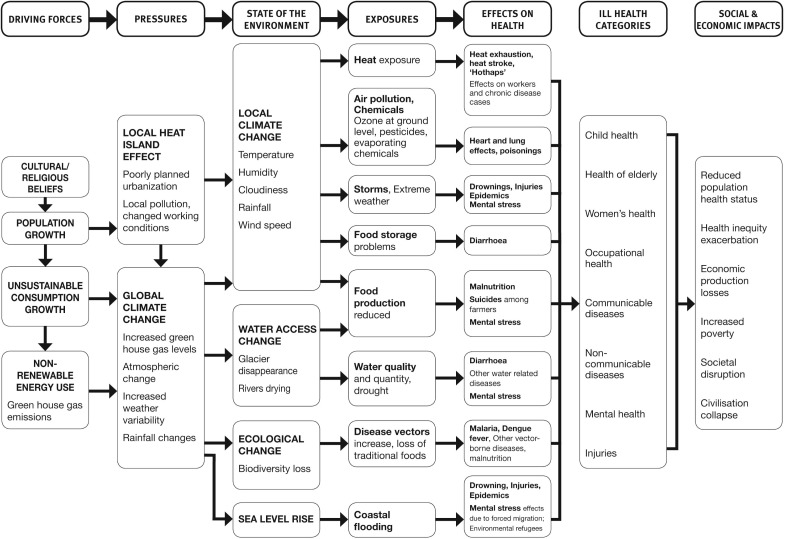
Background: The observational evidence of the impacts of climate conditions on human health is accumulating. A variety of direct, indirect, and systemically mediated health effects have been identified. Excessive daily heat exposures create direct effects, such as heat stroke (and possibly death), reduce work productivity, and interfere with daily household activities. Extreme weather events, including storms, floods, and droughts, create direct injury risks and follow-on outbreaks of infectious diseases, lack of nutrition, and mental stress. Climate change will increase these direct health effects. Indirect effects include malnutrition and under-nutrition due to failing local agriculture, spread of vector-borne diseases and other infectious diseases, and mental health and other problems caused by forced migration from affected homes and workplaces. Examples of systemically mediated impacts on population health include famine, conflicts, and the consequences of large-scale adverse economic effects due to reduced human and environmental productivity. This article highlights links between climate change and non-communicable health problems, a major concern for global health beyond 2015.
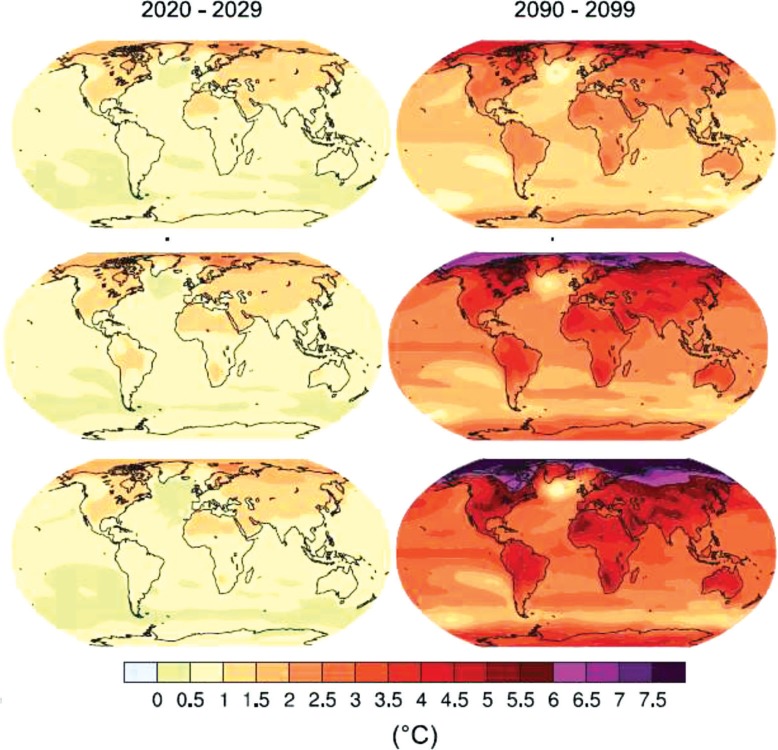
Discussion: Detailed regional analysis of climate conditions clearly shows increasing temperatures in many parts of the world. Climate modelling indicates that by the year 2100 the global average temperature may have increased by 34°C unless fundamental reductions in current global trends for greenhouse gas emissions are achieved. Given other unforeseeable environmental, social, demographic, and geopolitical changes that may occur in a plus-4-degree world, that scenario may comprise a largely uninhabitable world for millions of people and great social and military tensions.
Conclusion: It is imperative that we identify actions and strategies that are effective in reducing these increasingly likely threats to health and well-being. The fundamental preventive strategy is, of course, climate change mitigation by significantly reducing global greenhouse gas emissions, especially long-acting carbon dioxide (CO(2)), and by increasing the uptake of CO(2) at the earth's surface. This involves urgent shifts in energy production from fossil fuels to renewable energy sources, energy conservation in building design and urban planning, and reduced waste of energy for transport, building heating/cooling, and agriculture. It would also involve shifts in agricultural production and food systems to reduce energy and water use particularly in meat production. There is also potential for prevention via mitigation, adaptation, or resilience building actions, but for the large populations in tropical countries, mitigation of climate change is required to achieve health protection solutions that will last.
Keywords: adaptation; climate change; health; mitigation; well-being.
Figures
References
-
- McMichael AJ, Campbell-Lendrum D, Kovats S, Edwards S, Wilkinson P, Wilson T, et al. Global climate change. In: Ezzati M, Lopez A, Rodgers A, Murray CJL, editors. Comparative quantification of health risks, global and regional burden of disease attributable to selected major risk factors. vol. 2. Geneva: World Health Organization; 2004. pp. 1543–650.
-
- McMichael A, Campbell-Lendrum D, Ebi K, Githeko A, Scheraga J, Woodward A. Climate change and human health: risks and responses. Geneva: World Health Organization; 2003.
-
- McMichael AJ, Haines A, Sloof R, Kovats S. Climate change and human health. Geneva: World Health Organization; 1996.
-
- Costello A, Abbas M, Allen A, Ball S, Bell S, Bellamy R, et al. Managing the health effects of climate change: Lancet-University College London Institute for Global Health Commission. Lancet. 2009;373:1693–733. - PubMed
Publication types
MeSH terms
LinkOut - more resources
Full Text Sources
Other Literature Sources
Medical
