. 2013 Apr 5:8:54.
doi: 10.1186/1750-1172-8-54.

Mutational spectrum of the APC and MUTYH genes and genotype-phenotype correlations in Brazilian FAP, AFAP, and MAP patients

Affiliations

Mutational spectrum of the APC and MUTYH genes and genotype-phenotype correlations in Brazilian FAP, AFAP, and MAP patients

Giovana Tardin Torrezan et al. Orphanet J Rare Dis. .

Abstract

Background: Patients with multiple colorectal adenomas are currently screened for germline mutations in two genes, APC and MUTYH. APC-mutated patients present classic or attenuated familial adenomatous polyposis (FAP/AFAP), while patients carrying biallelic MUTYH mutations exhibit MUTYH-associated polyposis (MAP). The spectrum of mutations as well as the genotype-phenotype correlations in polyposis syndromes present clinical impact and can be population specific, making important to obtain genetic and clinical data from different populations.

Methods: DNA sequencing of the complete coding region of the APC and MUTYH genes was performed in 23 unrelated Brazilian polyposis patients. In addition, mutation-negative patients were screened for large genomic rearrangements by multiplex ligation-dependent probe amplification, array-comparative genomic hybridization, and duplex quantitative PCR. Biallelic MUTYH mutations were confirmed by allele-specific PCR. Clinical data of the index cases and their affected relatives were used to assess genotype-phenotype correlations.

Results: Pathogenic mutations were identified in 20 of the 23 probands (87%): 14 in the APC gene and six in the MUTYH gene; six of them (30%) were described for the first time in this series. Genotype-phenotype correlations revealed divergent results compared with those described in other studies, particularly regarding the extent of polyposis and the occurrence of desmoid tumors in families with mutations before codon 1444 (6/8 families with desmoid).

Conclusions: This first comprehensive investigation of the APC and MUTYH mutation spectrum in Brazilian polyposis patients showed a high detection rate and identified novel pathogenic mutations. Notably, a significant number of APC-positive families were not consistent with the predicted genotype-phenotype correlations from other populations.


Figures
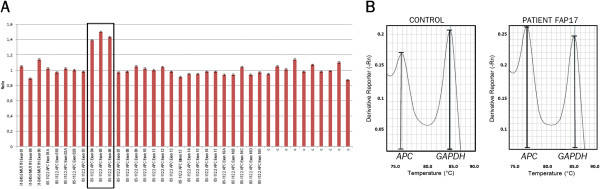
Figure 1
Figure 1
Duplication encompassing exons 1 to 3 of the APC gene (patient ID17). A: MLPA graphic showing normalized ratios of probes ordered by genomic position; the box marks the probes that indicate duplication of APC exons 1, 2, and 3 (exons 4, 5, and 6 according to MLPA exon numbering [GenBank:NG_008481]). B: Melt curve of duplex qPCR of APC exon 2 and GAPDH intron 7 (reference gene). The ratio of APC/GAPDH peaks of the melting curve was 0.72 in the control sample and 1.06 in patient ID17, leading to a normalized ratio of 1.47 for the FAP patient, which confirms the duplication.
Figure 2
Figure 2
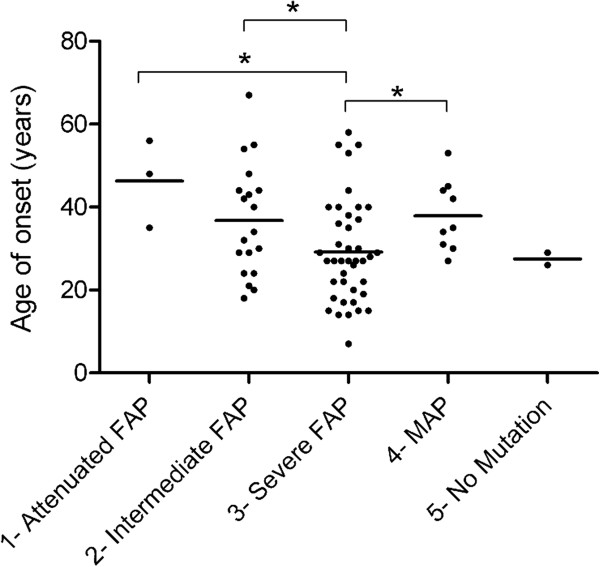
Age of onset per group. The graph shows the distribution and the mean (horizontal line) age of onset for each of the five defined groups. Groups 1, 2, and 4 patients had a significantly later age of onset than group 3 patients (t = 2.35 p = 0.024; t = 2.15 p = 0.04; t = 2.01 p = 0.05, respectively).
Figure 3
Figure 3
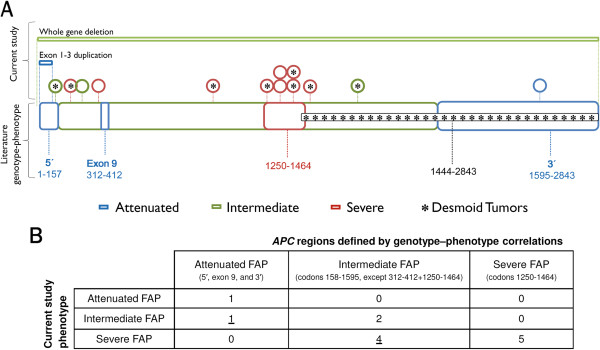
Genotype–phenotype correlation. A: Distribution of the polyposis phenotype of the index case and the presence of desmoid tumors along the APC gene. Schematic representation of the two large genomic rearrangements (top bars) and the 13 point mutations or small insertions/deletions (circles) identified in this series (including the variant of unknown significance – last circle). The asterisk inside the circles denotes patients with desmoid tumors. The lower, thick bar represents the APC regions defined by genotype–phenotype correlations proposed by Nieuwenhuis and Vasen (2007) [22]. Genotype–phenotype correspondence between our results and those previously published is indicated by concordant colors (blue/green/red/black). Numbers represent APC codons. B: Number of families presenting APC point mutations (N = 13) according to the index case polyposis phenotype and the APC codon limits, showing that five individuals (underlined numbers) presented a polyposis burden different from that predicted.
Figure 4
Figure 4
Family tree of ID10 family. This family harbored a truncating mutation at codon 1017 located in a region usually associated with an intermediate FAP phenotype. This mutation displayed an aggressive phenotypic expression: the proband (individual III:1, indicated by an arrow) presented her first polyposis symptoms at the age of 15, a desmoid tumor at age 20, and a thyroid carcinoma at age 21. When available, the ages of onset are presented under each individual. Her brother (III:2) and six first cousins (III:5, 6, 7, 8, 15, and 22) also developed polyps at early ages (14 to 29 years old). The most prematurely affected was a second cousin (individual IV:3), who was diagnosed with polyps at the age of 7. Desmoid tumors were described in another three relatives: two uncles at the age of 40 (II:7 and II:9) and one cousin at 32 years old (III:7).

References

    1. Gardner EJ, Burt RW, Freston JW. Gastrointestinal Polyposis: Syndromes and Genetic Mechanisms. West J Med. 1980;132:488–499. - PMC - PubMed
    1. Leppert M, Dobbs M, Scambler P, O'Connell P, Nakamura Y, Stauffer D, Woodward S, Burt R, Hughes J, Gardner E. The gene for familial polyposis coli maps to the long arm of chromosome 5. Science. 1987;238:1411–1413. doi: 10.1126/science.3479843. - DOI - PubMed
    1. Knudsen AL, Bisgaard ML, Bülow S. Attenuated familial adenomatous polyposis (AFAP). A review of the literature. Fam Cancer. 2003;2:43–55. doi: 10.1023/A:1023286520725. - DOI - PubMed
    1. Al-Tassan N, Chmiel NH, Maynard J, Fleming N, Livingston AL, Williams GT, Hodges AK, Davies DR, David SS, Sampson JR, Cheadle JP. Inherited variants of MYH associated with somatic G:C > T:A mutations in colorectal tumors. Nat Genet. 2002;30:227–232. doi: 10.1038/ng828. - DOI - PubMed
    1. Kinzler KW, Nilbert MC, Su LK, Vogelstein B, Bryan TM, Levy DB, Smith KJ, Preisinger AC, Hedge P, McKechnie D, Finniea R, Matrkam A, Groffen J, Boguski MS, Altschul SF, Horii A, Ando H, Miyoshi Y, Miki Y, Nishisho I, Nakamura Y. Identification of FAP locus genes from chromosome 5q21. Science. 1991;253:661–665. doi: 10.1126/science.1651562. - DOI - PubMed