


Association of diabetes with amnestic and nonamnestic mild cognitive impairment
- PMID: 23562428
- PMCID: PMC3830601
- DOI: 10.1016/j.jalz.2013.01.001
Association of diabetes with amnestic and nonamnestic mild cognitive impairment
Abstract
Background: Type 2 diabetes may increase the risk of amnestic mild cognitive impairment (aMCI) through Alzheimer's disease (AD)-related and vascular pathology and may also increase the risk of nonamnestic MCI (naMCI) through vascular disease mechanisms. We examined the association of type 2 diabetes with mild cognitive impairment (MCI) and MCI subtype (aMCI and naMCI) overall and by sex.
Methods: Participants were Olmsted County, Minnesota residents (70 years and older) enrolled in a prospective, population-based study. At baseline and every 15 months thereafter, participants were evaluated using the Clinical Dementia Rating scale, a neurological evaluation, and neuropsychological testing for a diagnosis of normal cognition, MCI, and dementia by a consensus panel. Type 2 diabetes was ascertained from the medical records of participants at baseline.
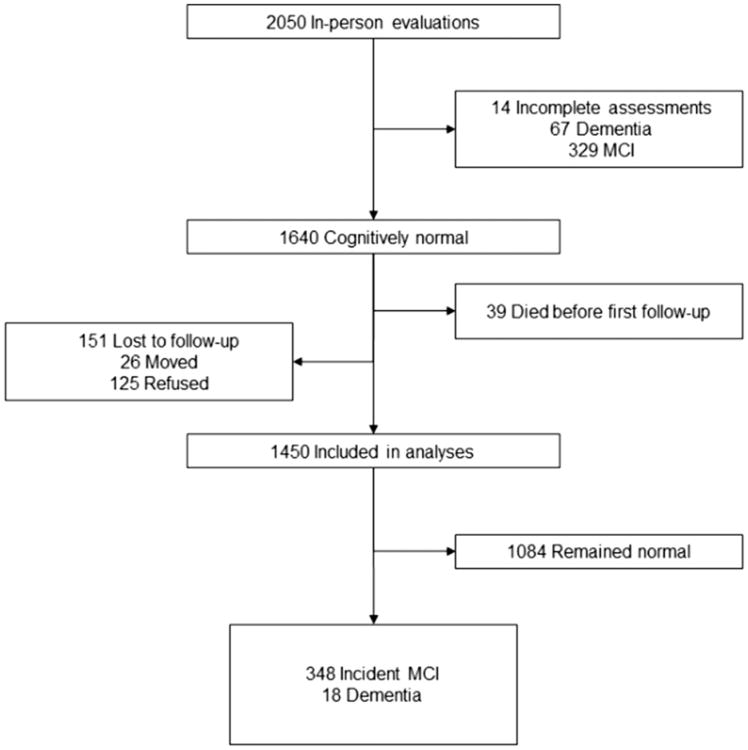
Results: Over a median 4.0 years of follow-up, 348 of 1450 subjects developed MCI. Type 2 diabetes was associated (hazard ratio [95% confidence interval]) with MCI (1.39 [1.08-1.79]), aMCI (1.58 [1.17-2.15]; multiple domain: 1.58 [1.01-2.47]; single domain: 1.49 [1.09-2.05]), and the hazard ratio for naMCI was elevated (1.37 [0.84-2.24]). Diabetes was strongly associated with multiple-domain aMCI in men (2.42 [1.31-4.48]) and an elevated risk of multiple domain naMCI in men (2.11 [0.70-6.33]), and with single domain naMCI in women (2.32 [1.04-5.20]).
Conclusions: Diabetes was associated with an increased risk of MCI in elderly persons. The association of diabetes with MCI may vary with subtype, number of domains, and sex. Prevention and control of diabetes may reduce the risk of MCI and Alzheimer's disease.
Keywords: Cohort studies; Diabetic neuropathy; Diabetic retinopathy; Incidence; Mild cognitive impairment; Population-based studies; Risk factors; Sex differences; Type 2 diabetes.
Copyright © 2014 The Alzheimer's Association. Published by Elsevier Inc. All rights reserved.
Figures
References
-
- Luchsinger JA, Reitz C, Patel B, Tang MX, Manly JJ, Mayeux R. Relation of diabetes to mild cognitive impairment. Arch Neurol. 2007;64:570–5. - PubMed
-
- Hassing LB, Hofer SM, Nilsson SE, Berg S, Pedersen NL, McClearn G, et al. Comorbid type 2 diabetes mellitus and hypertension exacerbates cognitive decline: evidence from a longitudinal study. Age Ageing. 2004;33:355–61. - PubMed
-
- Peila R, Rodriguez BL, Launer LJ. Type 2 diabetes, APOE gene, and the risk for dementia and related pathologies: The Honolulu-Asia Aging Study. Diabetes. 2002;51:1256–62. - PubMed
-
- Ott A, Stolk RP, van Harskamp F, Pols HA, Hofman A, Breteler MM. Diabetes mellitus and the risk of dementia: The Rotterdam Study. Neurology. 1999;53:1937–42. - PubMed
Publication types
MeSH terms
Grants and funding
LinkOut - more resources
Full Text Sources
Other Literature Sources
Medical
