


Pharmacist-led management of chronic pain in primary care: results from a randomised controlled exploratory trial
- PMID: 23562814
- PMCID: PMC3641445
- DOI: 10.1136/bmjopen-2012-002361
Pharmacist-led management of chronic pain in primary care: results from a randomised controlled exploratory trial
Abstract
Objectives: To compare the effectiveness of pharmacist medication review, with or without pharmacist prescribing, with standard care, for patients with chronic pain.
Design: An exploratory randomised controlled trial.
Setting: Six general practices with prescribing pharmacists in Grampian (3) and East Anglia (3).
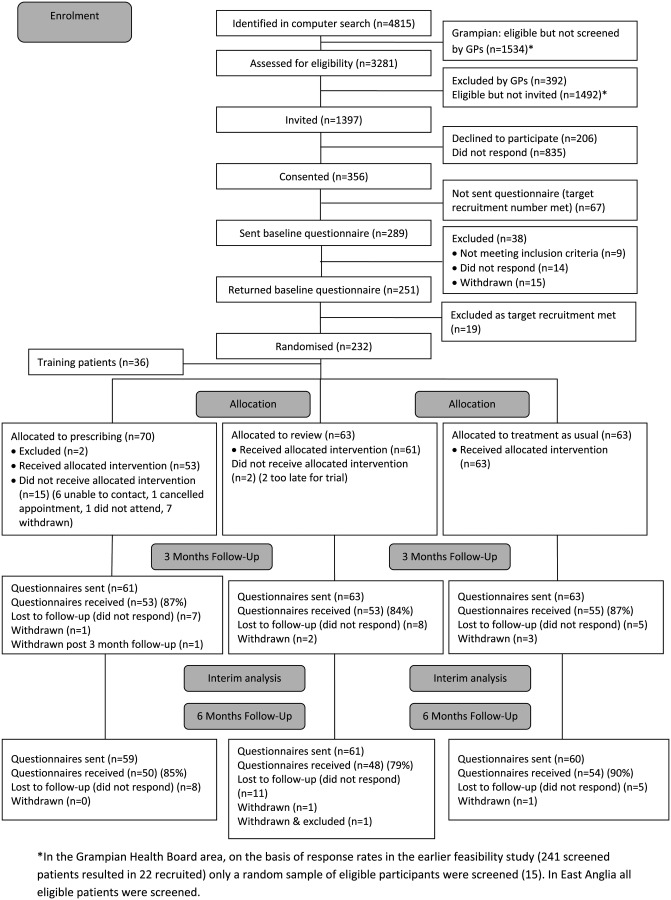
Participants: Patients on repeat prescribed pain medication (4815) were screened by general practitioners (GPs), and mailed invitations (1397). 196 were randomised and 180 (92%) completed. Exclusion criteria included: severe mental illness, terminally ill, cancer related pain, history of addiction. RANDOMISATION AND INTERVENTION: Patients were randomised using a remote telephone service to: (1) pharmacist medication review with face-to-face pharmacist prescribing; (2) pharmacist medication review with feedback to GP and no planned patient contact or (3) treatment as usual (TAU). Blinding was not possible.
Outcome measures: Outcomes were the SF-12v2, the Chronic Pain Grade (CPG), the Health Utilities Index 3 and the Hospital Anxiety and Depression Scale (HADS). Outcomes were collected at 0, 3 and 6 months.
Results: In the prescribing arm (n=70) two patients were excluded/nine withdrew. In the review arm (n=63) one was excluded/three withdrew. In the TAU arm (n=63) four withdrew. Compared with baseline, patients had an improved CPG in the prescribing arm, 47.7% (21/44; p=0.003) and in the review arm, 38.6% (17/44; p=0.001), but not the TAU group, 31.3% (15/48; ns). The SF-12 Physical Component Score showed no effect in the prescribing or review arms but improvement in TAU (p=0.02). The SF-12 Mental Component Score showed no effect for the prescribing or review arms and deterioration in the TAU arm (p=0.002). HADS scores improved within the prescribing arm for depression (p=0.022) and anxiety (p=0.007), between groups (p=0.022 and p=0.045, respectively).
Conclusions: This is the first randomised controlled trial of pharmacist prescribing in the UK, and suggests that there may be a benefit for patients with chronic pain. A larger trial is required.
Trial registration: www.isrctn.org/ISRCTN06131530. Medical Research Council funding.
References
-
- Elliott AM, Smith BH, Penny KI, et al. The epideomiology of chronic pain in the community. Lancet 1999;354:1248–52 - PubMed
-
- Elliott AM, Smith BH, Hannaford P, et al. The course of chronic pain in the community: results of a 4-year follow-up study. Pain 2002;99:299–307 - PubMed
-
- Becker N, Bondegaard Thomsen A, Olsen AK, et al. Pain epidemiology and health related quality of life in chronic non-malignant painpain center patients referred to a Danish multidisciplinary. Pain 1997;73:393–400 - PubMed
-
- Breivik H, Collett B, Ventafridda V, et al. Survey of chronic pain in Europe: prevalence, impact on daily life, and treatment. Eur J Pain 2006;10:287–333 - PubMed
-
- Gureje O, Von Korff M, et al. , Persistent pain and well-being: a World Health Organization Study in Primary Care. JAMA 1998;280:147–51 - PubMed
Grants and funding
LinkOut - more resources
Full Text Sources
Other Literature Sources
Miscellaneous
