


Agreement in computer-assisted manual scoring of polysomnograms across sleep centers
- PMID: 23565004
- PMCID: PMC3612259
- DOI: 10.5665/sleep.2550
Agreement in computer-assisted manual scoring of polysomnograms across sleep centers
Abstract
Study objectives: To determine intersite agreement in respiratory event scoring of polysomnograms (PSGs) using different hypopnea definitions.
Design: Technical assessment.
Setting: Five academic medical centers.
Participants: N/A.
Interventions: N/A.
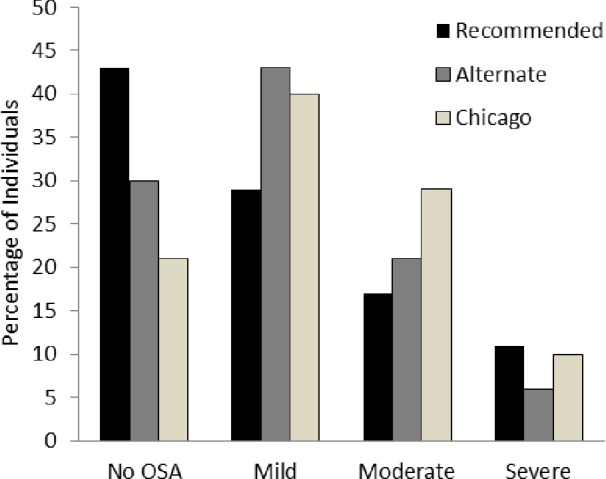
Measurements and results: Seventy good-quality PSGs performed in middle-aged women were manually scored by two experienced technologists at each of the five sleep centers using the particular laboratory's own software system. Studies were scored once by each scorer using American Academy of Sleep Medicine (AASM) standards for scoring sleep stages, arousals, and apneas. Hypopneas were then scored using three different AASM criteria: recommended, alternate, and research (Chicago). Means of each PSG variable for the scorers at each site were used to calculate an across-site intraclass correlation coefficient (ICC). Average AHI across the 10 scorers was 7.4 ± 12.3 (standard deviation) events/h using recommended criteria (ICC 0.984; 95% confidence interval [CI] 0.977-0.990), 12.1 ± 13.3 events/h using alternate criteria (ICC 0.947; 95% CI 0.889-0.972), and 15.1 ± 13.9 events/h with Chicago criteria (ICC 0.800; 95% CI 0.768-0.828). ICC across sites was 0.870 (95% CI = 0.847-0.889) for total sleep time, 0.861 (95% CI 0.837-0.881) for number of obstructive apneas and 0.683 (95% CI 0.640-0.722) for number of central apneas. ICCs across sites for hypopneas were very good using recommended criteria (ICC 0.843; 95% CI 0.820-0.870) but decreased when alternate criteria (ICC 0.728; 95% CI 0.689-0.763) and Chicago criteria (ICC 0.535; 95% CI 0.485-0.583) were used.
Conclusion: Experienced scorers at different laboratories have very good agreement in hypopnea and AHI results when good-quality PSGs are scored using AASM-recommended criteria. Substantial degradation of reliability was observed for alternative definitions of hypopneas, particularly that proposed for research.
Keywords: Apnea-hypopnea index; polysomnography; reliability; scoring.
Figures
Comment in
-
Entering the era of "big data": getting our metrics right.Sleep. 2013 Apr 1;36(4):465-9. doi: 10.5665/sleep.2524. Sleep. 2013. PMID: 23564993 Free PMC article. No abstract available.
References
-
- Trivedi NS, Ghouri AF, Lai E, Shah NK, Barker SJ. Pulse oximeter performance during desaturation and resaturation: a comparison of seven models. J Clin Anesth. 1997;9:184–8. - PubMed
-
- Zafar S, Ayappa I, Norman RG, Krieger AC, Walsleben JA, Rapoport DM. Choice of oximeter affects apnea-hypopnea index. Chest. 2005;127:80–8. - PubMed
-
- American Academy of Sleep Medicine Task Force. Sleep-related breathing disorders in adults: Recommendations for syndrome definitions and measurement techniques in clinical research. Sleep. 1999;22:667–89. - PubMed
-
- Iber C, Ancoli-Israel S, Chesson AL, Quan SF for the American Academy of Sleep Medicine. Westchester, IL: American Academy of Sleep Medicine; 2007. The AASM Manual for the scoring of sleep and associated events.
Publication types
MeSH terms
Grants and funding
LinkOut - more resources
Full Text Sources
Other Literature Sources
Medical
