. 2013 Apr 2:7:46.
doi: 10.3389/fnins.2013.00046. eCollection 2013.

Pain, decisions, and actions: a motivational perspective

Affiliations

Pain, decisions, and actions: a motivational perspective

Katja Wiech et al. Front Neurosci. .

Abstract

Because pain signals potential harm to the organism, it immediately attracts attention and motivates decisions and action. However, pain is also subject to motivations-an aspect that has led to considerable changes in our understanding of (chronic) pain over the recent years. The relationship between pain and motivational states is therefore clearly bidirectional. This review provides an overview on behavioral and neuroimaging studies investigating motivational aspects of pain. We highlight recent insights into the modulation of pain through fear and social factors, summarize findings on the role of pain in fear conditioning, avoidance learning and goal conflicts and discuss evidence on pain-related cognitive interference and motivational aspects of pain relief.

Keywords: affective; analgesia; cognitive; goals; learning; modulation; motivation; pain.


Figures
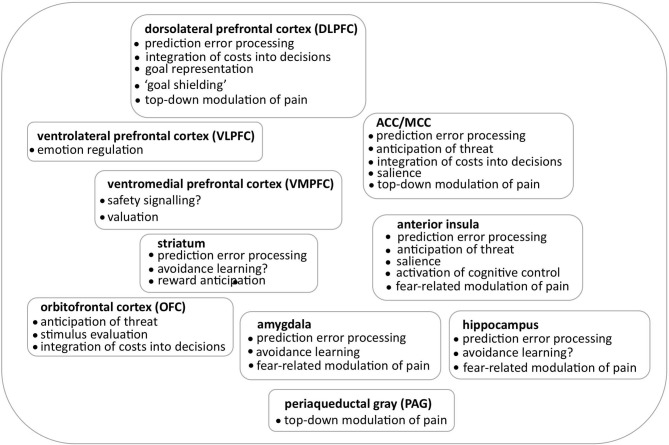
Figure 1
Figure 1
Overview on the brain regions implicated in motivational aspects of pain.

References

    1. Atlas L. Y., Wager T. D. (2012). How expectations shape pain. Neurosci. Lett. 520, 140–148 10.1016/j.neulet.2012.03.039 - DOI - PubMed
    1. Atlas L. Y., Bolger N., Lindquist M. A., Wager T. D. (2010). Brain mediators of predictive cue effects on perceived pain. J. Neurosci. 30, 12964–12977 10.1523/JNEUROSCI.0057-10.2010 - DOI - PMC - PubMed
    1. Baliki M. N., Petre B., Torbey S., Herrmann K. M., Huang L., Schnitzer T. J., et al. (2012). Corticostriatal functional connectivity predicts transition to chronic back pain. Nat. Neurosci. 15, 1117–1119 10.1038/nn.3153 - DOI - PMC - PubMed
    1. Ballard I. C., Murty V. P., Carter R. M., MacInnes J. J., Huettel S. A., Adcock R. A. (2011). Dorsolateral prefrontal cortex drives mesolimbic dopaminergic regions to initiate motivated behavior. J. Neurosci. 31, 10340–10346 10.1523/JNEUROSCI.0895-11.2011 - DOI - PMC - PubMed
    1. Bantick S. J., Wise R. G., Ploghaus A., Clare S., Smith S. M., Tracey I. (2002). Imaging how attention modulates pain in humans using functional MRI. Brain 125, 310–319 10.1093/brain/awf022 - DOI - PubMed

LinkOut - more resources
