


The role of textured material in supporting perceptual-motor functions
- PMID: 23565232
- PMCID: PMC3615024
- DOI: 10.1371/journal.pone.0060349
The role of textured material in supporting perceptual-motor functions
Abstract
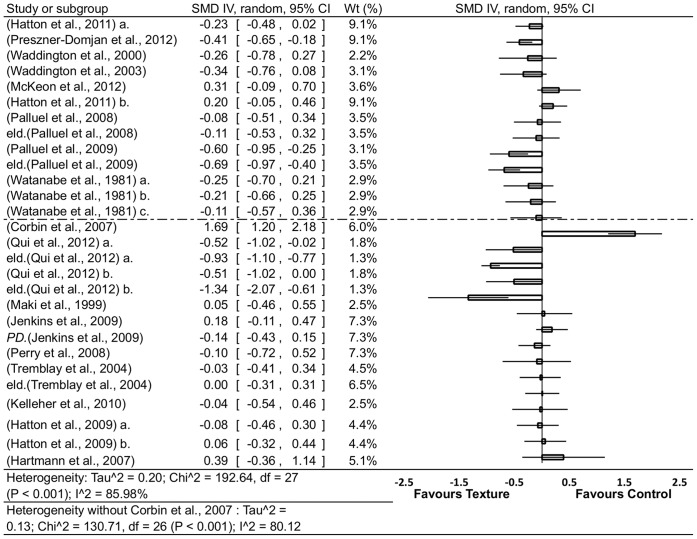
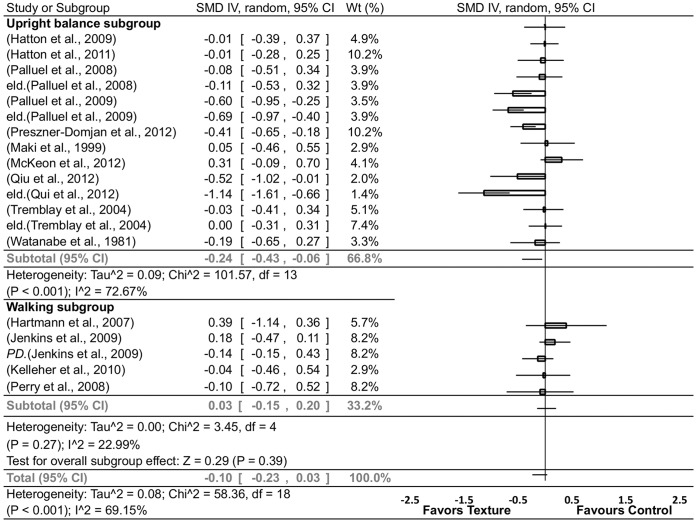
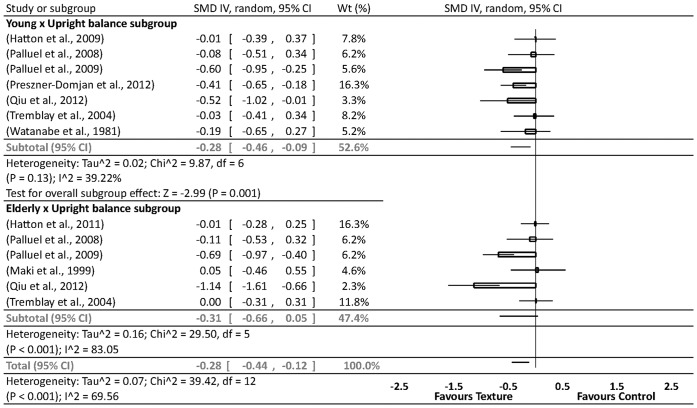
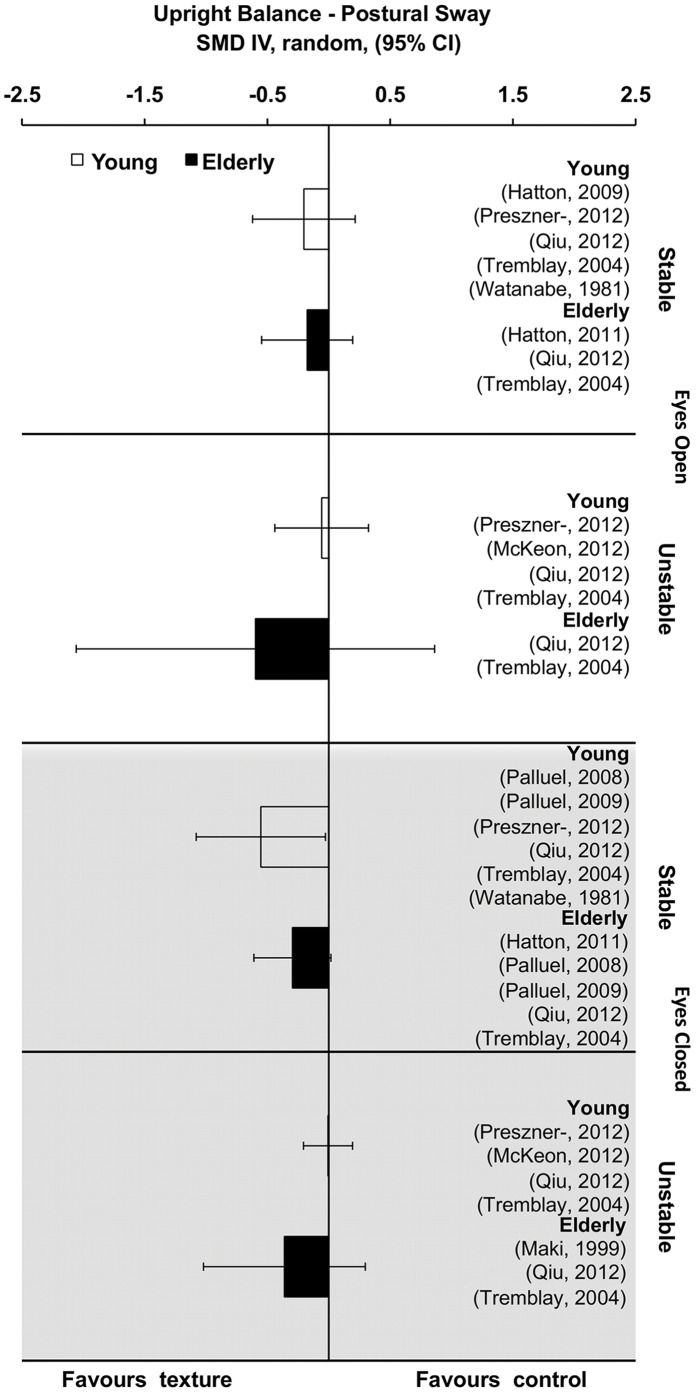
Simple deformation of the skin surface with textured materials can improve human perceptual-motor performance. The implications of these findings are inexpensive, adaptable and easily integrated clothing, equipment and tools for improving perceptual-motor functionality. However, some clarification is needed because mixed results have been reported in the literature, highlighting positive, absent and/or negative effects of added texture on measures of perceptual-motor performance. Therefore the aim of this study was to evaluate the efficacy of textured materials for enhancing perceptual-motor functionality. The systematic review uncovered two variables suitable for sub-group analysis within and between studies: participant age (groupings were 18-51 years and 64.7-79.4 years) and experimental task (upright balance and walking). Evaluation of studies that observed texture effects during upright balance tasks, uncovered two additional candidate sub-groups for future work: vision (eyes open and eyes closed) and stability (stable and unstable). Meta-analysis (random effects) revealed that young participants improve performance by a small to moderate amount in upright balance tasks with added texture (SMD = 0.28, 95%CI = 0.46-0.09, Z = 2.99, P = 0.001; Tau(2) = 0.02; Chi(2) = 9.87, df = 6, P = 0.13; I(2) = 39.22). Significant heterogeneity was found in, the overall effect of texture: Tau(2) = 0.13; Chi(2) = 130.71, df = 26, P<0.0001; I(2) = 85.98%, pooled samples in upright balance tasks: Tau(2) = 0.09; Chi(2) = 101.57, df = 13, P<0.001; I(2) = 72.67%, and in elderly in upright balance tasks: Tau(2) = 0.16; Chi(2) = 39.42, df = 5, P<0.001; I(2) = 83.05%. No effect was shown for walking tasks: Tau(2) = 0.00; Chi(2) = 3.45, df = 4, P = 0.27, I(2) = 22.99%. Data provides unequivocal support for utilizing textured materials in young healthy populations for improving perceptual-motor performance. Future research is needed in young healthy populations under conditions where visual and proprioceptive information is challenged, as in high-speed movements, or where use of equipment mediates the performer-environment interaction or where dysfunctional information sources 'compete' for attention. In elderly and ailing populations data suggests further research is required to better understand contexts where texture can facilitate improved perceptual-motor performance.
Conflict of interest statement
Figures
References
-
- Watanabe I, Okubo J (1981) The role of the plantar mechanoreceptor in equilibrium control. Ann N Y Acad Sci 374: 855–864. - PubMed
-
- Palluel E, Nougier V (2009) The lasting effects of spike insoles on postural control in the elderly. Behav Neurosci 123: 1141–1147. - PubMed
-
- Preszner-Domjan A, Nagy E, Szíver E, Feher-Kiss A, Horvath G, et al. (2012) When does mechanical plantar stimulation promote sensory re-weighing: Standing on a firm or compliant surface? Eur J Appl Physiol 112: 2979–2987. - PubMed
-
- Qiu F, Cole MH, Davids KW, Hennig EM, Silburn PA, et al. (2012) Enhanced somatosensory information decreases postural sway in older people. Gait Posture 35: 630–635. - PubMed
Publication types
MeSH terms
LinkOut - more resources
Full Text Sources
Other Literature Sources
Miscellaneous
