. 2013;8(4):e60722.
doi: 10.1371/journal.pone.0060722. Epub 2013 Apr 2.

Supplementation with α-lipoic acid, CoQ10, and vitamin E augments running performance and mitochondrial function in female mice

Affiliations

Supplementation with α-lipoic acid, CoQ10, and vitamin E augments running performance and mitochondrial function in female mice

Arkan Abadi et al. PLoS One. 2013.

Abstract

Antioxidant supplements are widely consumed by the general public; however, their effects of on exercise performance are controversial. The aim of this study was to examine the effects of an antioxidant cocktail (α-lipoic acid, vitamin E and coenzyme Q10) on exercise performance, muscle function and training adaptations in mice. C57Bl/J6 mice were placed on antioxidant supplement or placebo-control diets (n = 36/group) and divided into trained (8 wks treadmill running) (n = 12/group) and untrained groups (n = 24/group). Antioxidant supplementation had no effect on the running performance of trained mice nor did it affect training adaptations; however, untrained female mice that received antioxidants performed significantly better than placebo-control mice (p ≤ 0.05). Furthermore, antioxidant-supplemented females (untrained) showed elevated respiratory capacity in freshly excised muscle fibers (quadriceps femoris) (p ≤ 0.05), reduced oxidative damage to muscle proteins (p ≤ 0.05), and increased expression of mitochondrial proteins (p ≤ 0.05) compared to placebo-controls. These changes were attributed to increased expression of proliferator-activated receptor gamma coactivator 1α (PGC-1α) (p ≤ 0.05) via activation of AMP-activated protein kinase (AMPK) (p ≤ 0.05) by antioxidant supplementation. Overall, these results indicate that this antioxidant supplement exerts gender specific effects; augmenting performance and mitochondrial function in untrained females, but does not attenuate training adaptations.


Conflict of interest statement

Competing Interests: The authors have declared that no competing interests exist.

Figures

Figure 1
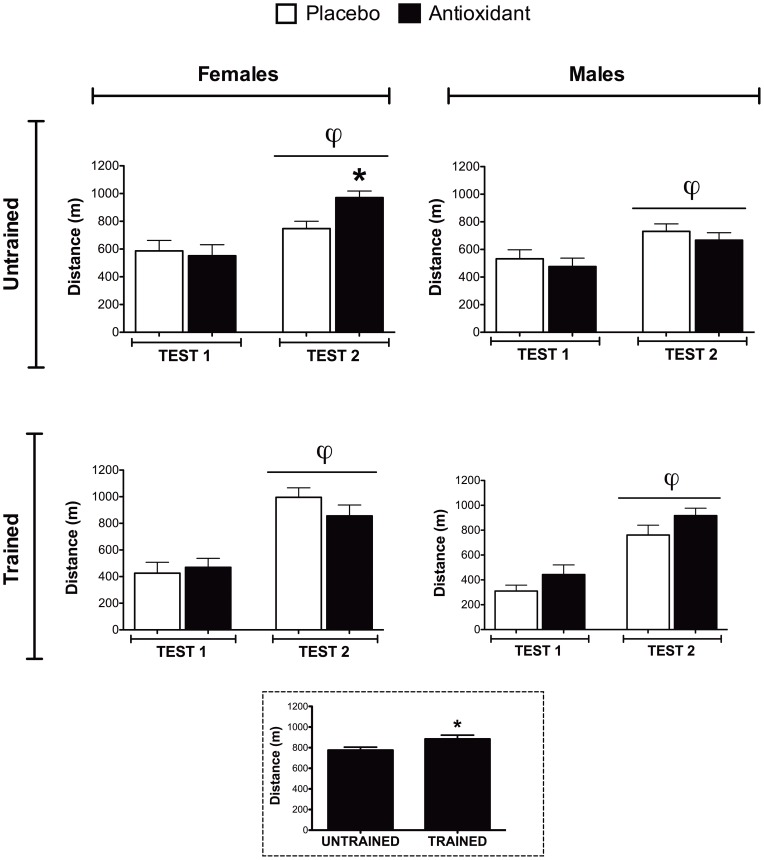
Figure 1. Exercise performance testing.
Performance tests were conducted at the beginning (Test 1) and end of the study (Test 2). Running distance, calculated from both treadmill speed increments and time till exhaustion, was plotted. The performance of all the groups improved over the course of the study (Test 1 vs. Test 2, φ indicates main effect of testing, p≤0.05). Post-hoc testing was used to compare antioxidant- and placebo-supplemented groups, * indicates p≤0.05. Effect of training on performance is shown in the inset figure (dotted border) represented by the distance run during Test 2 for trained and untrained mice (unpaired T-Test, * indicates p≤0.05).
Figure 2
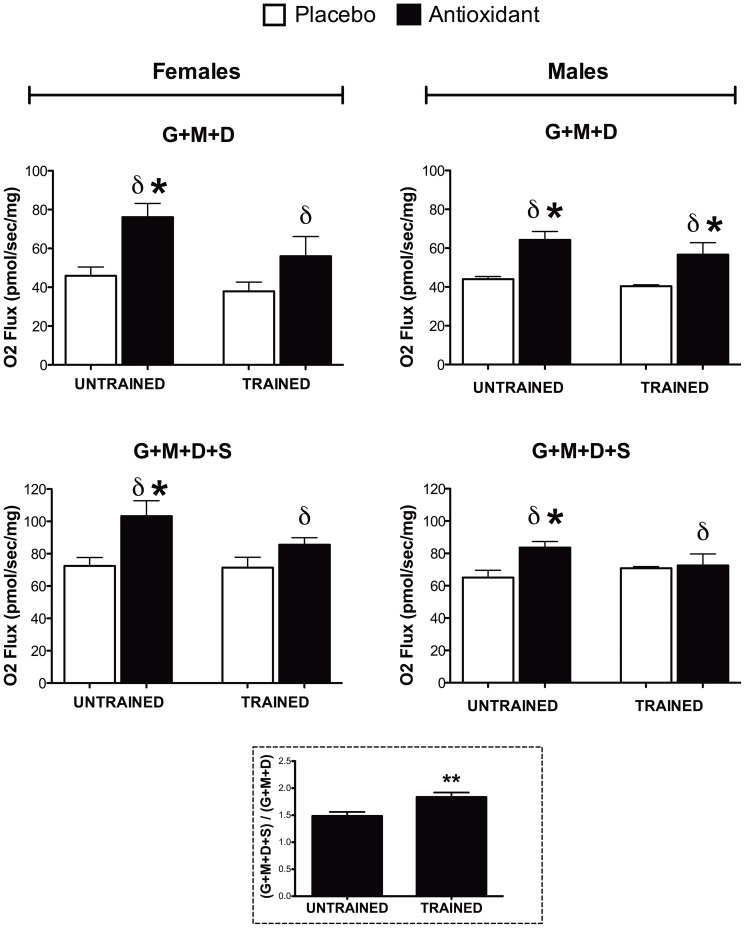
Figure 2. Mitochondrial respiratory capacity.
Respiratory capacity was assessed in permeabilized fibers from quadriceps femoris muscle tissue (n = 3–4). Maximal coupled respiration was measured in the presence of complex I substrates (glutamate and malate) and ADP (G+M+D, upper panels) followed by addition of the complex II substrate succinate to measure maximal coupled respiration through both complex I + II (G+M+D+S, lower panels). δ indicates main effect of antioxidant supplementation (p≤0.05), and post-hoc testing was used to compare antioxidant- and placebo-supplemented groups, * indicates p≤0.05. Effect of training on performance is shown in the inset figure (dotted border) as represented by the ratio of complex I+II respiration (G+M+D+S) to complex I respiration (G+M+D) (unpaired T-Test, ** indicates p<0.01).
Figure 3
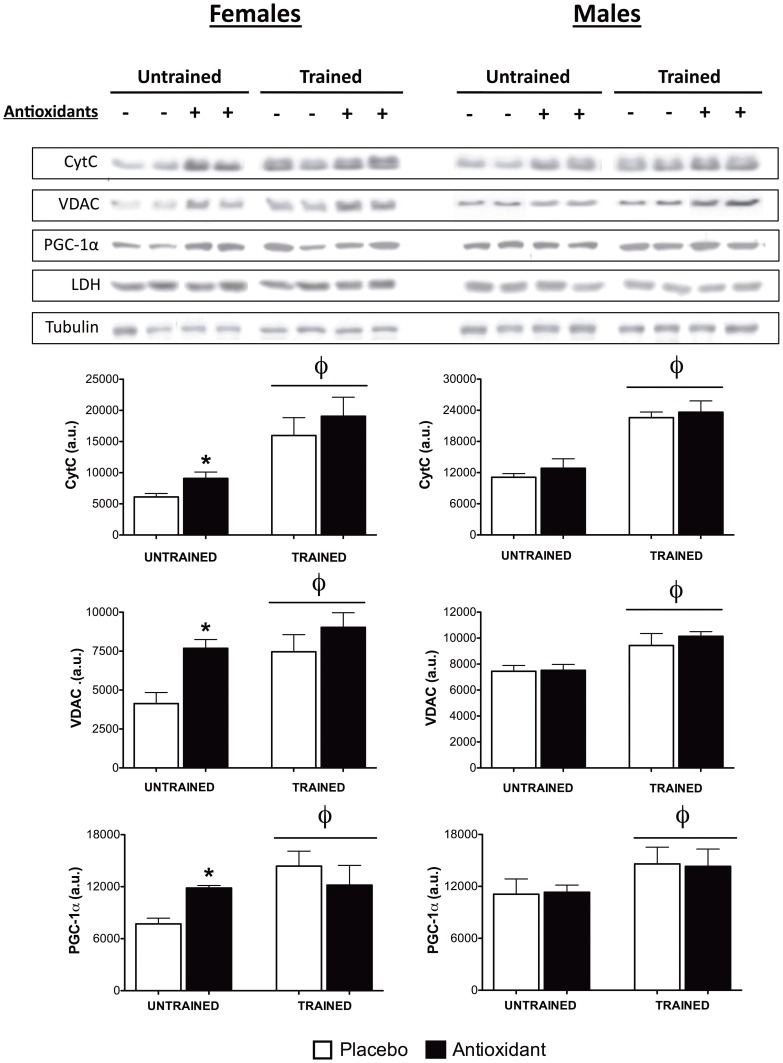
Figure 3. Expression of mitochondrial proteins and PGC-1α.
Expression of mitochondrial proteins and PGC-1α were determined using Western blotting on protein homogenates prepared from tibialis anterior muscle tissue (n = 4–6 mice/gender/group). Data are means ± SEM and representative bands from each gender and group are shown. φ indicates main effect of training, p≤0.05, and post-hoc testing was used to compare antioxidant- and placebo-supplemented groups, * indicates p≤0.05.
Figure 4
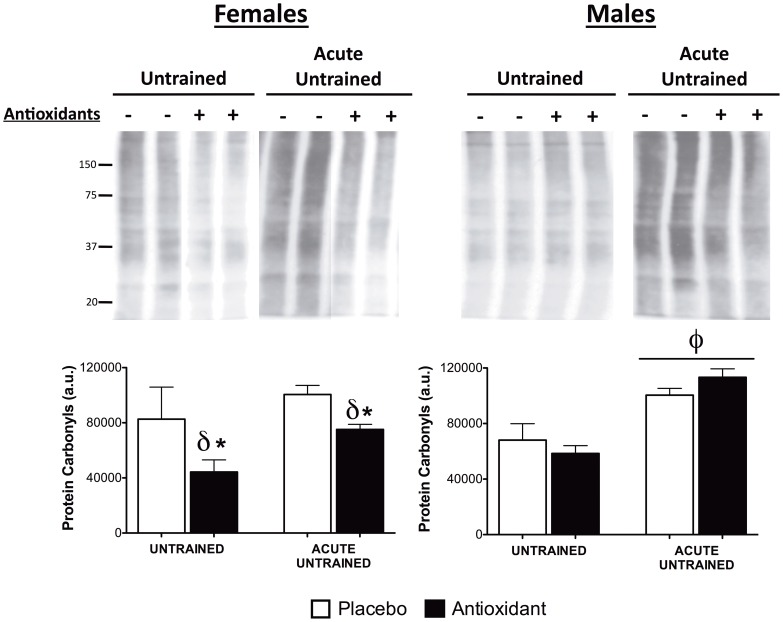
Figure 4. Oxidative damage to proteins.
Oxidative damage to proteins was assessed using anti-protein carbonyl antibody, and whole lane staining was quantified as in Figure 3. φ indicates a significant (p≤0.05) main effect of exercise, δ indicates a significant (p≤0.05) main effect of antioxidant supplementation, and post-hoc testing was used to compare antioxidant- and placebo-supplemented groups, * indicates p≤0.05.
Figure 5
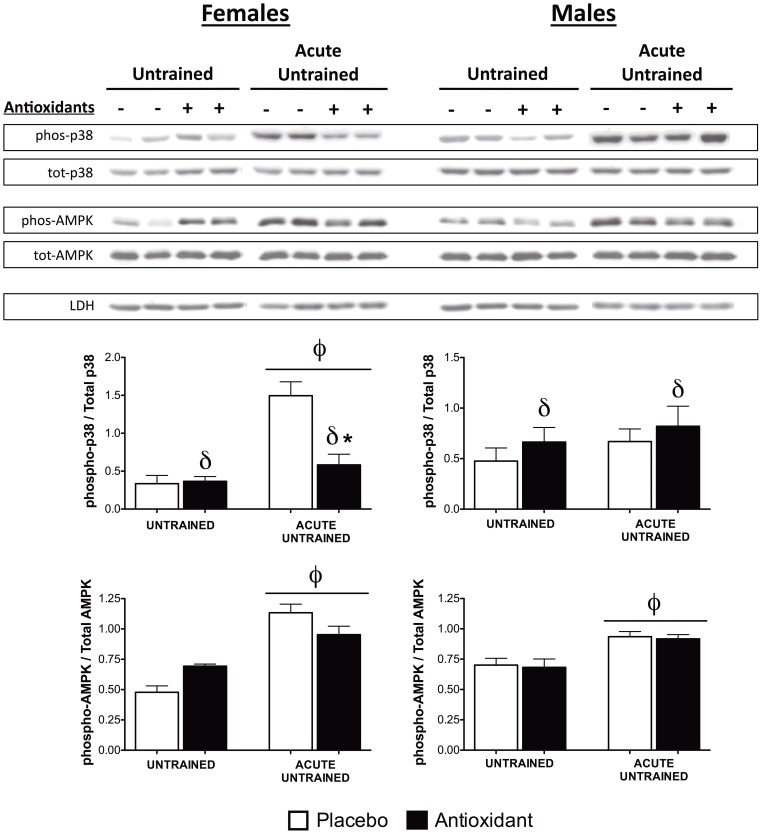
Figure 5. Activation of signaling kinases.
Protein expression of total-p38 MAPK, phospho-p38 MAPK (Thr180/Tyr182), total-AMPK, and phospho-AMPK (Thr172) was determined as in Figure 3. The ratio of phosphorylated bands to total bands was determined and plotted. φ indicates a significant (p≤0.05) main effect of exercise, δ indicates a significant (p≤0.05) main effect of antioxidant supplementation, and post-hoc testing was used to compare antioxidant- and placebo-supplemented groups, * indicates p≤0.05.

References

    1. Survey NHANE (2011) Antioxidant Supplements for Health: An Introduction. National Center for Complementary and Alternative Medicine, National Institutes of Health http://nccam.nih.gov/health/antioxidants/introduction.htm. NCCAM Pub No.: D450 NCCAM Pub No.: D450.
    1. Bjelakovic G, Nikolova D, Gluud LL, Simonetti RG, Gluud C (2008) Antioxidant supplements for prevention of mortality in healthy participants and patients with various diseases. Cochrane Database Syst Rev: CD007176. - PubMed
    1. Bjelakovic G, Nikolova D, Gluud LL, Simonetti RG, Gluud C (2007) Mortality in randomized trials of antioxidant supplements for primary and secondary prevention: systematic review and meta-analysis. JAMA 297: 842–857. - PubMed
    1. Lippman SM, Klein EA, Goodman PJ, Lucia MS, Thompson IM, et al. (2009) Effect of selenium and vitamin E on risk of prostate cancer and other cancers: the Selenium and Vitamin E Cancer Prevention Trial (SELECT). JAMA 301: 39–51. - PMC - PubMed
    1. Radak Z, Sasvari M, Nyakas C, Taylor AW, Ohno H, et al. (2000) Regular training modulates the accumulation of reactive carbonyl derivatives in mitochondrial and cytosolic fractions of rat skeletal muscle. Arch Biochem Biophys 383: 114–118. - PubMed

Publication types