. 2013;8(4):e60874.
doi: 10.1371/journal.pone.0060874. Epub 2013 Apr 2.

Climate change and range expansion of the Asian tiger mosquito (Aedes albopictus) in Northeastern USA: implications for public health practitioners

Affiliations

Climate change and range expansion of the Asian tiger mosquito (Aedes albopictus) in Northeastern USA: implications for public health practitioners

Ilia Rochlin et al. PLoS One. 2013.

Abstract

The Asian tiger mosquito, Aedes albopictus (Skuse), is an invasive species with substantial biting activity, high disease vector potential, and a global distribution that continues to expand. New Jersey, southern New York, and Pennsylvania are currently the northernmost boundary of established Ae. albopictus populations in the eastern United States. Using positive geographic locations from these areas, we modeled the potential future range expansion of Ae. albopictus in northeastern USA under two climate change scenarios. The land area with environmental conditions suitable for Ae. albopictus populations is expected to increase from the current 5% to 16% in the next two decades and to 43%-49% by the end of the century. Presently, about one-third of the total human population of 55 million in northeastern USA reside in urban areas where Ae. albopictus is present. This number is predicted to double to about 60% by the end of the century, encompassing all major urban centers and placing over 30 million people under the threat of dense Ae. albopictus infestations. This mosquito species presents unique challenges to public health agencies and has already strained the resources available to mosquito control programs within its current range. As it continues to expand into areas with fewer resources and limited organized mosquito control, these challenges will be further exacerbated. Anticipating areas of potential establishment, while planning ahead and gathering sufficient resources will be the key for successful public health campaigns. A broad effort in community sanitation and education at all levels of government and the private sector will be required until new control techniques are developed that can be applied efficiently and effectively at reasonable cost to very large areas.


Conflict of interest statement

Competing Interests: The authors have declared that no competing interests exist.

Figures

Figure 1
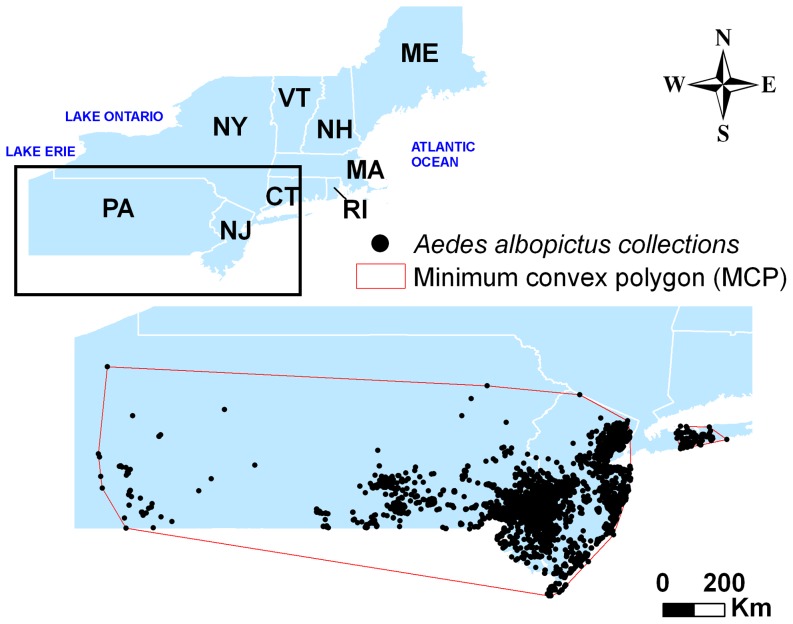
Figure 1. Study area and minimum convex polygon (MCP) around Ae. albopictus collection locations delineating general “presence” region for Maxent modeling.
Figure 2
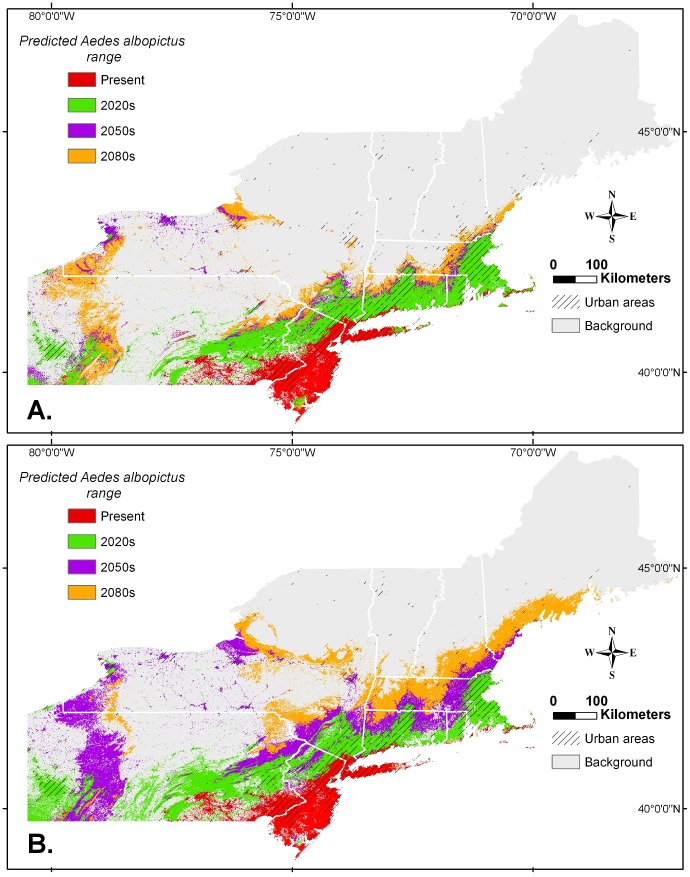
Figure 2. Predicted Ae. albopictus range expansion in the northeastern USA under two climate change scenarios.
(A) Moderate increase in CO2 emissions (B2 scenario). (B) Higher increases in CO2 emissions (A2 scenario). Predicted present range based on 1950–2000 climate data. Three future time periods: 2020s (years 2010–2039), 2050s (years 2040–2069), and 2080s (years 2070–2099). Urban areas are indicated (2010 US Census Bureau).
Figure 3
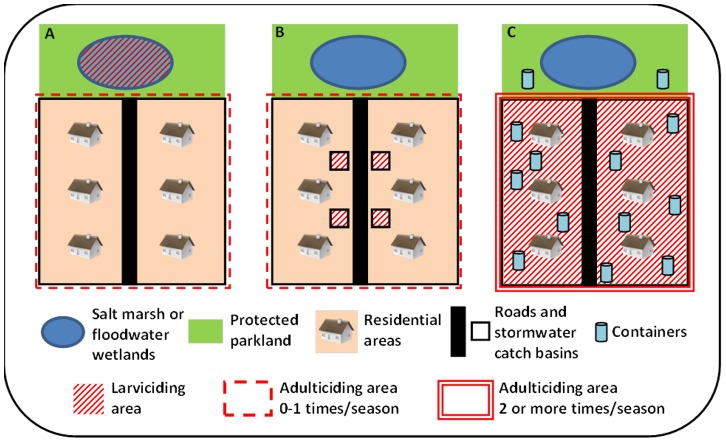
Figure 3. Schematic representation of mosquito habitat and control paradigm.
(A) Salt marsh and floodwater Aedes spp. emerge outside of residential areas and may be effectively controlled at the larval wetland habitat with timely larvicide applications (no adulticiding required). Heavy infestation may require infrequent (usually once per season) adulticide applications. (B) Urban Culex spp. utilize manmade stormwater structures within the residential areas. Delayed release larvicide formulations are very effective in suppressing Culex spp. emergence. In the years with high WNV activity, a timely adulticide application may be required for prevention of virus transmission to humans. (C) Ae. albopictus is a container-inhabiting species whose larval habitat is unpredictable and widespread throughout the residential as well as the adjacent natural areas. Effective control of biting adults may require combined areawide larvicide and adulticide applications, likely to be repeated multiple times during a mosquito season.

References

    1. Gubler DJ (1998) Resurgent vector-borne diseases as a global health problem. Emerg Infect Dis 4: 442–450. - PMC - PubMed
    1. Lounibos LP (2002) Invasions by insect vectors of human disease. Annu Rev Entomol 47: 233–66. - PubMed
    1. Benedict MQ, Levine RS, Hawley WA, Lounibos LP (2007) Spread of the tiger: global risk of invasion by the mosquito Aedes albopictus . Vector Borne Zoonotic Dis 7: 76–85. - PMC - PubMed
    1. Enserink M (2008) Entomology. A mosquito goes global. Science 320: 864–866. - PubMed
    1. Tsetsarkin KA, Vanlandingham DL, McGee CE, Higgs S (2007) A single mutation in chikungunya virus affects vector specificity and epidemic potential. PLoS Pathog 3: e201. - PMC - PubMed

Publication types